As children, when visiting our grandparents east of Bushnell, we knew that as noon time approached the house needed to become very quiet. That was when my grandfather, a very serious hog farmer, listened to the daily hog market. On his transistor radio he was probably listening to WKAI out of Macomb, however the daily markets Monday through Saturday were also broadcast on WBYS of Canton and WCAZ of Carthage.
Had we chosen to listen with him, we might have heard something like the following: “In the swine divisions of Bushnell Stockyards there were advances of 25 cents in the butcher and sow classes. This was for the week of November 9, 1957. However, major markets showed a decline in sows during the week. This is an indication that hogs around the 220 pound mark are going to be the most popular in the future. Extreme weight hogs on the Bushnell market seemed to have a dull demand and the outlet was somewhat limited except at lower prices. Receipts at the yard were at about normal for the period. The extreme top paid for well sorted meat-type hogs remained at $17.00. There were more hogs selling at $16.75 this week than last week.
Friday, November 8 market quotations follows. Butcher hogs in the 180 to 220 pound division went to killers at $16.50 to $17.00. Those in the weight range of 240 to 300 moved at $15.75 to $16.25. Sows topped at the end of the week at $15.50. Light smooth sows went to the scales at $15.00 to $15.50. Medium weight sows ranged in price from $14.50 to $14.75. Heavy sows were exchanging hands at $14.00 to $14.25.”
Those of us sitting at Grandma’s table eating her ham and mashed potatoes had no idea how complicated the hog business was.
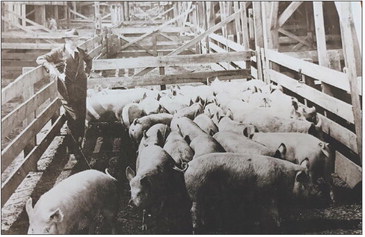
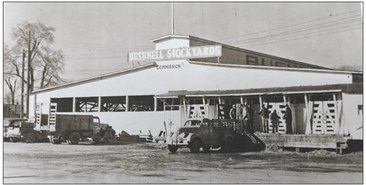
The Bushnell Stockyards was located on highway 41, just east of the main railroad tracks that go through town. There was even a brief time, before the railroad tracks, that the stockyards spread out farther west. The stockyards is just one more thriving business that used to exist in Bushnell, Illinois. That is now just a distant memory.
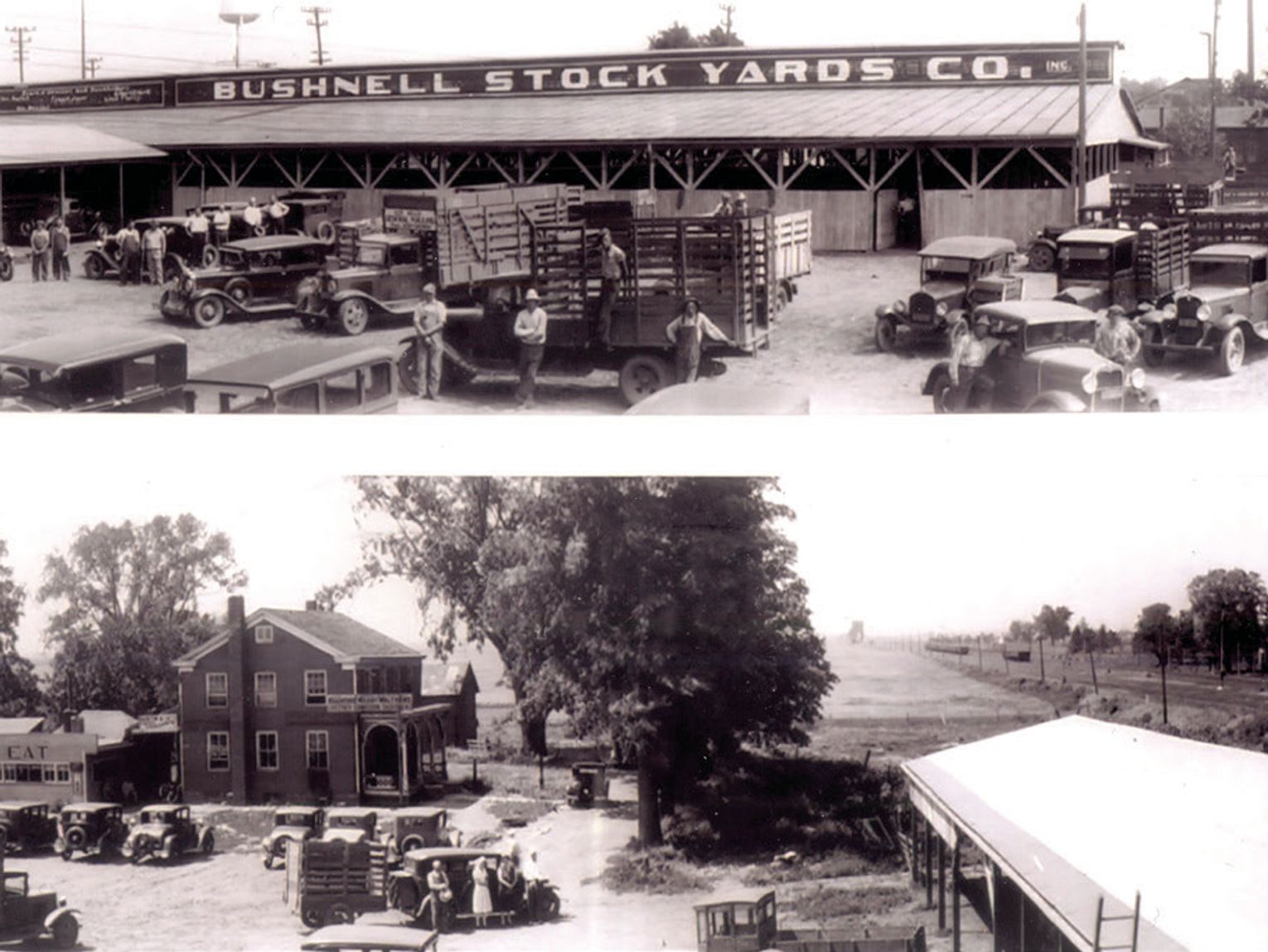
Fortunately the Bushnell Historical Society on East Main Street has a wealth of information and photographs given mainly by Tom Norris. Two of the photos are large panoramic shots taken of the property from two different angles.
Two write-ups in the McDonough Democrat, one very old and one as recent as 2008, told of how the Bushnell Stockyards came about.
“In October, 1928 a group of 21 men took advantage of the railways running through Bushnell and organized the Bushnell Stockyards, a public livestock market. These men were visionaries. Their roll call sounds familiar to the descendents names today still residing in Bushnell. Dwight Brown, William Brush, Francis Fennell, Clayton Filbert, H.E. Wood (buyer/owner) , Swan Nelson, L.J. Donehue (buyer), Pearl Preston, Harry Taylor, Charles Hinman, C.R. Cadwalder, Bennett Brant, Cecil Bellshaw, John Rose, Wayne Vance, Kenneth Heath, unknown fi rst name Bradford, E.E. Davidson, Asa Sailor, Ogle Hickman and Clyde Morey. And the day they took the picture every man was present. These men invested quite a large sum of money in the stockyards and were always looking for new industries to come to Bushnell.
By 1929, their method of business had proved so successful that the government had recognized the Bushnell Stockyards and placed them under supervision that continued until the stockyard closed in 1978.
The Bushnell Yards had the honor of being one of the fi ve posted markets in the state of Illinois who operated under the supervision of the government. The other four markets were Chicago, Peoria, Springfield and East St. Louis.
Before 1928, another stockyard was opened in Bushnell. From 1861-1877 a stockyard covered a half a block in front of I.M. & R.E. Balls Battery Shop and J.J. Balls Garage.
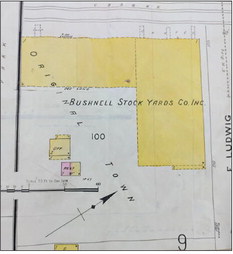
Though it didn’t last long, that stockyards gave way to the stockyards on Route 9 that lasted a much longer time.
The stockyards, at its conception, with buyer and owner Swan Nelson at the helm, was open Monday through Saturday with 24 hour a day shipments coast to coast. In the year 1931 the Stock Yards Company and the Commission men, realizing that the producer was getting less than cost of production for his livestock, decided to reduce their services charges. This market was the first market in this section to do this. At a later date other primary markets reduced their charges at the request of the government.
It is to be commended that the Bushnell Yards and Commission Merchants reduced their service charges willingly in order to help the producer and one must not forget this was the era entering the Great Depression.
On March 26, 1934 the owners of the Bushnell Stock Yards Company (as it was referred to in very early literature with stockyards being written with two words), sold the capital stock to John. E. Wood, of Buffalo, New York. As several of the initial owners had passed away during the past few years, the remainder of the owners felt that for the benefit of the city and community that they might sell the Stock Yards Company to one who had spent years in the stock yards game and who might further increase the work which they had started.
The new management started by further reducing the service charges of the Stock Yards Company and at the same time started building new cattle pens and modernizing the entire yards. It was significant to note that the receipts had increased over 75% under the new management.
On May 20th a meeting of all the buyers and commission men was held and an Exchange was formed and rules were adopted similar to those used at the larger primary market.
This assured cooperation between all buyers and sellers and could not help but benefit all who were concerned in the feeding and handling of livestock.
The membership of the Exchange consisted of four Commission Men and four five buyers.
On June 11th, the Hygrade Food Products Corporation, who had packing plants in Chicago, Detroit, Newark, New Jersey, Pittsfield, Pennsylvania, Wheeling and West Virginia, placed a buyer on the Bushnell market which added a great deal to the purchasing power of the market.
In 1948 the stockyards changed hands yet again.
John Scholes and Lee Harris bought the stock yards and renamed them Harris-Scholes Stockyards.
Lee Harris died in 1968, but John continued to run the business for another 10 years before closing the stockyards in 1978, still under the same name.
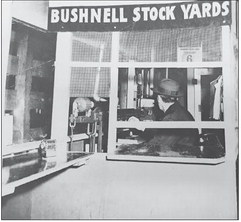
There are still many around the Bushnell area that can recall accompanying their fathers or grandfathers to the stockyards. This writer included, I vaguely recall the pop machine in the small house.
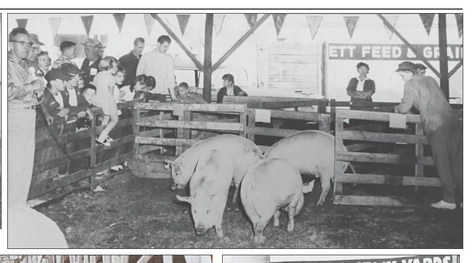
Sharon Pierce, of the prominent Bushnell Pierce family of nine children, remembers the Bushnell Stockyards well. Sharon’s father Fred (Blanford) was the manager of the business for 20-25 years. She recalls her Dad’s office being in the upstairs of the “big house” (see the big house in the panoramic photo). She recalls a small cafe on the grounds and a little building called “The Farmhouse”, a place designed for the wives of the farmers to go and wait while their husbands sold cattle or hogs. Sharon also remembers that people would bring eggs and cream to the stockyards to sell.
But one of Sharon Pierce’s favorite memories was when once a year the stockyards held a “Customer Appreciation Day”. A calliope would be brought in and its music delighted the children.
This writer found a good deal of information on this historical Bushnell business, more than I usually do on a story this far ago. But I must admit, I cannot list here, in any chronological order, the full list of owners, buyers, and managers. That area gets a little confusing and the articles I found sometimes conflict, especially when there was more than one stockyard in town.
H.L.Sparks, was highly connected with the East St.
Louis Stockyards, and is listed in one photo as being the owner of the Bushnell Stockyards. Kenny Maxwell’s obituary states that he was employed by Armour Packing Company, Heinold Hog Markets, and Cargill Meats before retiring in 2008. Sharon Pierce’s father was laid off when one of the buyouts took place, probably a hard pill to swallow for a man with nine children.
Regardless of who ran the Bushnell Stockyards at any time, it was obviously a very organized and efficient business. I have not intentionally left any managers out.
And let’s end with the noon hog report. I can hear Grandpa Harry’s transistor radio even now.
“In the swine divisions of Bushnell Stockyards there were advances of 25 cents in the butcher and sow classes.
This was for the week of November 9, 1957. However, major markets showed a decline in sows during the week. This is an indication that hogs around the 220 pound mark are going to be the most popular in the future. Extreme weight hogs on the Bushnell market seemed to have a dull demand and the outlet was somewhat limited except at lower prices. Receipts at the yard were at about normal for the period. The extreme top paid for well sorted meat-type hogs remained at $17.00. There were more hogs selling at $16.75 this week than last week.
Friday, November 8 market quotations follows.
Butcher hogs in the 180 to 220 pound division went to killers at $16.50 to $17.00.
Those in the weight range of 240 to 300 moved at $15.75 to $16.25. Sows topped at the end of the week at $15.50. Light smooth sows went to the scales at $15.00 to $15.50. Medium weight sows ranged in price from $14.50 to $14.75. Heavy sows were exchanging hands at $14.00 to $14.25.”
Credits for this article: Bushnell Historical Society Western Illinois University Archives Dept.
The McDonough Democrat Sharon Pierce Bushnell Public Library Teri Maxwell Braband Bushnell Reporter 1957