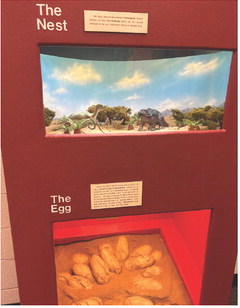
For nearly 50 years, area school children have had the opportunity to see fossils, minerals, the life cycle of life on Earth and more through Western Illinois University's free Geology Museum. After the closure of Tillman Hall on the Macomb campus in 2023, the museum was carefully broken down and moved to its new home on the north wing of Waggoner Hall's second floor, where it is now open for self-guided tours.
Geology Professor Emeritus Leslie Melim was instrumental in securing the new space, and ensuring the safe transportation across campus of the fossil casts and other precious items. In the past, Museum Curator Robert Johnson led personal tours; however, Johnson's position was among those cut, and with the elimination of the geology major when the remaining three students graduate, the museum is being set up for self-guided tours for school groups, homeschoolers and other organizations interested in learning more about the history of life before an asteroid wiped out the dinosaurs and set the stage for the dawn of man. The final students from the Sigma Gamma Epsilon earth honor society is working on a new brochure that will lead museum-goers throughout the exhibits.
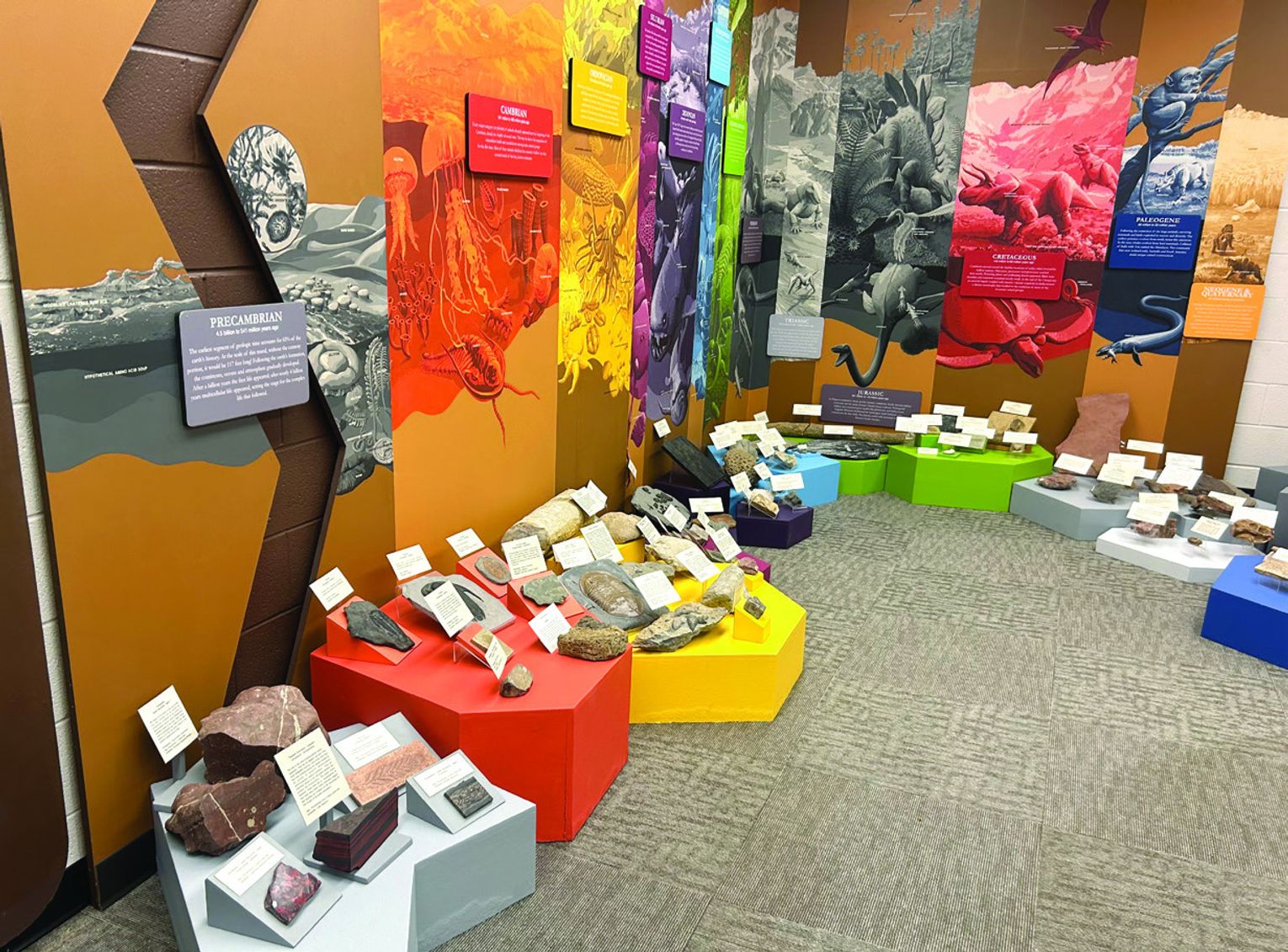
Founded in 1975 by Geology Professor Emeritus Jack Bailey as a teaching lab, the Geology Museum morphed into a museum that serves the general public, with hundreds of school children passing through each year on field trips. The museum houses more than 40 displays and exhibits covering Earth history and processes, as well as Earth materials and resources. From the Late Proterozoic to the Cenozoic and all periods in-between, the museum has fossils from many of these time periods. The History of Life mural, which Johnson carefully took apart and reassembling, including touching up the panels with his artistic flair, is also part of the Geology Museum.
'The History of Life mural and display offers a full spectrum of geologic times,' Melim said. 'That's the beauty of that room. It's from Pre-Cambrian, when there was no life, to the ice age.'
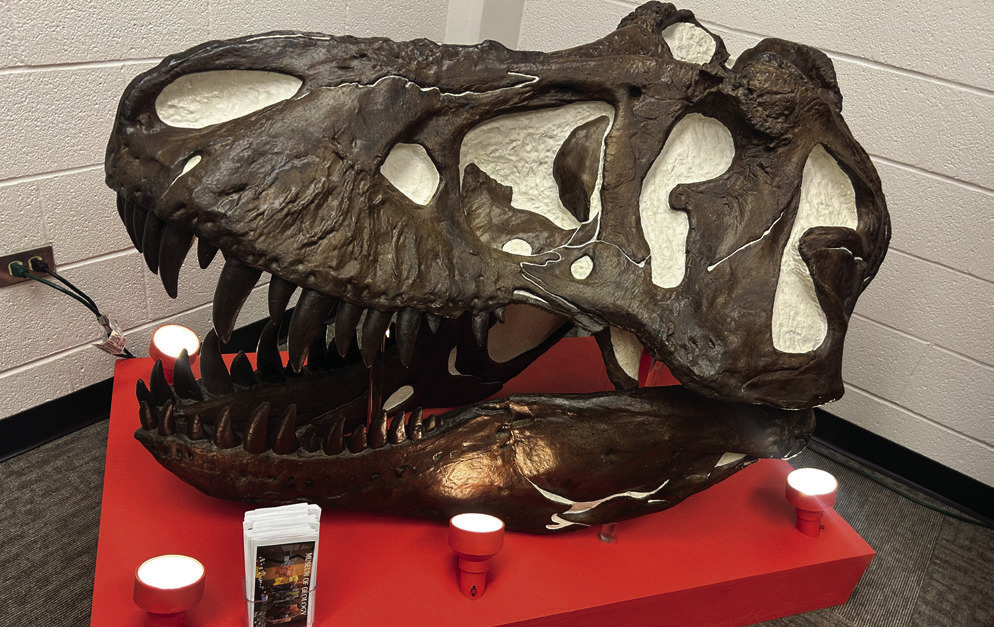
As for the fossils, minerals and other pieces, the majority were donated from private collections, and others were curated. Many of the skulls are replicas/ casts from real fossils the department purchases specially for the museum. The mural was created by the museum's first curator, David Hruby. While Melim retired last year, she's staying a bit longer as the museum's director as she's the closest to a paleontologist to see the transition of the museum to its self-guided status and to get the last of the students through the geology program. What makes these museums – large and small – so important?
'Geology gives us a sense of time. That's why I like the History of Life mural to see the changes over time. Our sense of time as humans, we think 100 or 1,000 years is a long time, but to see how long it actually takes life and Earth to form, it's really incredible,' Melim shared. 'And it's important for us to know our past so we can better understand the future.'
Geology is also important to know more about as it's all about how we use the Earth and its resources, she added. And since we all live on Planet Earth, Melim things we should understand more about it, especially when movies like 'Jurassic Park' might blur the timelines.
'That's why, when Tillman Hall closed, I really pushed to move this museum to a new location. First and second graders might not get it just yet when they visit, but it's a start and it might spark something in a few of them,' she added.
The museum's timeline, and fossils, also clearly demonstrate that by the end of the Permian period, 90 percent of life was lost, and by the Cretaceous period, almost all the dinosaurs were wiped out … except a few, which we can see the direct descendants even today, she pointed out. Right in front of us, on farms and flying through the air … birds, including chickens, are a direct line from dinosaurs. And taking those larger dinos out when the asteroid hit Earth allowed the rise of mammals (man) and cleaned the ecosystem for new varieties. Today, it's humans changing the ecosystem, with specialized species becoming extinct and 'generalized' species – think rats and the common house sparrow – adapting and thriving.
'Life on earth will always survive, but humans are up for grabs. Homo sapiens haven't been around all that long, about 150,000 years. And the changes in the planet – the environment, the atmosphere – will have a lasting impact,' Melim noted. 'But if we can understand what happened in the past, it might help us do better going forward. Major climate change is disrupting our planet and we could face a large volcanic event, with an exponential rise in carbon dioxide. We look to geology to understand where we're likely to go.
'And places like the WIU Geology Museum are starting points, especially for kids. That one student who visited our museum might be the one to come up with something in the future,' she concluded. 'Science isn't perfect or smooth, but it's pretty good at making predictions. It's easy to get lost in the minutia of things, but young people need to see that geology remains a necessity for everything on earth.'