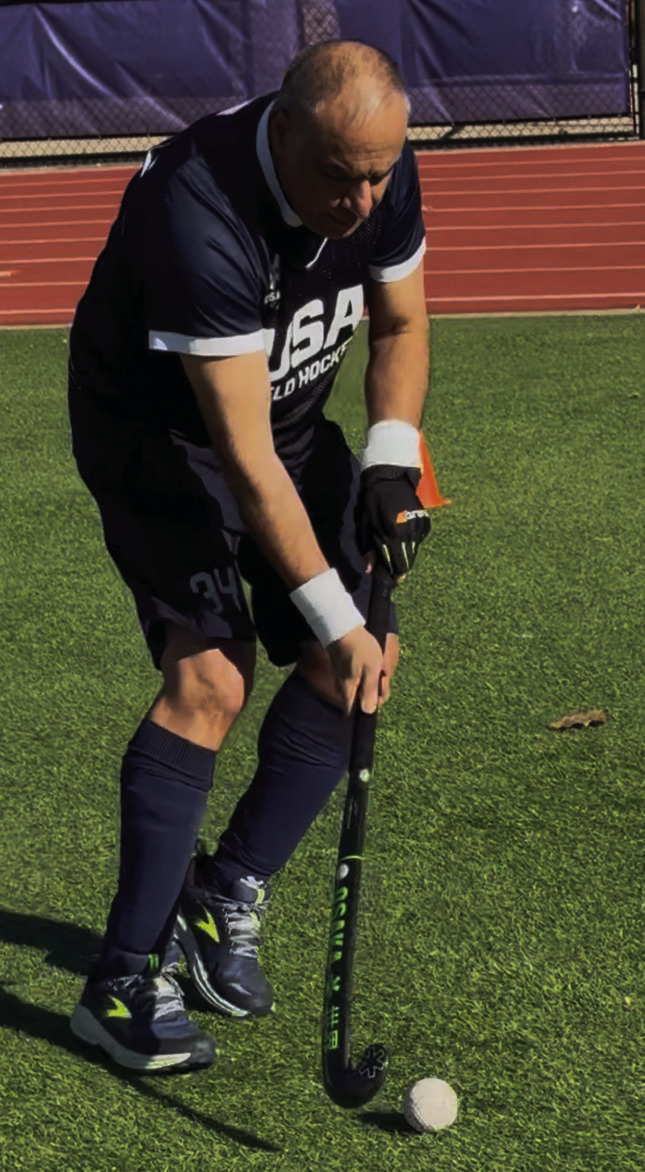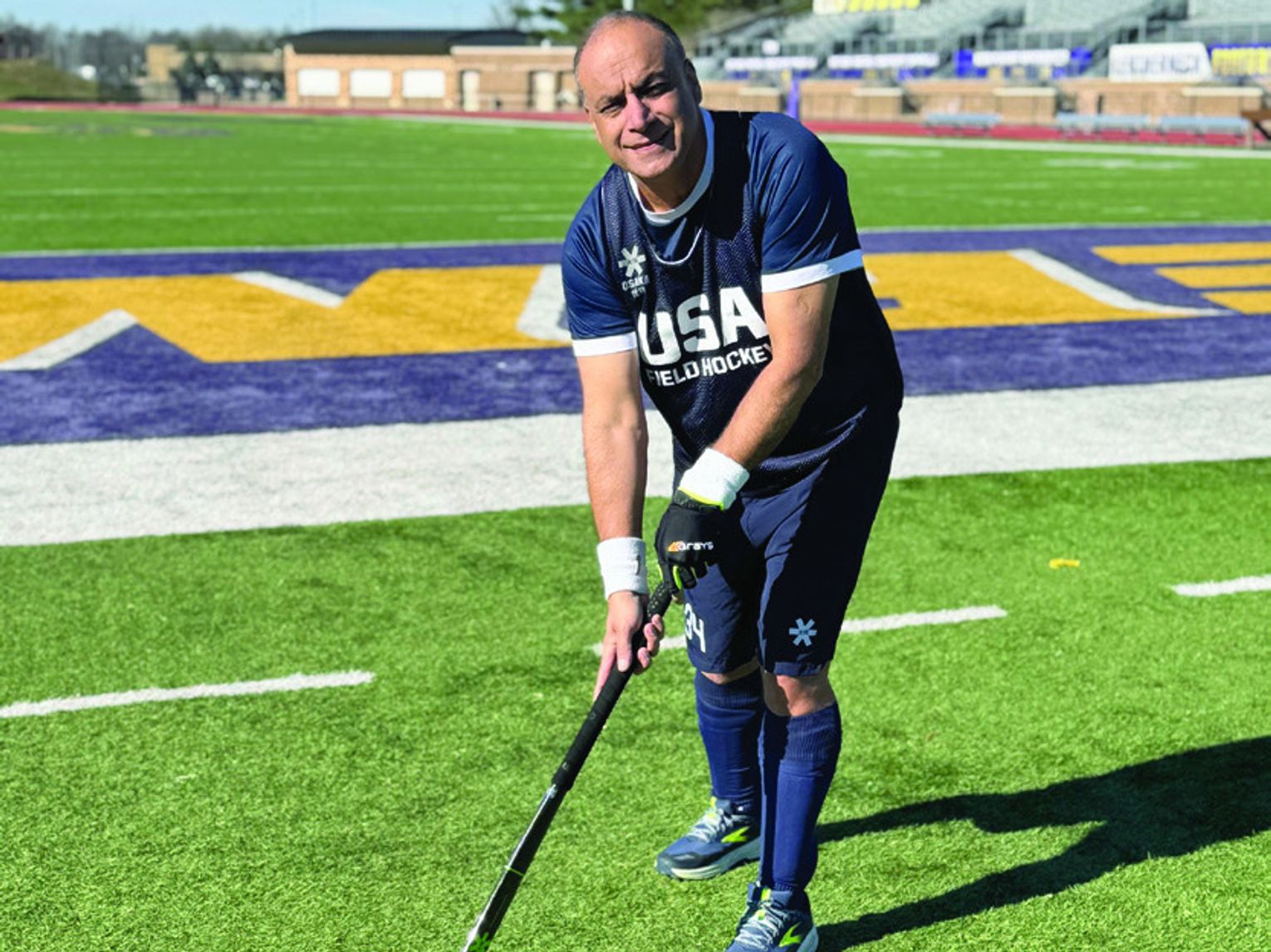
Parampal Singh, Assistant Director of Events and Athletic Compliance at Western Illinois University, has joined an elite corps of athletes.
After invitation-only tryout camps held at Bryn Mawr College, July 2025; at Cassady School, Oklahoma, October 2025; and Moorpark College, January 2026, he has been selected as a member of the USA 60+ Men's Master Field Hockey World Cup National Team. He joins 16 other players from throughout the United States who will compete at the World Cup Field Hockey tournament in Brasschaat, Belgium, from August 6th through the 16th.
The journey to this level of competition did not happen overnight. Singh tried out and made both the 2022 and the 2024 teams, competing in Capetown, South Africa, and Auckland, New Zealand, respectively.
Twelve international teams, mostly from Europe and Asia, make up the competitive field. In 2022, the U.S. Masters team finished 10th, then finished ninth in 2024. Param and the team's goal is to make it to the final four this August.
The Early Years In his home town of Punjab, India, Singh grew up playing on dirt and grass fields with the most basic of equipment. 'My journey in field hockey begins with my father,' Singh said. 'He used to play hockey, and he would play with me sometimes when I was elementary age. I didn't have a stick. I just had a flat wooden board with no curve. One day my father saw my interest in playing with a plain stick, so he purchased my first wooden hockey stick with a curve,' a yard-long wooden stick with a flat front side and a curved back side, sort of like a golf driver with a thicker shaft.
'At that age, I didn't know I was going to play field hockey. It was India's national sport, and the country has the record for the most field hockey Olympic gold medals.' Between 1920 and 1956, India's men's Olympic teams won six consecutive gold medals. “But then, a new type of field was introduced, and European teams began to dominate,' Singh stated.
As with children everywhere involved in competitive sports, Param played on various school and club teams, gaining skills that would mark him as one of better players among a multitude of field hockey enthusiasts. 'So many universities in India had field hockey teams. They would compete in conferences and at various levels for national championship.
Then they made one team — an All-Star team. I was very grateful and humble to be selected for that national university team. It was a very competitive experience.'
Moving to the U.S.
Param and his family came to the U.S. in 2000 with his wife Abha and their son Sunny. Abha had entered the PhD program at the University of Iowa, pursing a degree in Science Education and Gifted Education. Meanwhile, Param was working as a volunteer assistant coach for the University of Iowa's women's field hockey team.
The Singhs moved to Macomb and Western Illinois University in 2008 with Abha joining the faculty of the Curriculum and Instruction Department.
Meanwhile, Param taught PE at Calvary Baptist school and at Trinity Academy in Industry before joining the Kinesiology Department at Western.
Preparing for Battle
So, how does a bunch of 60-year-old men get, and stay, in shape for competition at the World Cup level?
For Param there's a 'Rocky' intensity to his training regiment, in that he's often alone, working to keep his edge in a team sport. Around here, few people are available to compete against, at his level.
'For me, training is about perseverance and commitment. My coach who lives out east sends me training assignments. For example, a one-mile run, shuttle runs, calisthenics. We have to submit times every month.'
In addition, you might have seen him running 'suicides' on Hansen Field, snaking through agility drills, or working on stick skills either on University Drive athletic fields or in Brophy Hall. Weight lifting is also part of his routine.
Finding competitors to play with and against is another matter, which makes Param's rise to World Cup level all the more amazing, especially since most of the U.S. field hockey talent comes from the east and west coast. For the 2026 team, Param and a member from Nashville, Tennessee, are the only Midwest players selected.
The Game
To put it mildly, field hockey is not a very wellknown sport here in the U.S.
Imagine world- class athletes (even at age 60+) running around with yard-long carbon fiber upside-down crochet hooks with the mad intent of propelling a baseball-size orb into a net.
Despite the fact that players wear little protective gear and that players aren't supposed to make physical contact with opponents, when competitors are hacking and swinging at a golf ball on steroids, stuff happens.
Shins and lower limbs get whacked by back swings and slap shots, and every inch of human flesh risks getting pelted by a 100-mph supersized golfball. 'It happens,' Singh laughed. 'I have stitches!'
Most of us have little understanding of the game.
In many ways it's like ice hockey, except on a football- size field, Nowadays, players compete on synthetic turfs wetted down to provide a slicker surface for the ball to slide. Imagine trying to run full-tilt on wet plastic grass while manipulating a golf-club size J-shaped stick and fending off defenders.
Until recently, games consisted of two 35-minutes halves; now, the playing time is divided into four 15-minute quarters. Teams consist of 11 players, including a goalie equipped with protective gear like their ice hockey counterparts.
The object is to knock the ball with the flat side of the stick into a 7x12 netted goal (soccer goals measure 8x24).
'The main thing in field hockey is that you can use only one side of the stick,' explained Singh. 'That's the skill part of it since it's illegal to hit on the curved side of the stick. In ice hockey, players can hit on both sides of the stick, but in field hockey there's a skill in turning the stick upside down in order to hit with the flat side. This is called 'dribbling'.'
Injury Setbacks
In 1988 in India, Param tore his left ACL when he was playing for Punjab University's team. Back then, sports medicine wasn't as well developed. Doctors in India knew little about how to treat or even to repair this type of ligament damage.
'The doctors told me there was nothing wrong, that I was good to play, but I kept feeling something lock up when I was playing. I was very frustrated because I was in my playing prime.'
Fortunately, he was able to contact a specialist who had studied in England. When he first saw Param, the doctor diagnosed the problem instantly. Param then traveled eight hours to Delhi for immediate surgery. Afterward, a long year of rehab occupied his time while he dealt with the anxiety of ever being able to regain his level of field hockey competitiveness. It's the all-to-common devastation elite athletes fear — a career ending injury.
Fortunately, he recovered, though he had to contend with a mild recurrence because of rough body contact in a non-contact sport.
Journey to the Masters So, how did Singh find a way to grow in the sport here in the U.S.? 'When I came to the States, I didn't bring my hockey stick because I didn't know if I would have the opportunity to play.
When Abha was doing her PhD work at University of Iowa, they had a field hockey team, so I talked to the head coach. She listened to me and said, 'OK, you can come in the evening and play with us or hit some balls with us.' I said I didn't have a stick, so she gave me one. Then I became part of the coaching team, and the team qualified for the NCAA tournament. I was very grateful for that.'
One can only imagine what the coach thought when she saw Param demonstrate his skills. From there, Param's involvement in collegiate and club field hockey blossomed. He has helped coach a few Big Ten teams, including University of Iowa and Northwestern, the latter being the current backto- back NCAA women's national field hockey champions. He spoke with some confidence that the United States Women's field hockey team has a good chance of winning gold at the 2028 Los Angeles Olympic Games.
But the road to competitive field hockey best describes Singh's commitment to the sport. 'I used to play for clubs — Chicago Club, Milwaukee Club — and I participated in the Shooting Stars tournament organized by USA Field Hockey. That is how I got the invitation to attend the national team tryouts. The last time I played in a competitive tournament was for a New York club.'
For the upcoming 2026 International, Singh recalled the competition at the three camps. 'For my first tryout, there were 160 players in open tryouts, but they changed that to a squad of 60 players. These players, who have good skills and IQ and who can represent the country, then try out for the national team.' A team that Param has now earned the right to join for the third time. In June, he will again head to Pennsylvania to attend camps in preparation for the August world competition.
Yes, field hockey is kind of a big deal, and here amid the corn fields of Illinois far from his native India, Parampal Singh is still living the athlete's dream.