The sisters of slain Mormon prophet Joseph Smith, Jr., the founder of the Church of Jesus Christ of Latter-Day Saints, didn't follow their family west, inside they stayed in west central Illinois where they made their homes, often against hardship and shunning by their neighbors because of their family connection. The first part of this series featured the eldest sister, Sophronia. Katharine's and Lucy’s stories round out part two.
Katharine
Much of what we know about the middle sister of Joseph Smith is owed to historian Kyle R. Walker.
In an oral presentation at Benchmark Books in Salt Lake City, he shared many details from his biography of her life.
Katharine (spelled with two 'a's') was unusually tall and strong for her time.
Mother Emma assigned her the jobs of tending to livestock and other barnyard duties as well as working the garden. She had big, rough hands and was sometimes mistaken for a man. Walker cites that she milked cows twice a day. In fact, she enjoyed the task that she continued milking throughout the rest of her years, even milking a cow the day before she died at age 87.
Katharine has a significant role in the development of the Mormon faith, indeed, may be the single cause of its survival. She was 10 years old when Joseph first encountered the angel Moroni and 14 years old when he first brought the golden plates home. These plates were thin sheets of gold-colored metal engraved with a secret language that Smith would later translate into the Book of Mormon.
Katharine recalled Joseph bringing these plates to their home near Manchester, New York. Apparently, he was carrying the bundle under his left arm because he had injured his right hand.
Katharine, she claimed, was the first to take the plates from his arms and carry the 60-pound weight into the house (remember that Katharine was unusually big and strong for her age).
Walker reports the following about that moment: 'I hefted the plates and found them very heavy and estimated that they weighed about 60 pounds. I then examined them more closely, rippling my fingers up the edges of the plates and felt that they were separate metal plates and heard the tinkle of sound that they made. They were held together on the backs by three rings.'
The non-Mormon community heard rumors about these plates, so, needing little reason not to persecute the Smith family, often tried to break into their house.
Walker shared that one time Joseph took the plates outside but soon encountered a crowd. Katharine heard the noise outside, opened the door, and grasped the plates as Joseph staggered through the door. She took the bundle and rushed upstairs to the room she shared with older sister. Sophronia pulled back the covers and Katharine placed the plates on the bed, then replaced the covers, at which she and Sophronia climbed atop the bed and pretended to be asleep. The mob, searching the house, failed to find the plates.
The quick thinking of both sisters, led by Katharine's vigor, might be said to have preserved the origins of the Mormon faith.
Sadly, Katharine's story as an adult is filled with unimaginable hardship.
Walker said that she married Wilkins Jenkins Salisbury in Kirtland, OH, in 1830.
On their way from Kirtland to Missouri, Katharine was pregnant and about to deliver. She went by herself into an abandoned hut during a driving rain, bore her first daughter Elizabeth, then walked 40 miles to rejoin the procession. Her husband and family had essentially abandoned her to her fate.
Jenkins was a convert to Mormonism, but not a very devout one. In fact, he was excommunicated for 'tale-bearing and drinking strong liquor.' Both Joseph and Hyrum testified that he frequently deserted his family. Joseph even accused him of stealing his rifle and selling it for whiskey. Nevertheless, he remained with the larger Smith family on their movement to Illinois and eventually settled near the Hancock County town of Webster (then known as Ramus) after the power struggle in Nauvoo following Joseph and Hyrum's deaths. He continued to abandon Katharine and his children, often for months at a time, leaving his family in extreme poverty.
One time when she was living in Plymouth, with relatives, Joseph stopped by for a visit and was distressed to see her in such poor circumstances, with barefoot children and without much food. He helped out financially when he could.
Another of her unimaginable hardships occurred when her family built a flatboat raft in 1846 and were headed down the Mississippi River. A steamboat collided with the raft near Alexandria, MO, and spilled all their possessions into the river. They salvaged only a few personal articles and a cow. They stayed for a while near Alexandria cutting cordwood for the steamboats. They then moved to Warsaw (the town known for the mobsters who killed her brothers) then on to south of Fountain Green, where Katharine lived for the next 50 years.
Katharine's husband, Jenkins Salisbury, died in 1853 leaving her a widow with eight children and little means of support. Plus, she was soon discovered to be the sister of Joseph and Hyrum Smith, resulting in ongoing insult and persecution. Solomon, her first-born son at 15 worked for farmers in the area and had to suffer constant cursing about his now dead uncles. Solomon had a girlfriend whose father, when learning about Solomon as a Mormon, forbade her from seeing him. Walker reported that Solomon never forgot that slight during the next 70 years of his life.
Katharine eventually pulled her children out of school and taught them at home. The wives shunned her, and the neighbor children refused to play with them. A family by the name of Duff lived nearby and often took shots at the children as they walked by. Others of Katharine's children faced even more serious threats. Don Carlos (named after Katharine's youngest brother who died at age 25) once was nearly drowned by a bully while swimming in a creek. The older youth repeatedly held Don Carlos's head underwater and would have killed him had not an older neighbor boy intervened.
Most tragic of all is what happened to Katharine's son, Alvin (named after another of her brothers who also died at age 25). At a political rally in the 1880s, Alvin was confronted by a group of young men led by Thomas Duff (the family that frequently shot at the Smith children) and threatened him. He sprang at Alvin with a Bowie knife, slashed his left arm severing muscles, sliced him across the chest and then plunged the knife into Alvin's forehead.
Somehow, Alvin managed to pull the Bowie knife out of his skull, stagger to the nearby church where the rally was being held, and call out for a doctor. He died two hours later. Thomas Duff was arrested and sent to the Carthage Jail (where the Smiths had been murdered) to await trial. He lingered there for five months before the trial, which resulted in a light sentence.
Walker said that this event began to shift the attitudes of the Hancock County community for Katharine and her family. They saw her as a strong woman and a link to a part of the county history, as ugly as it might have been. Ironically, each of her surviving sons became police officers in Hancock County.
Katharine had stayed close to Emma Smith, Joseph's wife, assisting her with the deposition of the bodies of Joseph and Hyrum and with their burials. Her sons were pall bearers at Emma's funeral. She spent the last years of her life in the Fountain Green area, a widow of 47 years, dying in 1900. She is buried with her husband in the Webster cemetery.
Lucy
And then there was little sister Lucy, 16 years younger than her brother Joseph.
Born at Palmyra, Ontario County, NY on July 18, 1821, Lucy was a toddler when Joseph began the Latter Day Saints movement. As with her sisters, she suffered several childhood traumatic experiences. Middle sister Katharine looked out for her, though she was largely confined to the household with oldest sister, Sophronia.
She dearly adored her oldest brother Alvin, who died at 25 when she was only two and a half years old. Calvin Smith's study of her life noted she called him 'Amby' in her child-like way. As he lay on his deathbed, he called little Lucy to him and told her that she must be strong and take care of her mother, an awesome responsibility considering she had older sisters. Many years later, Lucy would take a significant role in carrying for the elderly Emma, even being with her at her death.
In place of Alvin, Lucy turned her affections to her older brother, Joseph, especially in the spiritual developments of the new Mormon community. But by that time, she was the only sibling left with Joseph Sr. and Emma, the others either having died or formed families of their own. Even so, the nine siblings with their parents remained a closeknit community, traveling together and enduring all the hardships that history records.
In 1831, the family moved to Kirtland, OH, mainly because Joseph Sr. had been sent to jail for a time in New York for unpaid debts. This was also about the time that Joseph Jr. and Hyrum formed the theology that would shape so many lives.
Unfortunately, dissension grew among the members of the emerging community in Ohio such that the Smiths were compelled to move to Far West, Missouri, where the first serious and near fatal challenges to their beliefs emerged.
By this time, the Mormon community had grown to about 5,000. Tensions grew so strong among the Missouri locals that Joseph and Hyrum were jailed for treason against the state of Missouri in response to the Mormon Wars in Missouri in 1838. One of the battles during that war was called the Battle of Crooked River.
After that battle, Missouri Gov. Lilburn Boggs issued an order calling for 'the extermination or the expulsion of the Mormons from the state.' Families dispersed, with the Smiths heading for Illinois, leaving Joseph and Hyrum behind in jail.
Calvin Smith's study recounted a portion of Lucy Mack Smith's history of the efforts she took, along with little Lucy, to make contact with her imprisoned sons.
She was taken to two separate wagons in which Joseph and Hyrum had been held with a tight canvas stretched across their bodies. They were to be transported to Independence, Missouri.
In Lucy Mack's history, she writes about what she thought would be the last time she would ever see her two sons alive: 'Lucy and I started alone, for we were the only well ones of the family. When we came within about four hundred yards of the wagon, we could go no farther because they were surrounded by men. 'I am the mother of the Prophet,' I cried, 'and is there not a gentleman here who will assist me through this crowd to that wagon so that I may take a last look at my children and speak to them once more before they die?' 'We went on through the midst of swords, muskets, pistols, and bayonets, threatened with death at every step, until at last we arrived at the wagon. The man who accompanied me spoke to Hyrum, who was sitting in the front, and told him his mother was there and wished him to reach his hand to her. He did so, but I was not permitted to see him, for the cover of the wagon was made of very heavy cloth and tied closely down in front and nailed fast at the sides.
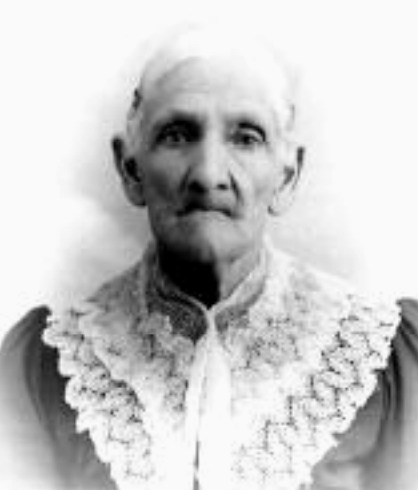
'We merely shook hands with him ... before several of the men in the mob exclaimed, 'Drive over them, calling to us to get out of the way, swearing at us and threatening us in the most dreadful manner.
'Our friend then conducted us to the hinder part of the wagon where Joseph was, and said, 'Mr. Smith, your mother and sister are here and wish to shake hands with you.' Joseph crowded his hand through between the wagon and cover where it was nailed down to the end board. We caught hold of his hand, but he did not speak to us. I could not bear to leave him without hearing his voice.
'Oh, Joseph,' said I. 'Do speak to your poor mother once more. I cannot go until I hear you speak.' 'God bless you, Mother,' he sobbed out. Then a cry was raised and the wagon dashed off, tearing my son from us just as Lucy was pressing his hand to her lips to bestow upon it a sister’s last kiss — for we knew that they were sentenced to be shot.'
Little Lucy by this time was nearly 17 years old and once again faced the horror of losing two more of her brothers.
As the Mormon families were forced to leave Missouri, many crossed at Quincy. Lucy lost her shoe in the mud and grew sick because of the cold, icy weather. From Quincy they migrated up to Commerce (later renamed Nauvoo) and settled in 1839. Meanwhile, her mother contracted cholera, as did several of the other pilgrims.
Many miles to the west, Joseph and Hyrum managed to escape their captivity and headed back to Illinois.
Calvin Smith's article in Church News, a companion periodical of Deseret News, relates that Lucy managed to recover from her ordeal crossing the river, but a little later she grew deathly sick again while she and her mother visited Hyrum's daughter in Plymouth, Illinois. Joseph came to seek his mother.
According to Lucy Mack's history, 'When Joseph arrived from Commerce, however, [Lucy] sprang from her bed and flew downstairs as though she was altogether well, and was so rejoiced to hear that her relatives were all still living and in better health than when she left them that the excitement performed an entire cure. She soon regained her strength and we returned home.'
When Lucy was 18, she married Arthur Millikin, who came from Maine with the families moving westward. He was four years older than Lucy and had been severely wounded in the Battle of Crooked River in Missouri. Brother Joseph performed their wedding at Nauvoo in 1840. There, the Millikins became active in church functions, with Lucy being one of the first to practice the ritual of baptism of the dead. For a time, they moved to Arthur's home town in Maine on a mission trip.
Their first child was born in Maine and named Don Carlos after the death of Lucy's older brother. The family returned to Nauvoo in 1844 just at the time when tensions throughout the area reached the breaking point. The July 14, 1844, martyrdom of Joseph and Hyrum Smith at the Carthage Jail is well-known in this area. The reason for their imprisonment was previously mentioned in the section about Sophronia.
The tragedy and the ensuing power struggle in Nauvoo drove the Millikins and Lucy Mack out of the area to Knoxville, IL, in 1846, but they returned to Nauvoo because the elder Lucy still had property in Nauvoo, which they sold and moved to Webster, in 1849 to be near her sister Katharine.
Around 1856, Lucy and Arthur moved to Colchester, and became a vital and leading family in the new town. Since Mormons had already been in the area in the 1830s, Arthur mined coal and served as a railroad agent. With Katharine in nearby Webster and Sophronia living with her daughter in Colchester, the sisters shared responsibilities in caring for their mother.
However, as each of the older sisters aged, more of the duties fell on Lucy.
More than the other sisters, Lucy became a proponent of a new movement in Mormonism, one not in keeping with the direction Brigham Young took the faith when his adherents moved west. Those who stayed created an offshoot called The Reformed Latter- Day Saints (RLDS), a variant that survived until 2010. It largely arose out of the steadfast devotion to the memory of Joseph Smith in that whatever direction the church leadership took, it should be a direct descendant within the Smith family.
During Lucy and Arthur's lifetime, they raised five daughters and three sons.
He died April 25, 1882.
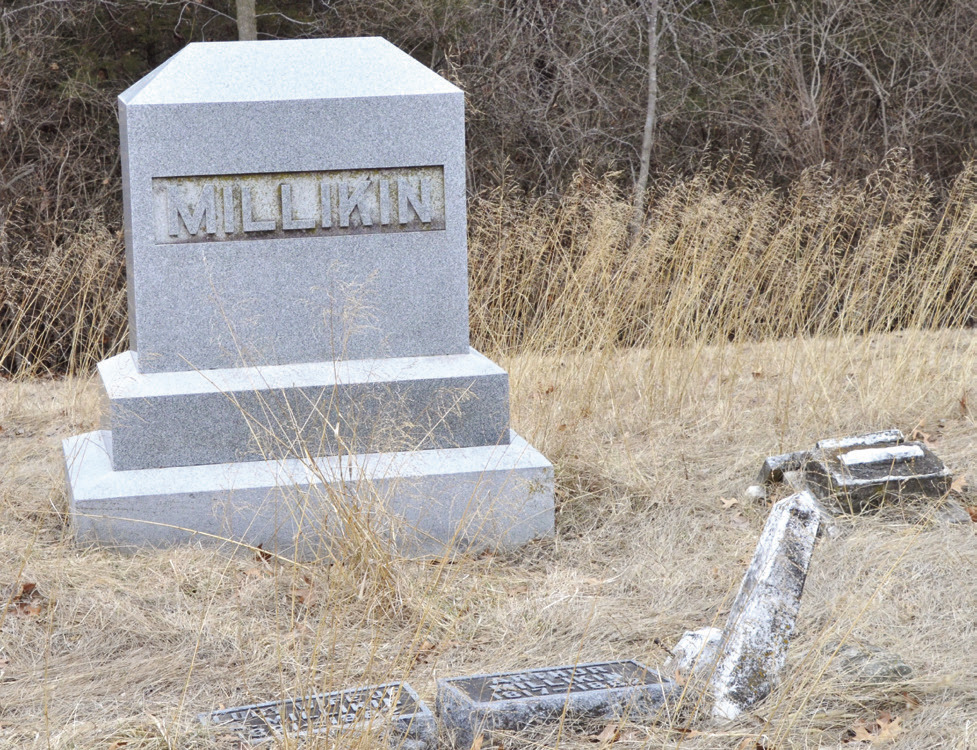
Eight months later Lucy died on December 9, 1882, of respiratory illness while caring for a sick relative — ever living out the wishes of Alvin on his deathbed for Lucy to serve as a family caretaker. She and Arthur are buried in the Widow Moore Cemetery just northwest of Colchester. Standing beside their ornate granite monument is an ancient limestone monument to her daughter Julia Amelia Millikin Harper.
Many of us are familiar with the Mormon experience here in western Illinois, but we're likely less familiar with the lives of Joseph Smith's three sisters. Rather than take the long exodus west to Utah, they elected to stay in the Colchester and eastern Hancock County area. Their stories are of the women who helped shape our communities, stories of hardship and perseverance.