A previous article in The Community News Brief about Colchester history recounted the experiences of the Stevens brothers who moved out of the area to seek their fortune. Earlier in the 1800s, a trio of sisters moved into the Colchester area and spent the rest of their lives as part of the community. They were the sisters of Joseph Smith, Jr., the founder of the Church of Jesus Christ of Latter-Day Saints.
Most everyone around here knows some details about the Mormons at Nauvoo and the mob that assassinated Joseph and Hyrum Smith at the old Carthage Jail. They may also know that Nauvoo was once the largest city in Illinois back in the early 1800s, bigger than Chicago. Then, the community was known as Commerce, but the Latter-Day Saints purchased the village in their western exodus from New York state to Illinois and beyond.
The community boasted a population of 12,000-15,000 citizens, depending on who's counting, while Chicago numbered only about 8,000 by the mid-1800s. The Mormon population also had the biggest private militia in the state and were a theocratic entity unto themselves. No wonder early intolerant non-Mormon settlers felt threatened by these invaders with their strange religious practices.
Sisters
Matters percolated and then boiled until eventually the majority of the Mormon population headed west with Brigham Young as their leader (after many squabbles). But three of those families remained in the area, three sisters: Sophronia, Katharine and Lucy. The oldest sister is buried in Mt.
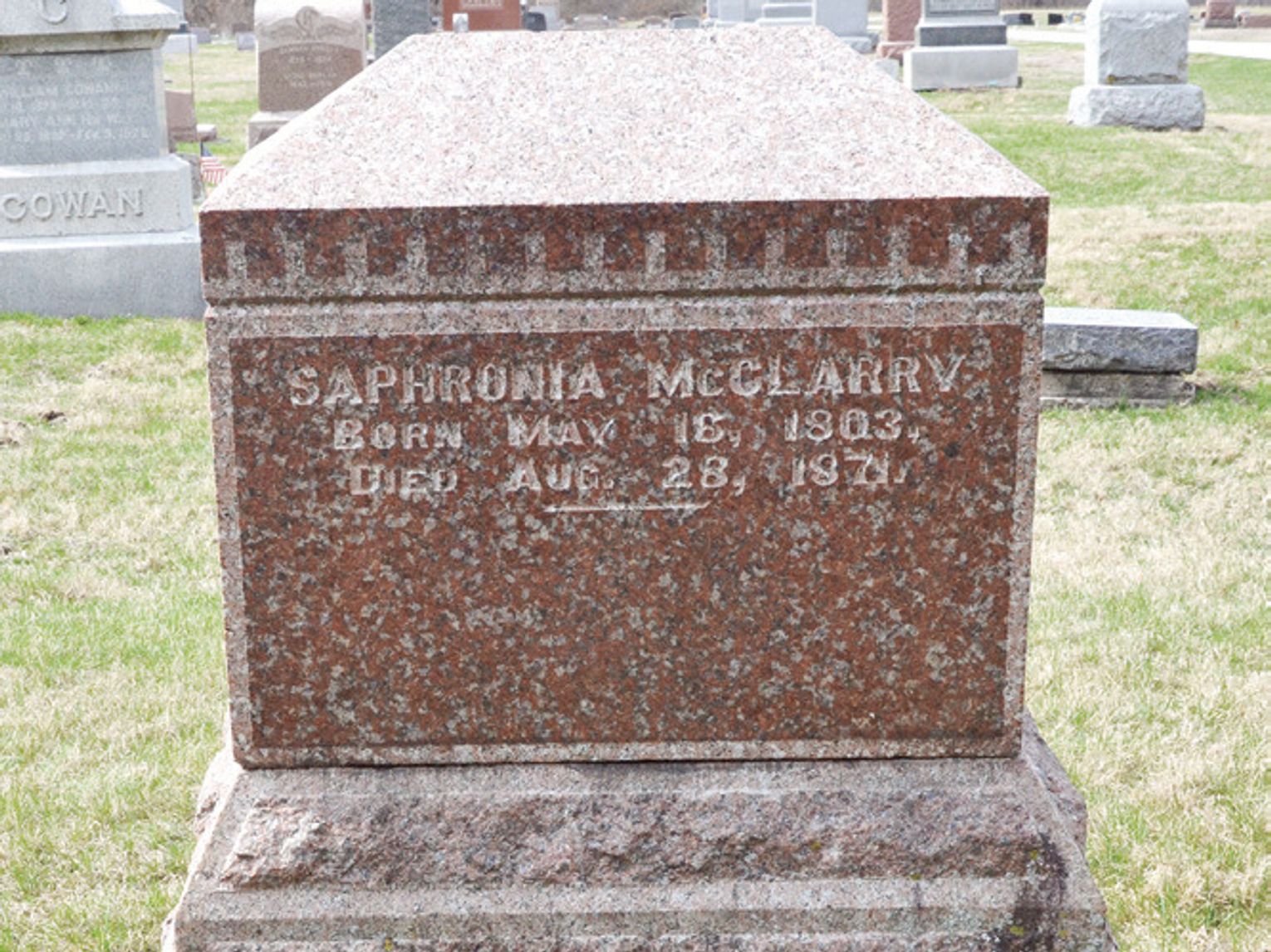
Auburn cemetery in Colchester, the middle sister is buried in Webster Cemetery in eastern Hancock County, and the baby of the family is buried in Widow Moore Cemetery, three-fourths of a mile northwest of Colchester.
So, who were these women and their families?
Why did they stay when almost all of the rest of the children of Joseph Sr. and Emma (Hale) Smith headed west?
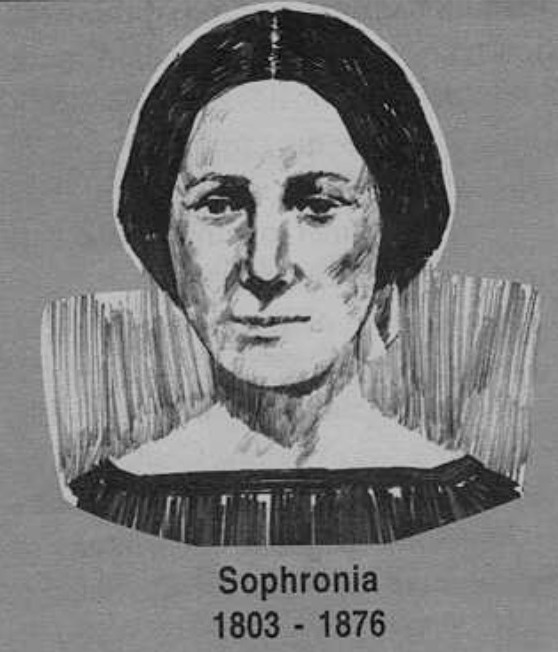
Sophronia
Joseph and Emma Smith had eight children, five sons and three daughters.
The most notable of them, Joseph Smith, Jr. was the fourth of the siblings. Sophronia was his older sister by two years, born in 1803.
One wonders the reason her parents chose that name when all the other siblings had common names for the time. All of the children were born in New York state, and all of them eventually moved westward because of the strong faith of their parents as well as son Joseph's discovery of the sacred golden plates of Moroni.
By all accounts, Sophronia was the least-healthiest of the sisters. Severe illnesses were a common problem with all families during that time. Oldest brother Alvin died at age 25 from mercury poisoning caused by treatment of 'bilious colic.' This event traumatized youngest sibling Lucy, who appears later in this series.
Sophronia married Calvin Stoddard on December 2, 1828. However, another Mormon historian, Richard L. Anderson, stated that he was not a particularly dependable husband. He had to surrender his preaching license for 'inactivity and transgression,' likely for over-consumption of alcohol. In later years, Sophronia was quoted as saying that she 'confessed much sickness and much sorrow because of the conduct of my husband.' Stoddard died in 1836.
Now a widow with two daughters, Eunice and Mariah, Sophronia married William McCleary, a convert to Mormonism, in Ohio in February 1838. Mentioned earlier was Sophronia's tendency to contract illnesses.
A famous story from her youth is shared by many historians, based on the extensive records Emma Smith kept of her husband and family.
In 1813, when Sophronia was 10 years old, typhus fever came to Lebanon, NY. She caught the disease and fell deathly sick and remained so for 89 days.
As Emma tells it, on the 90th day the doctor said that Sophronia was so far gone that she would never recover. That night, the sick girl lay motionless in bed with her eyes wide open 'with that particular set which most strikingly exhibits the hue of death.' Emma wrote that she gazed upon her daughter 'as a mother looks on the last shadow of life in a darling child.'
Joseph and Emma then knelt to pray. 'Did the Lord hear our petition?' asked Emma. 'But when we arose to our feet the appearance was far otherwise. My child had ceased to breathe. I seized a blanket, threw it around her, caught her in my arms, and commenced pacing the floor. ... I would not, for a moment, relinquish the hope of seeing her again breathe and live.'
'At last, she sobbed. I still pressed her to my breast and walked the floor. She sobbed again and then looked up into my face with an appearance of natural life, breathing freely.
... I laid her on the bed and sank down beside her, over powered by a swell of feeling. From this time forward, Sophronia continued mending until she entirely recovered.'
Did the Lord answer the Smiths' prayers? The Mormon tradition says so.
Sophronia would live for another 63 years.
Sophronia’s husband William McCleary died in 1846, leaving her a widow at age 43. She remained with her younger daughter Mariah the rest of her life and moved with them to the Colchester area to escape further harassment at Nauvoo. She is buried alongside her daughter Mariah Woolley in Mt. Auburn Cemetery in Colchester.
Historical Digression To understand the trek of the Smith sisters from Palmyra, NY, to Colchester, one needs to know the dynamics of the Mormon movement from the east to the banks of the Mississippi.
After Joseph Smith, Jr. is reported to have recovered the golden plates and the Mormon faith emerged, the family was forced to move to many other sites along the way. Persecution faced them at settlements from Palmyra, New York, to Kirtland, OH, to Far West, Caldwell County, MO, and eventually to Nauvoo. At each place, the faithful grow stronger and more committed but also more contentious.
As mentioned earlier, with the growth of the community at Nauvoo came great animosity, fueled by the Smiths' political hold over the area. When Joseph Smith fomented a riot that destroyed the Nauvoo Expositor, a newspaper critical of Joseph Smith's policies, charges of dissent and treason against the state of Illinois were filed.
At that point, Smith called on the Nauvoo militia, an army bigger than any other in the state, to defend the city. Eventually, Joseph and Hyrum fled to Iowa but returned when Gov. Thomas Ford 'guaranteed' their safety.
Joseph and Hyrum were then transported to the county seat in Carthage and placed without bail in the jail. You know the rest of the story.
After the deaths of Joseph and Hyrum, a power struggle emerged over who would take the places of the two leading forces in the Mormon movement.
Three men vied for leadership: Sidney Rigdon, Brigham Young and James Strang. Eventually, Young would emerge the strongest and organized the famous movement westward to Salt Lake. However, many others disagreed with this strategy, claiming instead that the rightful leader for the Mormon church should be a descendant of Joseph Smith, particularly Joseph Smith III, Joseph Jr.'s son.
Obviously, the families of all three sisters chose not to move west and remained in the area.
Part 2 in Friday’s edition will continue Katharine's and Lucy's stories.