What are the odds that an 1800s farm boy/store clerk from Colchester would rise to become the builder of the largest hotel in the world, and his descendant would take a prominent place in the U.S. Supreme Court?
Backstory
In the 1840s, a Hoosier by the name of Socrates Stevens moved his family to the Colchester area and took up farming and school teaching. With such a pretentious first name, one wonders what his parents were thinking. John Hallwas, in his account of Kelly Wagle, suggests that Socrates, who taught Latin, was the likely creator of the phrase multum in parvo -'much in little' - which is Colchester's motto on the official seal of the city.
Not much is known about Socrates and his wife Amanda (Stevens) Stevens who are buried in Mt. Auburn Cemetery in Colchester. Together, they raised four forward- thinking sons who saw opportunity in the booming coal town of Colchester.
The story of the rise to prominence of the Stevens family begins with first-born son Edward Demosthinos Stevens, the unusual middle name likely his father's way of honoring Greek philosopher Demosthenes. He attended Abingdon College in Abingdon, IL, for three years, returned to Colchester, and began teaching school.
In 1869, he opened a store with $1,500 worth of stock.
The business grew until 1872 when second son James Williams Stevens joined the family business.
James also attended Abingdon College but only for one term, then returned home to work in the store as a clerk but moving up to partner. A third son, John Henry worked as a farmer but eventually joined the family business in 1879 as did fourth son Joshua Franklin in 1880. Two other brothers, Charles Anthony and Thomas Albert, weren't as involved with the growing business, even though Charles became the catalyst for the family's future beyond Colchester.
In 1874, the brothers joined forces with fellow merchant A.S. Smith & Co. (whose advertisement banner is still faintly visible on the east brick wall of the former Market Street Grill). When Smith retired in 1881, the Stevens Brothers resumed business under their name, carrying stock worth $35,000-$40,000. It was claimed that the brothers were doing the largest business of any other enterprise in the county. Altogether, the family was involved in flour milling, in pottery and clay, in poultry production and processing, and in banking along with their mercantile interests.
Heading North
It's with Charles Anthony Stevens that we begin a journey never imagined by farmer/teacher Socrates.
Though the family business was a huge success (in McDonough County), fourth oldest brother Charles felt the pull of Chicago and its opportunities. From the chicago.designslinger website (devoted to the architecture of Chicago), we learn that he headed there in 1886 and discovered a market for silk products. He opened a store on the second floor of Burling & Adler's Central Music Hall Building near Marshall Field's State Street store.
According to a transcript of a presentation that legendary Colchesterian J. Hughey Martin gave to the McDonough County Historical Society in January of 1975, Charles telegraphed his brothers and told them to drop everything and move to Chicago. Thinking he was crazy, one of the brothers went there to bring him home. However, he, too, felt the lure of the big city, and told his down-state brothers to head to Chicago to get rich.
By 1889, all of the brothers had moved north and together they formed the Charles A. Stevens & Bros. Co. on the street level beneath the second floor shop. The company became the largest exclusive dealer in silk products in the country, cornering the market on fine silk products from around the world.
Success meant expanding the business. In 1890, Charles moved into a larger storefront and by1901 expanded to the upper floors of that building as well as acquiring two adjacent properties. But that still wasn't enough. In 1912, Charles built an elaborate 19-story structure with a white terra cotta exterior, leasing out the upper floors to smaller retailers. The ground floor had an arcade allowing passageway from State Street to Wabash Avenue.
Meanwhile, the other brothers were striking out with entrepreneurial ideas of their own. It's here that our focus will turn to the oldest and second oldest brothers, Ernest Demosthino and James William Stevens.
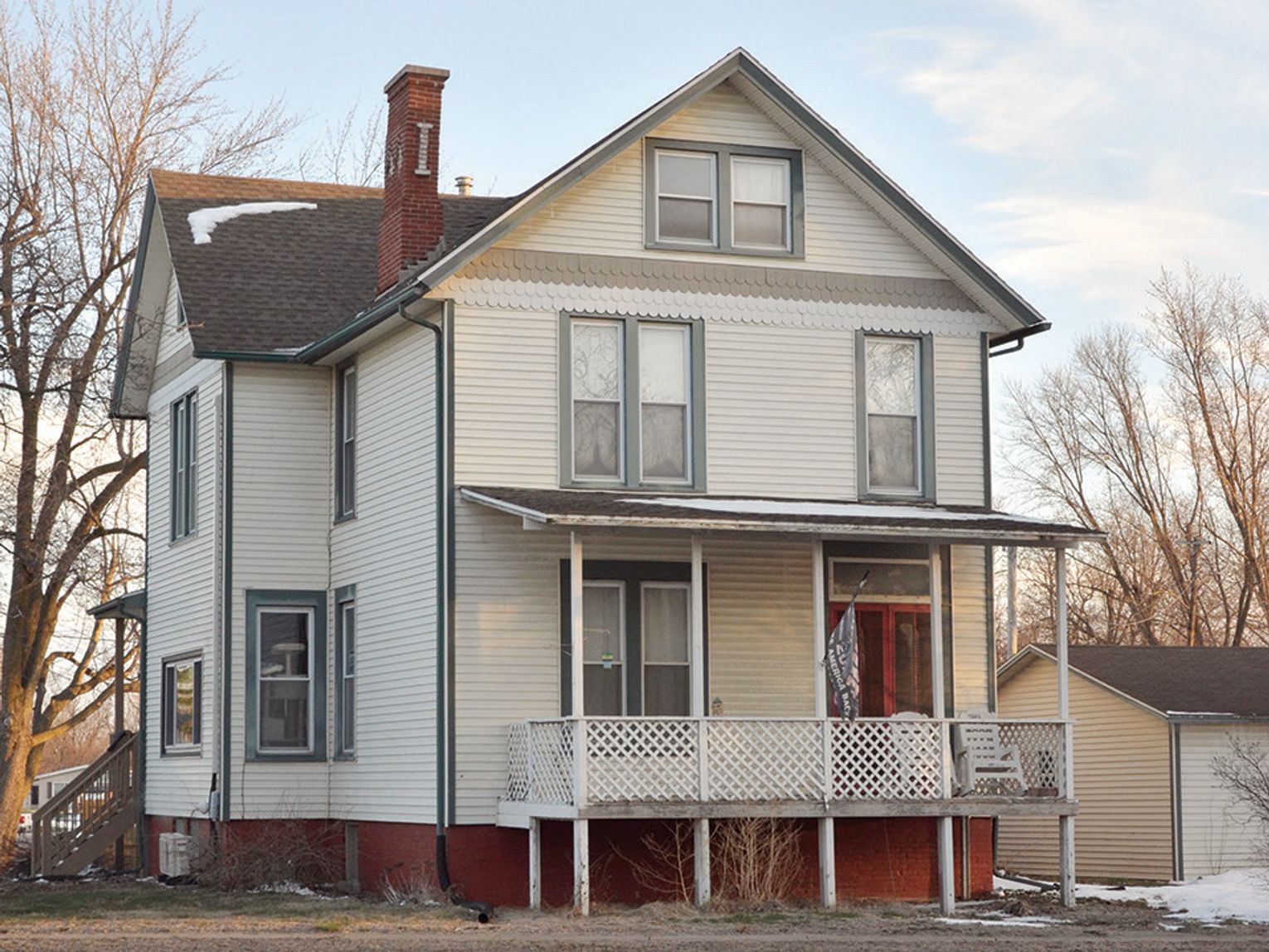
The Stevens Family in Chicago With their financial success in McDonough County, James William Stevens and his wife Jessie Louise (Smith) Stevens (likely the daughter of A.S. Smith, former business partner with the Stevenses) built an imposing house currently standing in Colchester just northeast of Jones Mortuary on the curve. But their residency in Colchester was short-lived as noted in J. Hughey Martin's account.
In 1888 James and his family moved to Chicago where he worked with younger brother Charles.
Shortly thereafter in 1890, he and older brother Ernest Demosthino Stevens formed the Illinois Life Insurance Company, which grew to become the largest insurance company in the state, with over 80,000 policyholders. In highly ironic language, given the events that will follow, Josiah Seymour Currey in Chicago: Its History and Its Builders, Vol. 5 described Ernest as follows: '... a man who has successfully coped with large business enterprises, who has made the best of and used in the most beneficial way the opportunities of life, a man of clear business record, sound judgment, and strong intellectuality. His people were of that sturdy and reliable class that all might be proud to claim as ancestors, and the business career which he has pursued has brought out the qualities which make the successful business man.'
Sidenote: Currey's series on Chicago builders was published in 1912 by S. J. Clarke, the noted historian who compiled the 1885 history of McDonough County.
With such a sterling endorsement of Ernest and with the success of the insurance business, younger brother James turned his attention to real estate.
Years later, in a less-than-flattering description, the Jan. 23, 1933, edition of Time magazine described James as 'a shrewd, smallish old man who used to prowl around the Loop on Sundays spotting likely real estate propositions.' Charles Lane in his article 'Heartbreak Hotel' in the June 19, 2007, Chicago Magazine reported that when Ernest heard of an investment group planning to build a 25-story hotel next to Stevens' proposed site, James bought the property out from under them for $1 million. Chicago real estate was a cut-throat business.
The Hotels
Much of the information for the following account of the Stevens hotel operations is compiled from Lane's article and from Alec Abramson's ePortfolio report about the Conrad Hilton Hotel.
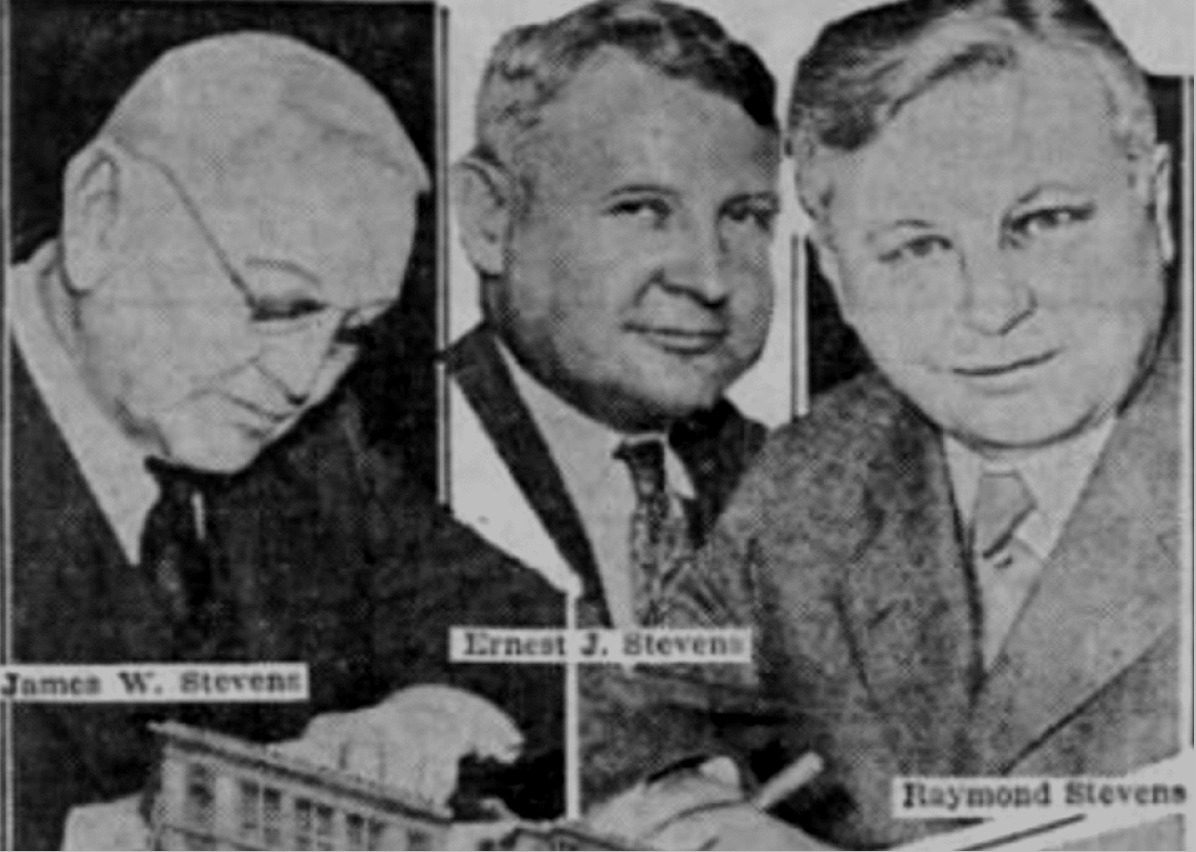
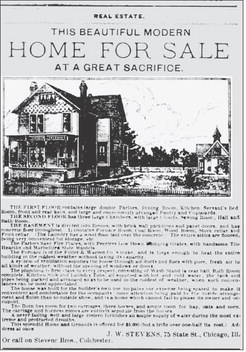
James was the leading force in wanting to make his mark on Chicago. In 1905, he orchestrated the construction of a hotel at the corner of LaSalle and Madison Streets in the Chicago Loop, resulting in the famous Hotel LaSalle. The 22-story, 1048room hotel cost $3.5 million (about $129 million today).
The Chicago Examiner of Sept. 5, 1909, boasted of the hotel having almost all of the rooms with hot and cold running water and bath tubs.
It was called 'the tallest hotel in the world.'
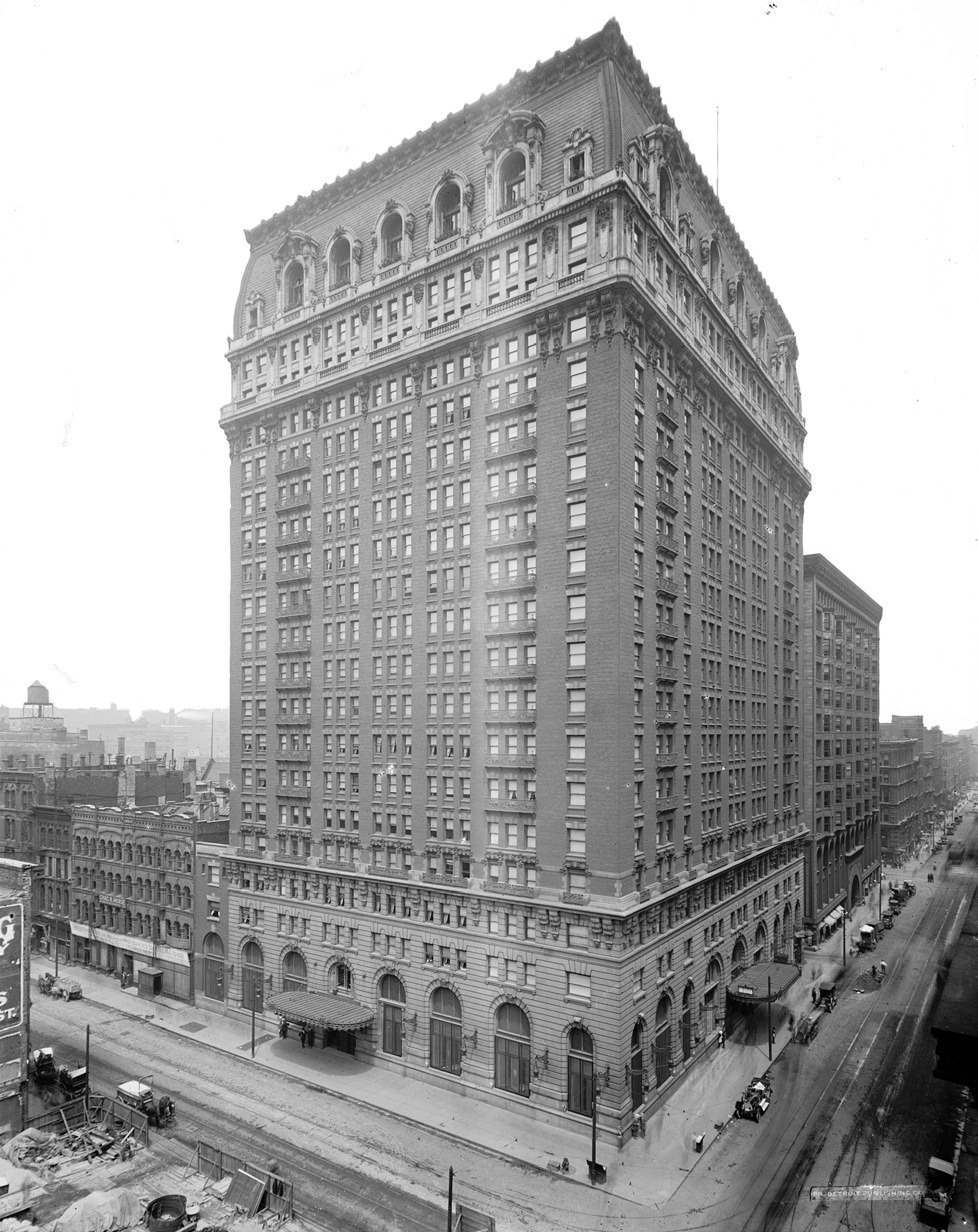
As often happens with business people in the upper strata of wealth, the largest hotel in the world wasn't large enough. James wanted something bigger. He convinced his extended family (though not all of them) to purchase property on Michigan Avenue between Seventh and Eighth Street overlooking Grant Park. Construction began on the Stevens Hotel on March 16, 1926, at a cost of $28 million (about $520 million today). To finance the project, the brothers issued bonds, something of which Ernest's son Raymond did not approve. However, Ernest and James went ahead and initiated the building on borrowed money.
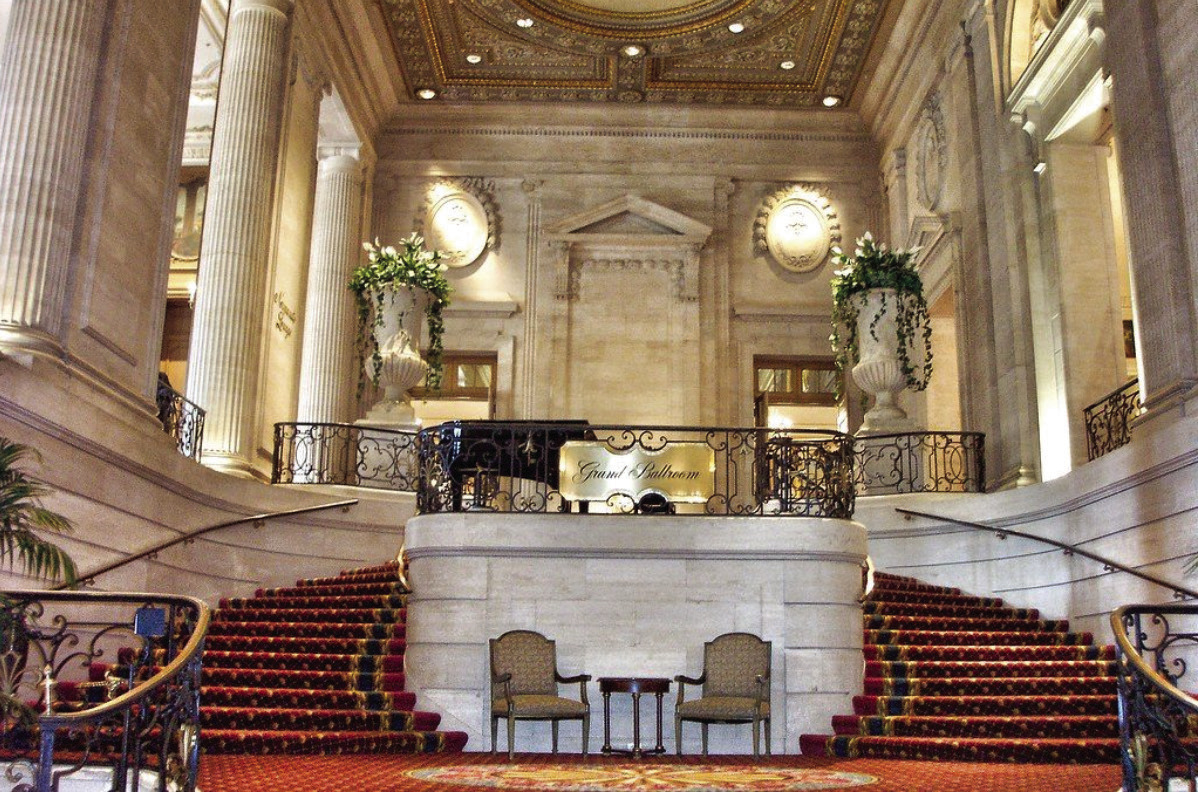
So, what did you get for 28 mil back in 1927? Lane's article in Chicago Magazine quoted an article stating, 'What a grand realization of an ambition and an ideal is this great caravansary (Middle Eastern/North African road side inn), this magnificent palace of hospitality dedicated to Chicago and to the world.'
The Stevens Hotel, said to be 'a city within a city,' had 3,000 rooms on 28 floors, making it the tallest hotel in the world (thereby reducing the Stevens' family Hotel LaSalle to the second tallest). It had a 1,200 seat theater, a 27-seat barbershop, a five-lane bowling alley, an 18-hole mini golf course on the rooftop known as the High-Ho Club, a hospital with an operating room and medical staff, a library of over 20,000 books, and an ice cream shop that produced 120 gallons of ice cream a day, with other amenities too numerous to mention.
In memory of the brothers' roots, the first floor grand hallway was labeled 'Colchester Lane' and the hotel provided several eateries, the most prominent known as the 'Colchester Grill.'
The Beginning of the End Perhaps because of all this luxury, the hotel lost over $1 million in its first year and $500,000 in the next year. Need we be reminded of what was about to occur two years later in October 1929? With the stock market crash and inevitable Depression to follow, the Stevens empire was forced to file for bankruptcy. Alec Abramson's history of the Conrad Hilton Hotel stated that the owners tried to rent out rooms as apartments.
Then in 1933 auditors discovered $13 million dollars of financial shenanigans in interactions between the Stevens owned Illinois Life Insurance Company and the Stevens Hotel. Because of the Depression, many of its 80,000 policy holders tried to borrow against their paid-up policies. Unfortunately, funds in the insurance company weren't available because the family was using insurance assets to prop up the building of the hotels as well as the struggling hotel operations.
The real crisis came in 1933 when a Cook County grand jury indicted James, Ernest, and Raymond for Illinois Insurance's illegal 'loans' to the hotel corporation.
Abramson revealed that Raymond, who was leery of the original financing plan for the hotel, tried to put up his 24-acre estate in Highland Park, but the offer was denied. Several conflicting stories tell of what happened to Raymond. Abramson wrote that on March 23, 1933, he committed suicide by shooting himself in the head at his home, The Meadows. Other sources, perhaps influenced by stories about financiers ruined in the stock market crash in 1929, claim that he jumped to his death from atop either the Stevens or the LaSalle hotel or some other tall building.
James suffered a severe stroke on March 18, 1933, from which he would never fully recover. He had not been informed of his son's suicide five days earlier.
Creditors seized his Lincoln, his Cadillac, and his two Rolls Royces. He died May 14, 1936.
Back in 1903, James had divorced his wife Jessie Smith and married Alice Bradley of New York, who was 27 years younger than he. Jessie had been uncomfortable with her husband's and her in-laws' business manipulations. She was quoted in the Chicago Tribune as saying that she agreed with Raymond's doubts about the hotel finances: 'Ernie and (James) were set for (building the hotel). They wanted to see their name up in the sky.
Well, they saw it. Now maybe they see that I was not so foolish.'
Ernest was the only family member to stand trial for embezzlement, the trial beginning on Sept. 25, 1933.
The prosecutor said that Ernest had 'fraudulently' converted Illinois Insurance funds 'to his own use' in propping up the Stevens Hotel. Ernest's cousin Bert Stookey from Colchester, a former treasurer of Illinois Life, even testified against him, claiming that Ernest had overruled him about bailing out the hotel. Stookey didn't claim that the 'loans' were illegal — just unethical. In all likelihood, what the Stevens family was doing in the 1920s was standard operating procedure then and now.
Assistant States Attorney Earle C. Huston ridiculed Ernest's claim that he wasn't shifting money for his own purposes. He was only trying to keep the hotel afloat during unprecedented financial times. Said Huston, 'It was not for philanthropic reasons nor for love of Chicago that money was pumped from the insurance company into the hotel. It was for private greed.'
In fact, one might conclude that prosecutors were trying to extract some kind of cathartic vendetta against a family who worked to game the system while the rest of the world was falling into economic disaster.
For what it's worth, Lane made a staggering reference to the fact that 81 percent of the hotels in the country went bankrupt because of the crash.
Verdict and Aftermath On Oct. 14, 1933, the jury, after only five hours of deliberation, found Ernest guilty of embezzling $1.3 million, and the judge sentenced him to a term of up to 10 years in prison. However, in 1934, the Illinois Supreme Court overturned the ruling on appeal on the grounds that Earnest hadn't shifted money without the knowledge of parties concerned (his family).
Neither was there proof that the money was used for personal use; instead, the money went to creditors. Bad judgment — yes; a crime — no. Nevertheless, the damage to the Stevens companies and to their reputations was irreparable.
Ernest eventually took a job as a hotel manager. His son Raymond was dead, and his brother James was an invalid near death. Ernest died in 1972 at the age of 81.
As for the hotels and insurance company, they fell into receivership. The Stevens Hotel was eventually purchased by the U.S. Army in 1942 for $6 million, using the rooms for military housing and training of 10,000 troops. A year later, Conrad Hilton purchased the hotel for $7 million. After restoration, it reopened in 1951, and the name was changed to The Conrad Hilton Hotel Chicago. Today, it still stands, like the grand dame of hotels along the Magnificent Mile and known as the Chicago Hilton & Towers at 720 South Michigan Avenue.
In describing the tragedies that befell the Stevens family, Lane wrote that it is 'not just the tale of a gaudy Jazz Age venture laid low by the Depression. It is also the story of a remarkable family that paid dearly when its reach exceeded its grasp.'
Epilogue
Ernest and Jessie had four sons: Ernest Street, who, ironically, became an expert in fiscal finance; Richard James and William Kenneth, who both became prominent lawyers; and John Paul, who graduated from Northwestern University Law School, who became a U.S. Supreme Court clerk, who led an official investigation into corruption at the Illinois Supreme Court, who was appointed by Richard Nixon as a federal appeals court judge, and who was appointed to the United States Supreme Court by President Gerald Ford in 1975 and served as one of the most respected justices in recent history.
Yes, we've saved the best for last. A poor, but educated family of farmers, teachers, and businessmen scrabbled their way from successful enterprises in Colchester to high society and high finance in Chicago. They produced the biggest and best insurance company and hotels but fell prey to vanity and the desire for more (Gordon Gecko's 'Greed is good. Greed is right.
Greed works.') only to see it all coming crashing down through financial mismanagement. Yet out of this dysfunction came United States Supreme Court Justice John Paul Stevens.
A Gatsbyesque story that began in Colchester with Socrates and ended with John Paul.
Sources
Highly recommended are the Charles Lane article and a YouTube video tracing the history of the hotel from its inception as The Stevens Hotel to its present Chicago Hilton & Towers: 1. Alec Abramson ePortfolio:The Conrad Hilton Hotel Chicago at canvas.northwestern.edu/eportfolio/ 1296/History/StevensHotel_ Hotel_History 2.chicagodesignslinger.blogspot.com/2015/02/charles-a.html Charles Lane. 'Heartbreak Hotel.'
Chicago Magazine, June 19, 200, at chicagomag.com/chicago-magazine/ august-2006/heartbreak-hotel 3. Hilton Chicago History Timeline https://www.youtube.com/ watch?v=M8bxVtRAaoU 4. J. Hughey Martin. WIU Oral Histories Program presented to the McDonough County Historical Society, January 1975, transcribed by Julia Thompson, February 2018 at https://www.wiu.edu/library/units/archives/CARLI_ContentDMCollections/oral_histories/transcripts/ 004_J.H.Martin.pdf 5. McDonough ILGenWeb 1885 History, Chapter 23 — The Town of Colchester at https://mcdonough. illinoisgenweb.org/1885towncolchester.html