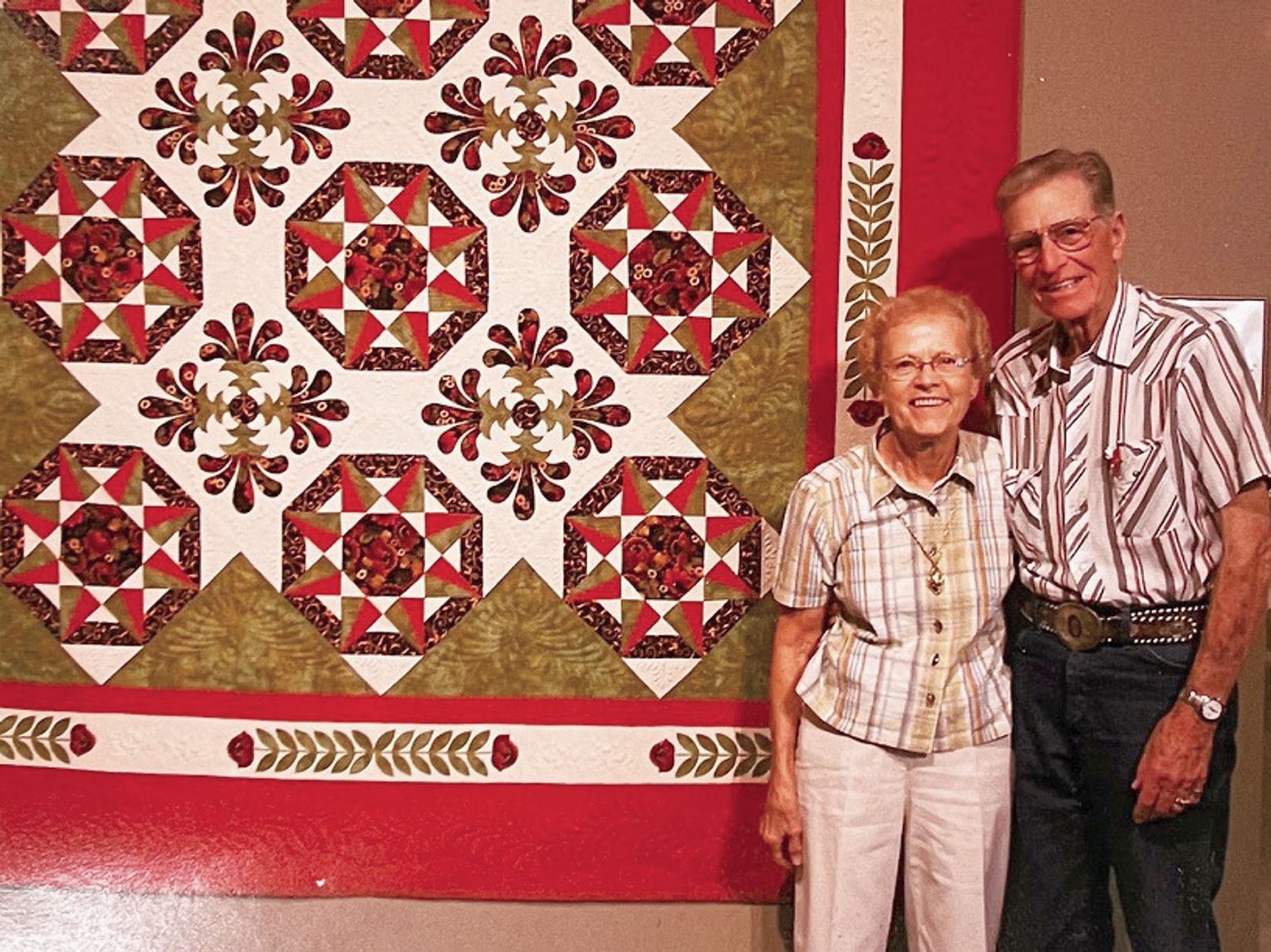
At 95, Millie Sorrells still drives, still quilts, still tends her flower garden, and still refuses to hire anyone to do work she can do herself — a trait that’s defined her entire life.
Millie Sorrells is known across the country for her award-winning quilts — designs of stunning complexity that have earned recognition at state fairs, national competitions, and international exhibitions. But those quilts didn’t appear out of nowhere. They’re the product of a lifetime of learning, creating, and refusing to accept limits — for herself or for those she loved.
The Middle Child Who Had to Excel
Millie was born and raised on a farm outside Prairie City, Illinois, during the Depression to Kenneth and Margaret Curtis. She was the middle child of three — an older sister and a younger brother— and that position shaped everything.
“We didn’t have a lot but we made the best of what we had,” she said.
Being in the middle, she felt the need to stand out.
“As a middle child, I guess I always felt like I had to excel at things to stand out,” she recalled. And she did.
In school, she was a cheerleader and active in sports and a multitude of organizations. She was a bit of a tomboy, helping with gardening and farm work, and she loved to draw — the first sign of the artist she would become.
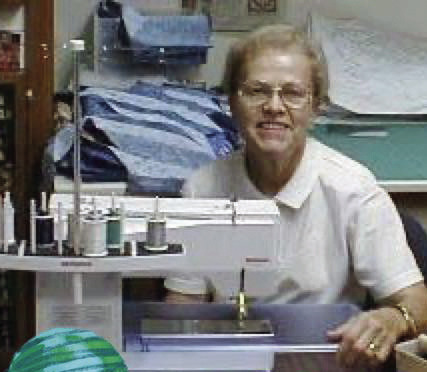
At 15, she made a decision that would be unthinkable for most teenagers today. She rented an apartment in Galesburg for the summer and waitressed down the street. The money went toward one thing: school clothes. She did this every summer through high school, ensuring she had new clothes each fall.
That’s who Millie was — even then. If she needed something, she would figure out how to do it herself.
The Boy Down The Road
Around that time, a handsome boy and his family moved down the road. His name was Duane.
Millie giggled as she told the story of their first date — or rather, Duane’s attempt at one. “He pulled up beside me on the road and started to ask me out on a date, I think, but, I kind of panicked and sped off, ripping off his front bumper in the process!”
Duane didn’t give up. He drove to Millie’s father to ask about getting the car repaired. Her father listened to the story, then said: “Well, I think you got your answer.”
Duane persevered. He and Millie became a couple, married, and started farming together.
When people talk to Millie about her life, she gives much of the credit to Duane. And she should — he was her partner. But as the conversation deepens, it becomes clear: she was just as much a part of every aspect of their life together as he was.
The Farmer’s Wife Who Did Everything By His Side
Being a farmer’s wife in the 1950s and 1960s was relentless work. Millie tended a large garden. She landscaped and mowed the yard and barnyard. She cared for farm animals. She managed household chores and she helped Duane farm. They were a team.
This was also the time that Millie purchased her first sewing machine, a Singer Featherweight from Mrs. Butterworth, a Singer sewing machine dealer located on Lafayette Street in Macomb. Little did she know then that this would be the beginning of something much bigger.
She learned to sew by taking classes from Mrs. Butterworth and the Home Extension. Millie loved learning new techniques to perfect her craft. She made a few things for her family, but at first it was mostly her own wardrobe.
Her advanced seamstress skills soon became known throughout the community. She made numerous prom dresses, bridesmaid dresses, and custom suits for people throughout McDonough County. Word spread and women sought her out — a glimpse of what was to come with her quilts.
“Sewing for others gave me a chance to work with a variety of new and different fabrics, and make some additional money” Millie said, just another example of her love of learning and entrepreneurial spirit.
The Son Who Changed Everything Duane and Millie’s son, Curtis, was born and named after Millie’s family. The delivery was long and brutal. As Curt grew, Millie noticed he wasn’t developing like other children his age.
A specialist in Peoria offered little help.
It wasn’t until they took Curt to the local doctor in Blandinsville, Dr. Borum, that they got answers: cerebral palsy, a condition marked by impaired muscle coordination, typically caused by damage to the brain before or at birth. Millie believed it was possible that her difficult delivery may have deprived Curt of oxygen.
In the 1950s and 1960s, many parents would have institutionalized a child with this condition. Not Millie and Duane.
“He was our son, it was up to us to take care of him and make sure that his life and his childhood was just like any other child’s,” she stated.
And so they did. They took Curt to Iowa City, where they trained with a specialist on supporting his development. It took a lot of patience and perseverance, but they knew that’s what it would take.
Around the age of 10, Curt had surgery on his legs and was fitted with leg braces that came up to his waist to help him walk. Millie and Duane worked with him on his speech, included him in every job and chore around the farm. He attended school. He joined 4-H, just like the other kids.
“It took a lot of patience and hard work, but we did what we needed to do,” Millie said. “We would show him repeatedly how to do something, and eventually he would do it. He wanted to learn.”
Duane taught him to drive and work around the farm. Millie taught him to mow. Later in life, Curt started his own mowing business, was involved in social clubs, and lived independently — because Millie and Duane ensured he had the skills and confidence to do so, just like the other kids.
The Side Gigs
The Sorrells always farmed, but they always had other ventures too, one was raising popcorn to sell.
“Curt would shell the popcorn and then we would bag it up together,” Millie said. It was work the whole family could do.
Later came the Christmas tree farm. Millie helped plant every tree — one thousand trees! She took families back to pick out their trees. And yes, she helped saw them down — some customers couldn’t believe this 5-foot-2-inch woman could handle cutting such large trees. But Millie could.
Again, when you ask her about the Christmas tree farm, she credits Duane with starting it. But it becomes clear: she was there, beside him from the beginning, planting, working, selling. They were a team.
The Businesswoman Behind The Opry
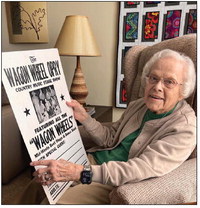
When Duane was asked to sing in a local opry, he had no idea that one day he would branch out and form his own successful show: the Wagon Wheel Opry, named after his CB radio handle.
The Opry began at the 4-H Center. Soon Duane moved it to Felheimer Auditorium and made an agreement with the school: a portion of the proceeds would go to the Bomber Boosters. For 25 years, thousands of dollars were raised for the athletic booster program.
People came from miles around on one Saturday night each month to enjoy the country music and comedy show. The Wagon Wheel Opry became a fixture in McDonough County. Duane was talented enough that famous singers — including Lil Jimmie Dickens — invited him to Nashville. But Duane’s priorities were here, with Millie and Curt, living the country life.
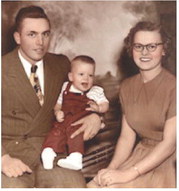
And behind every show, Millie was right there beside Duane, selling tickets, paying bills, and tracking every dollar of proceeds.
Duane also had his own side ventures. He owned a large tree spade and moved trees for people. He pushed snow and excavated for others. At 70, he became a pilot and was always happy to take friends for a ride.
Returning To School — The Artist Emerges Millie stated many times: “I love to learn.” She took her first college classes at Spoon River College in her late 40s and continued to learn.
She also took her first formal art class from Nancy Jones. She had always loved drawing and painting, but this class added another layer to her artistic talents, talents that already included being a first-class seamstress.
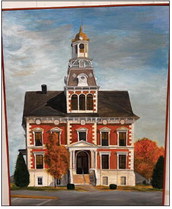
Her first painting was that of the McDonough County Courthouse that ended up hanging in Spoon River College, from there she continued to paint the historic building ”I would pull up and park in the first parking space just off the square on the west side, put up a chair and easel and paint the Courthouse,” she said. “From there on out I painted many.”
So many, in fact, that locals began calling her the “Courthouse lady.” She sold her paintings — large and small — at the local Farmer’s Market. One still hangs in the County Treasurer’s’” office.
But when you visit Millie’s home today, the only painting of hers hanging on the wall is not a courthouse scene. It’s a picture of Charlie Brown, the family’s Chihuahua.
The Quilter
“I just love to learn and work with my hands,” she said. Millie had always enjoyed knitting, crocheting, macramé, and even refinishing furniture and caning.
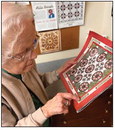
At 50, she took a computer class and purchased a Gateway computer. She didn’t just learn how to operate it — she learned design programs that would propel her quilting career. She took simple designs and made them extraordinary, repeating and layering elements into something far more intricate than the original.
She hand quilted for the first 10 years before switching to free motion machine quilting, which allowed her more freedom to create unique patterns and techniques.
She recalled one specific quilt that required her to seek permission to recreate — an 1856 quilt measuring 91 x 91 inches, which she called “Phantasy.” This quilt took her over three years to hand quilt, incorporating quilted feathers, quarter-inch diagonal lines, and center quilting that gave the appearance of seersucker material.
She laughed when she recalled a customer asking, “Is that seersucker fabric?” She replied: “No, it was just a sucker who did it.”
Her first award-winning quilt earned recognition at the Springfield State Fair. “I got a ribbon and money!” she said with delight. Millie, the businesswoman, recognized opportunity. She loved quilting and she could earn money doing it.
But a little money turned into more when she won the coveted American Quilters Society’s Bernina Workmanship Award at Paducah — a $12,000 prize for her quilt titled “Charisma,” named by her husband, Duane. It was a turning point and the highlight of her quilting career.
Her quilts began earning awards and recognition across the country and beyond — recognition that reflected not just her technical skill, but the lifetime of learning, discipline, and creativity that came before.
She was invited to teach at conventions. She traveled, taught what she loved, and was paid for it — plus hotel and meals were covered. “It was a win-win for me,” she said. “I could travel, teach what I loved, and be paid for doing it. The money I made supported my habit: quilting!”
Millie has since made hundreds of quilts. She is a charter member of the American Quilter’s Society, past president of the Land of Lincoln Quilters, and an active member of several regional quilt guilds. Her award-winning work has been exhibited across the country and is included in the permanent collections of the Illinois State Museum, the International Quilt Museum in Nebraska, the National Quilt Museum in Kentucky, and the Wisconsin Museum of Quilts & Fiber Arts.
Her international travels have taken her to quilting conferences and exhibitions. She once attended a quilting conference with a friend in Ireland, further expanding her artistic horizons and connecting her with quilters around the world.
In 2022, Sorrells donated a number of her quilts to the Western Illinois Museum, ensuring that a selection of her work remains in her hometown for future generations.
Millie is still an active member of the Prairie Quilters Guild in Macomb, a group that makes quilts for charity organizations.
Recently, they’ve been supplying 36-by-36-inch lap quilts for wheelchair recipients in underserved areas, most recently in Kenya. The group also quilts bedspreads for ‘Sleep in Heavenly Peace,’ a local organization that builds and provides twin beds to children in the area who lack an adequate place to sleep.
The Prairie Quilters meet once a month, and anyone who quilts — or is interested in learning — is welcome to join.
The quilts were the culmination of everything Millie had learned: The precision of a seamstress. The eye of a painter who captured the courthouse from every angle. The patience and discipline of a mother who, along with her husband, raised a disabled son to be an independent man. A farmer’s wife who was always working by her husband’s side. The creativity of a woman who refused to accept that anything was beyond her reach.
The Adventurer
Millie somehow always found time for adventure. She and Duane enjoyed traveling and snowmobiling with a group of friends. Of course, Millie had her own snowmobile — no back seat rider for this woman.
The couple celebrated their 25th anniversary in Hawaii and their 50th in Alaska. Millie planned the entire Alaska trip herself, adding travel agent to her ever-growing resume. They especially loved the airplane ride that landed on a glacier near Mount McKinley.
The Community Volunteer
It’s hard to believe that Millie would have time to volunteer, but she gave many hours of her life to helping others. She was a lifetime member of the McDonough District Hospital’s Auxiliary, where she served on the scholarship committee. She also served on the United Way board and organized, with others, a camp for children with disabilities held each year at the Girl Scout camp.
This work was deeply personal. Having raised Curt with cerebral palsy, Millie understood the challenges families faced. She was committed to ensuring that other children with disabilities had the same opportunities and support that she and Duane had provided for their son.
Loss And Legacy
In January 2021, Duane passed away after 72 years of partnership. It was a profound loss for Millie — the man who had persevered through a ripped bumper to win her heart, who had been her partner in every venture, every dream, every challenge.
In October 2021, just nine months after losing Duane, Millie lost her son, Curt. The woman who had fought so hard to give him a life of independence and dignity now faced a grief that few could understand.
Yet even in loss, Millie continued. She did not stop. She could not stop. It was not in her nature. She quilted. She gardened. She learned. She lived.
True to form, when she decided to sell their home, she didn’t hire a realtor. She added realtor to her resume and sold the house herself, saving the commission fees. Millie said she sold it to the perfect family, one she knew would maintain and improve the beautiful home, grounds and pond.
Before she left, she transplanted several hostas from the over 100 varieties she had cultivated at the homestead — each one tagged with the name and year it was planted. She brought them to her new home at Wesley Village Estates, where she tends them still.
(Editor’s note: This writer’s son is the family that purchased the Sorrells home and is very proud to own it.)
Still Learning At 955 Millie will be 96 in July. Neuropathy in her legs and feet slows her down some, but not much.
She still drives. She still quilts. She still sews. She still gardens. She still teaches.
Ask her what keeps her going, and she’ll tell you the same thing she’s been saying her whole life: “I just love to learn and keep busy.”
At 95, Millie Sorrells is still proving it — one stitch at a time, leaving a legacy stitched into fabric for generations to come.