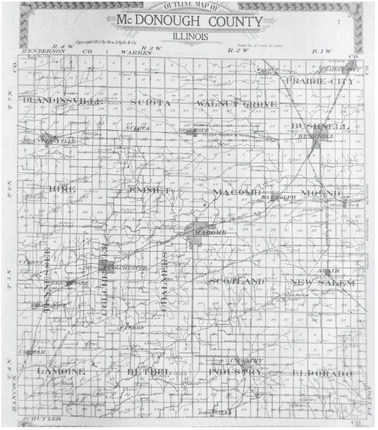
In keeping with coverage of the McDonough County bicentennial celebration, consider how the 18 townships were named, either by tradition or by official adjustments in the 1850s and 1880s. The following information is compiled from Gordana Rezab's exhaustive study of local places in her book, 'Place Names of McDonough County, Illinois: Past and Present,' published in 2008 by Western Illinois University and the 1976 'McDonough County Sesquicentennial Book,' prepared by the Colchester Lions Club.
Bethel: The township originally had the name 'Eagle Town,' but it was changed in 1857, likely because of desire for a term more in keeping with a Christian community. The name 'Eagle' was informally used to describe a school, a church, and a neighborhood. Elizabeth Bainter, in the Sesquicentennial book, suggested that the name may have come from earlier setters from Bethel, Pennsylvania.
Blandinsville: This township was named after the community laid out by Joseph L. Blandin in1846.
Bushnell: The settlement was first known as 'West Prairie.' Years later, the town was named in honor of I. Nehemiah Bushnell, president of the Northern Cross Railroad, August 9, 1854. Perhaps some 'arrangement' was made between the railroad officials and town officials for honoring an outsider.
Chalmers: An early name given for this township was 'Erin,' the ancient name of Ireland. It's unknown why 'Chalmers' was eventually chosen, but perhaps from Chalmers, Indiana, because earliest settlers James and William Edmonston came from there.
Colchester: As with other townships, this name derives from the town established in 1855. It was formed from a portion of western Tennessee Township and western Chalmers Township when the county conducted an 1879 reorganization.
Eldorado: Originally named 'Sugar Creek,' this township name was changed in 1856 to 'Eldorado,' Spanish for 'the golden one,' likely referencing the rich soil in the area.
Emmett: 'Spring Creek' was the original name for this territory. The name was changed in 1856 for unknown reasons, perhaps, as Rezab noted, because of Robert Emmet, an Irishman executed by the British in 1803. However, no known reference exists to link the Emmet, with the name for the township.
Hire: Hire Township was originally named 'Rock Creek.' The name changed in 1857 to honor Charles W. Hire, a veteran of the War of 1812, who settled in the area.
Industry: Unlike the other townships whose names original from people or place, Industry Township is given a 'commendatory' name supposedly coined by John M. Price sometime in the mid-1850s after the character of the people who settled there.
Lamoine: An early post office in the area was called either 'La Mine' or 'La Maine.' How the name shifted to the present spelling is unknown. A settlement at the confluence of the Troublesome and Crooked creeks was named Lamoine, perhaps, speculates Rezab, from the French version of the English word 'monk' — moine — after Catholic monks who interacted with indigenous populations in the late 1680s. In 1834, the river was locally known as 'Big River' but mapmakers from the era labeled the creek with some form of Lamoine.
Macomb: In 1830, the original, though temporary, name chosen for the county seat was Washington. It was changed to Macomb in 1831 after General Alexander Macomb, commander of American forces in the War of 1812 and later Commander- in-Chief of the army.
Mound: Likely named for its elevation in the SE quarter of Sec. 14. The 'mound' was originally known as 'Dyer's Mound.' The actual highest elevation in the county is on the McDonough and Henderson County lines north of Sciota at 800 feet above sea level. The lowest point is on the McDonough and Schuyler County lines near Camp Grindstone Creek at 500 feet above sea level.
New Salem: Derived from the home town of its first settlers, New Salem, Mass. 'Salem' is a shortened for Jerusalem or perhaps an adaption of the Jewish term for peace — 'shalom.'
Prairie City: Dorothy Stoneking in the Sesquicentennial book states that J.R. Parker established the first store in a home. When asked by suppliers where goods should be shipped to stock the store, Parker puzzled a moment. Since no specific address yet existed, except for the intersection of the Northern Cross railroad and the old State Road, he replied, 'By George, sent it to Prairie City, Illinois.' The name stuck, becoming the name for the town and the subsequent township.
Sciota: Perhaps the term 'Sciota' derives from Scioto County and river in Ohio, and likely from the Scioto indigenous tribe from that area. How the last letter became an 'a' is unknown. Phyllis Wood writes that the name Sciota means 'red leaf.' Legend has it that the Harden family, early settlers in the area, had experience the kidnapping of Molly Harden and her four-yearold son Robert back in Ohio. During captivity, Molly gave birth to a daughter named Mary. Son Robert died in an attack to retrieve the captives. Oddly, the Hardens thought the tribal name of their family's captors merited the similar naming of this community and township.
Scotland: Named after Scottish pioneers, notably prominent Illinois attorney Cyrus Walker, the area is informally known as 'Little Scotland.'
Tennessee: Logically, this township is named after the state from which many of the settlers originated.
Walnut Grove: The area was once called both Hickory Grove and Walnut Grove. The latter is the more likely choice because of a large grove of walnut trees even though they grew in Bushnell Township.