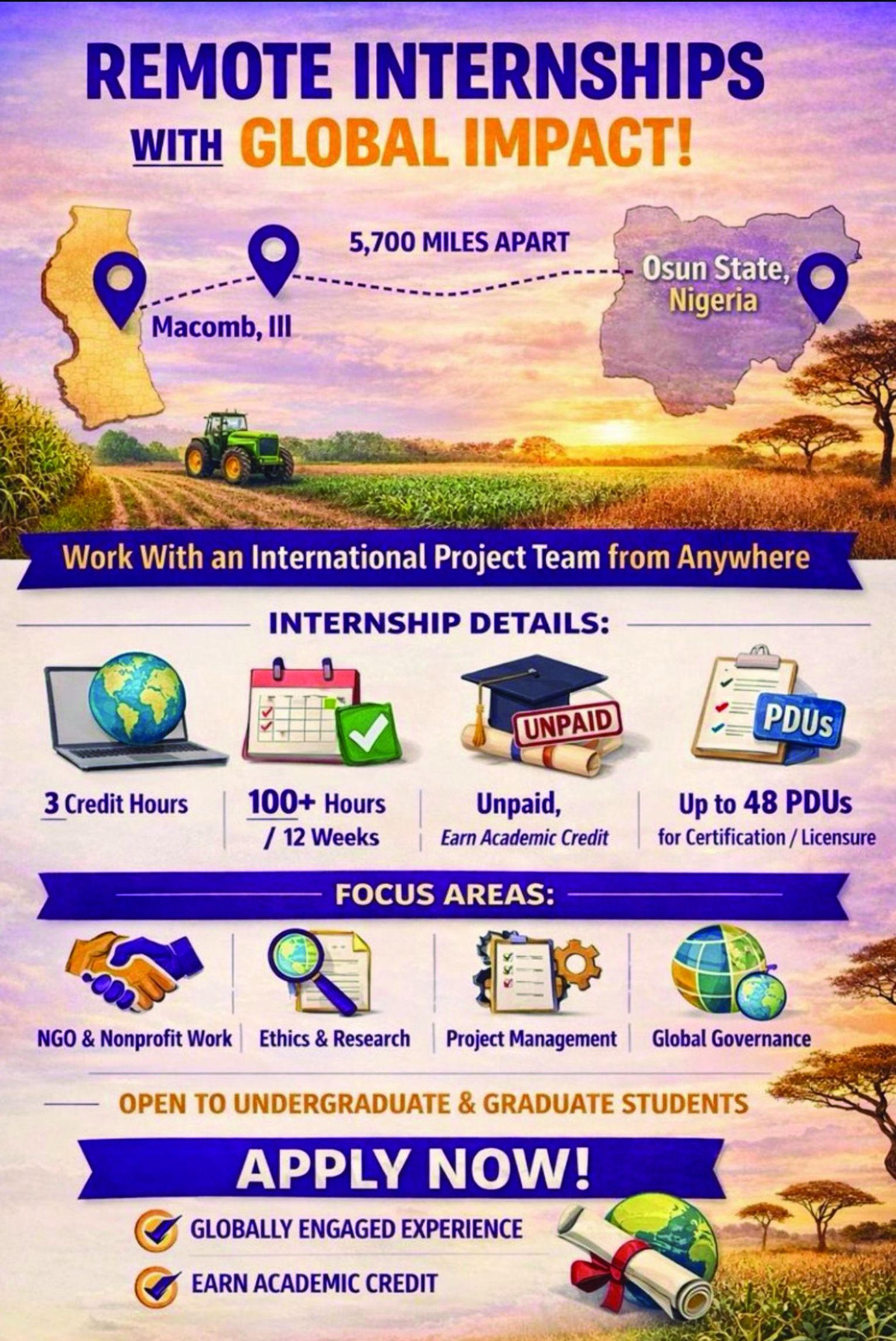
Even though there are 5,700 air miles between Macomb, Illinois and Osun State, Nigeria, faculty and students from Western Illinois University and professionals from the Western Africa sovereign state are forging partnerships to help propel Nigerian women into leadership roles so they can further build their country's independence.
The large populous federal republic has a longstanding relationship with Western, with hundreds of Nigerian students enrolling at WIU over the years. But it was actually a LinkedIn post that created the WiWa (Western Illinois Western Africa) Women's Project Collaboration, led by Adebimpe Jesujobi, with support and assistance from WIU Political Science Professor Casey LaFrance and other University faculty, staff and students.
'Bimpe and I met in a global group, and we both saw the possibilities, but she needed funding for a pilot project to offer training to women in her country,' LaFrance explained.
Zack Cleghorn, the founder and president of business development at Star Global College of Workforce Development, a program that primarily trains veterans, saw promise the promise of the program and donated $1,000, with LaFrance donating additional funding to get Jesujobi training and certified so she can in turn begin training other women. Western's role is to help get the word out and supply students from the Department of Political Science to provide assistance, and in turn, the students will learn more about nonprofits, international regulations and more. Currently, five WIU students are working in a support capacity this semester, and earning academic credit, while also earning credentials in project management and related fields from DisasterReady's free offerings.
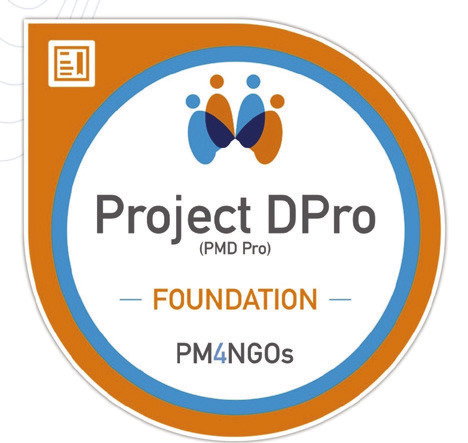
Western's former director of international studies, Randy Glean, had initially helped build a large presence for the institution in Africa, especially Nigeria, which has also helped with the project, LaFrance noted. Now with the travel restrictions in place through the U.S. federal government, getting students here – and there – is much more difficult, but WiWa is focusing on building partnerships for the future. Recently, Jesujobi, along with her co-leader Derrick Amponsah, have earned the prestigious, globally recognized Business Professional Certification (PBP) from the Project Business Foundation in Germany, as well as the Project DPro (Development, Professional) Certification from PM4NGOs. In addition, 10 other women in the program will sit for the exam in the coming weeks, and after earning the credentials, will be eligible for grants, funding, business incubation and other uses.
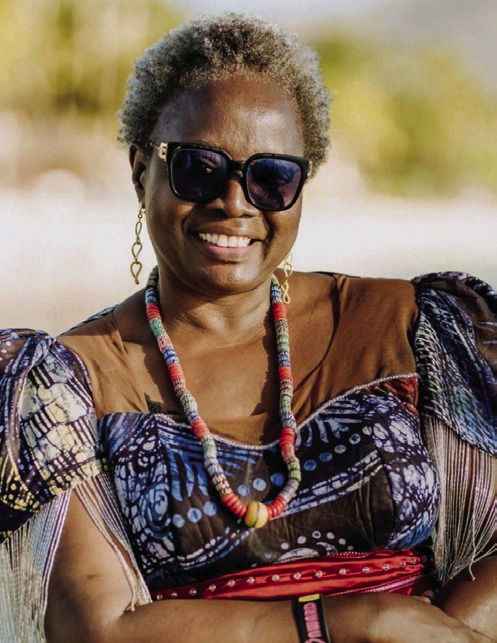
Debimpe Jesujobi of the Western Illinois Western Africa (WiWA) Project
Now, with Jesujobi receiving the certifications, she can begin training others in her country through the Eden-Educare Foundation (EECF), of which she serves as the executive director. In addition, Jesujobi has just been admitted to the School of the Future International Academy in England's 2026 Mentoring for School Leaders Program.
According to Jesujobi, EECF was established to bridge the gap for Nigeria's most vulnerable: out-ofschool children, maladjusted children and adolescents, teen mothers and trafficking survivors. Rather than adapt to a 'western' style of assistance from United States and other non-African-based social service organizations, Jesujobi, through her recent training, and working with LaFrance, is striving to train and develop peers in her country in a way that makes sense to their lives.
'I'm from Appalachia and people who came in to help us made decisions for us. They wanted to change us and our culture. With the WiWa Project, we aren't doing colonial thinking. We're not imposing our agenda, rather individuals living in Nigeria are being trained to make a difference, in their own way and style, in their country,' LaFrance pointed out.
Since it was founded in 2018, it has reintegrated hundreds of children into a formal educational system, provided shelter and support for children, empowered teenage mothers to achieve literacy and vocational skills and more.
'Rather than delivering a 'pre-packaged' set of services, WiWa, working through Eden-Educare, is designed as a temporary governance structure that empowers women through workforce development and professional leadership training,' Jesujobi explained.
The project integrates five lenses: people – protecting the dignity and safety of the community; planet – maintaining environmental consciousness in a region facing ecological shifts; prosperity – building economic resilience; and product and process – ensuring the quality and ethics of the project's delivery.
'As this project develops from design to delivery, it stands as a beacon for how international partnerships can – and should function: by authorizing local leaders to drive change from within,' LaFrance added.
For Jesujobi, her goal has always been to help the women of Nigeria grow and develop professionally so they can change their circumstances. By training the women in the necessary leadership skills, they in turn can continue the next generation and so on, which reduces the need to rely less on those outside their culture and environment.
'The women involved are so empowered, and they can do more for their communities, the organizations they are with and more,' she added. 'This helps us to have a community of women who have become more versed in project management when it comes to nonprofit and humanitarian work.'
While project management and leadership development are the goals of the WiWa initiative, it extends beyond, the pair added. Sustainability- focused economic incubation and workforce development will grow out of the training, with many participants taking these skills back to their own nonprofit organization, LaFrance said. Beyond project management, DPro is aligned with grant-writing, workforce development and education efforts, he noted. Since passing her DPro exam, Jesujobi has begun the process of applying for training partner status so she can train other nonprofit leaders.
'This is about women following my example. I've had to drop out of school several times in my life. I had to live with other people who were not my family. I had a very challenging childhood and my mother wasn't in the picture,' Jesujobi explained. 'I didn't want to continue that life and I don't want to see other children out on the streets. I'm not just using this training for myself and to make my life better, I'm using this methodology to improve the lives of others. There is hope and there are ways to make our lives better.'
With the recent decimation by the U.S. federal government of USAID, individuals living in development countries must make their own way, LaFrance noted. That comes with the good and the bad … good as it's a way for a community or a country to say 'This is what we want and need, not what you think we need,' and the bad because there are not the resources available any longer.
'The WiWa project, and the training, gives people a voice. Their voice. Women are the voice of this project, and women are instrumental in designing this project and leading it. We're serving in an advisory capacity, but the cool thing is we are not imposing our will and our values,' LaFrance stressed. 'We're responding when we are asked, and we are not taking over. There is amazing leadership by Bimpe, and the key takeaway is we're creating potential in an area that has not had a lot over the years.'
To learn more, visit the WiWa Project on LinkedIn at linkedin.com/company/ wiwa-project/