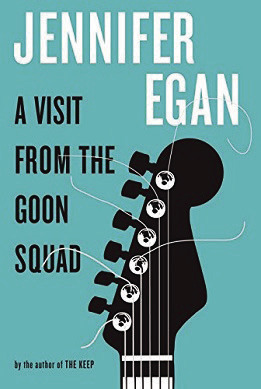
As a child, Jennifer Egan wanted to be a doctor. On March 5, the prize-winning novelist came to Western Illinois University as part of The Fred Case & Lola Austin Case Writer-in-Residence program, and during Q&A, she described an early childhood fascination with her grandfather, Dr. Graham Kernwein, an orthopedic surgeon: “He would talk about cutting people open at the dinner table, and I loved it!,” Egan said. “I would go to the graveyard with my grandmother in Rockford and say ‘I just wish we could dig someone up.’” But Egan didn’t become a surgeon (or a graverobber). Instead, she became a writer: her fiction includes several short stories and six novels, the fourth of which –'A Visit from the Goon Squad” (2010) – won the 2011 Pulitzer Prize for Fiction and was named by The New York Times as one of the hundred greatest novels of the 21st century. In a sense, Egan just became a doctor of a different kind: whereas her grandfather cut into bodies, Egan cuts into the human mind. Her work is deeply concerned with memory and time, how episodes from the past—both our own and others—can come back to haunt us again and again. Her fiction delves deep into the thoughts of her characters, providing intimate portraits of the inner lives of mentally ill rockers, middle age burnouts, and desperate housewives.
Perhaps the greatest insight she took from her grandfather is that getting a good look often requires some kind of cutting. “A Visit from the Goon Squad” famously consist of several episodes cut out from the lives of her characters and juxtaposed against each other outside of chronological order, for example, one chapter told from the perspective of a music producer suffering a midlife crisis might be followed by a 25-year jump back into the head of a hanger-on for the producer’s band back when he was a young, teenage punk rocker. Sometimes Egan even cuts inside her chapters: in one chapter, she chops up a devastatingly intimate family portrait into 76 separate PowerPoint slides for the reader to examine, almost like specimens under a microscope.
Egan’s surgeon grandfather was often on her mind throughout her visit. I got to pick her up from the train station Wednesday night, a willowy, cheerful woman with a Midwestern look, nothing like who I expected from reading her often hardedged work, and she immediately brought him up. It turned out Dr. Kernwein had a connection to Macomb. During World War II, he served in the Army Medical Corps as a lieutenant colonel, and he was put in charge of the Camp Ellis army hospital in 1944. While serving at Camp Ellis, Dr. Kernwein lived in Macomb with his family: his wife Elva and his young daughters Kay and Lynn, the first of which became Jennifer Egan’s mother. Now in her mid-80s, Kay still remembers Macomb and the house where they lived when she was five. She recalls a ceramics factory and some train tracks.
Professor Barbara Lawhorn, WIU's creative writing professor who first pitched for Egan to come to WIU, went on a Thursday morning adventure with Egan to try to discover the location of the old family home. With Lawhorn’s help, they were able to identify the “ceramics factory” as the old Haeger Pottery buildings at West Carroll and North Charles streets, which were razed in 2021. Lawhorn has her own family history with the site. Her father used to work at Haeger Pottery as a kiln lighter back when the company was still one of the world’s largest producers of art pottery. Lawhorn has vivid memories from childhood of bringing dinner to her father and eating with him in the breakroom.
Egan and Lawhorn took some photographs of the site she thought might have been the old family home. They also took in the nearby solar farm, identified a Killdeer bird, a new life bird for Egan, and drove around Compton Park and the square.
“She is the first visiting writer, in my experience, who really wanted to see the campus and our larger community,” Lawhorn noted.
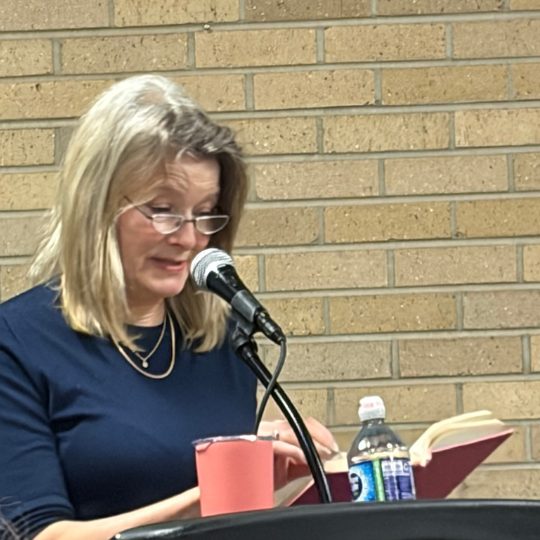
Following a luncheon where she met with students to discuss writing craft, Egan went to the Lincoln Room in the University Union to give a public reading and take questions. She read from “The Candy House” (2022), sequel to “A Visit from the Goon Squad” and her most recent novel. She read from “The Mystery of Our Mother,” a chapter told from the perspective of two young girls with separated parents waiting for their father to come pick them up.
“How could you marry him?” the two girls asked in Egan’s voice.
“Love is a mystery,” the mother responded.
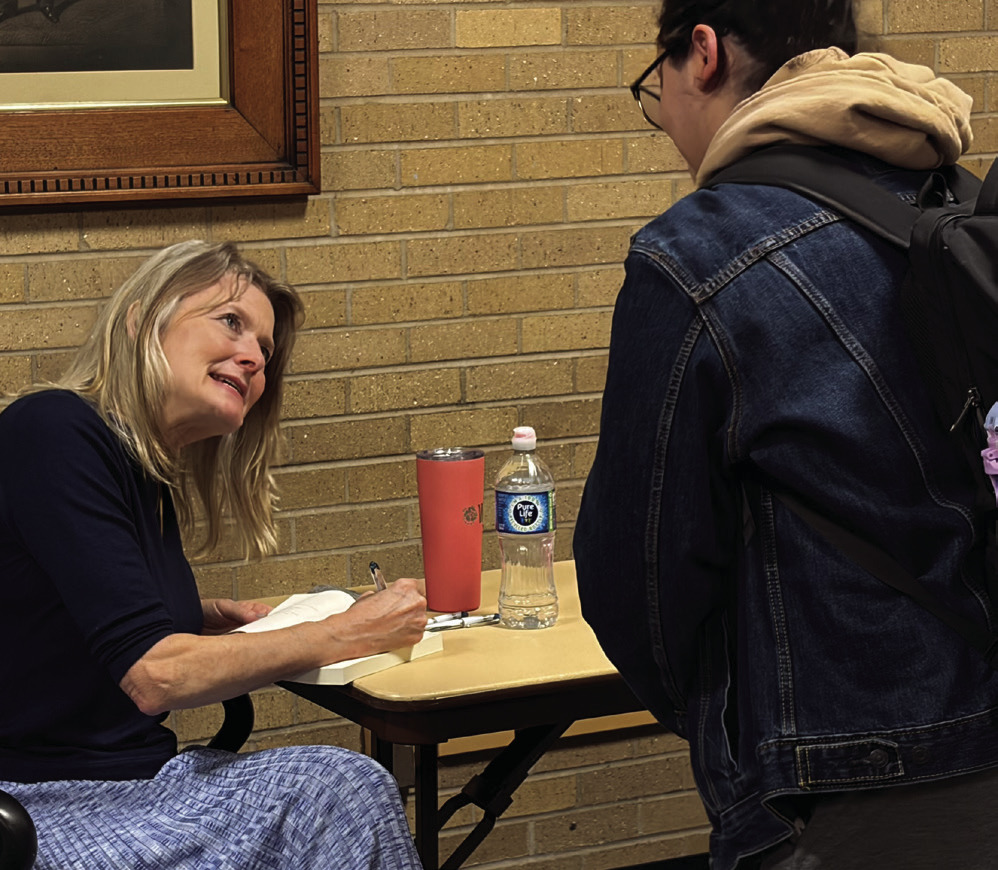
After the reading, Egan took an extended Q&A with questions from Lawhorn and then members of the audience. Highlights from the exchange include stories about Egan’s failed stint as an archeologist in Kampsville, Illinois and a discussion about how she does read her own book reviews, but not very carefully. She also went on at some length about the poetics of PowerPoint.
What I wanted to hear about was Egan’s journalism. In addition to her fiction, she has written several longform pieces reporting on difficult subjects. Addiction has featured heavily in her most recent work. “Children of the Opioid Epidemic” (2018) is about opioid-addicted pregnant women. “Off the Street: A Journey from Homelessness to a Room of One’s Own” (2023) is about several homeless people and the challenges of finding stable housing, but it most prominently features a woman named Jessica, a homeless woman whose troubles are compounded by her addiction to heroin.
Given how much Egan’s fiction focuses on the effects of time, I asked her whether she had ever followed up with the recovering addicts from her reporting to see if they’d relapsed. She told me that in fact she was working on a book about revisiting the people from her journalism, and that the results were mixed: all the mothers from “Children of the Opioid Epidemic” who she got back in contact with were clean and raising their children. Jessica, however, had relapsed and died last September. This was quite hard for Egan because in the course of reporting the story, she had grown quite close to Jessica and made personal efforts to help her.
“I want to save everyone, kind of, in life and in art. And that is a weakness,” Egan said. “It’s a weakness in art for sure.” She seemed to be still deciding whether it was a weakness in life as well.
One thing Egan won’t write is autobiography. She expressed that what attracts her to both fiction and journalism is learning new things about other people and the world, and she’s not able to get this from just writing about herself. “I am the opposite of the old writer’s maxim ‘write what you know.’ I am not interested in what I know. I already know it!” Egan said. “I don’t like writing about myself. I don’t like writing about people who remind me of myself.”
Perhaps this is for the best—generally, it’s not a good idea for surgeons to be cutting into themselves—but I can’t help but be a little disappointed that we’re never going to get a Goonsquad style memoir about Egan’s life and extended family history. If I can be indulged, I’d like to close by using some of the leftover research I did for this article to imagine some chapter headings for this never to be written book: 1: Life Bird
Macomb, 2026: Told from the perspective of Barbara Lawhorn, who has read everything Jennifer Egan ever wrote, identifying Killdeers and old foundation stones with her.
2: Nesting Haeger Pottery Girls Macomb, 1944: Told from the perspective of Kay, Jennifer Egan’s mother, when she was a little girl waiting for her father to come back home from the army.
3: 128K
Philadelphia, 1984: Told from the perspective of Steve Jobs, trying to impress his new girlfriend Jennifer Egan by installing one of the first ever Mac computers in her college dorm room.
4: Slideshow
New York City, 2008: Told from the perspective of a Knopf publisher growing increasingly uncomfortable with Jennifer Egan, who is trying to pitch a new book that includes a chapter which is just 76 PowerPoint slides (this chapter written in the form of 237 Bazooka Joe comics).
5: With a Few More Threats Tacked on For Good Measure Chicago, 1927: Told from the perspective of Graham Kernwein as a young man, who was a star college football halfback while getting his medical degree.
6: I Want to Study the Human Body San Francisco, 1972: Told from the perspective of Mr. Hinton, Jennifer Egan’s fifth grade teacher at Katherine Delmar Burke School, who has caught her passing notes.
7: Transcript of a Call from the Q—9/11/2001 New York, 2001: Told from the perspective of David Herskovits, Jennifer Egan’s husband, watching planes hit the twin towers from a Q train on the Manhattan bridge.
8: Save Everyone
to sign up today!
Brooklyn, 2023: Told from the perspective of Jessica, interviewing with Jennifer Egan in the new apartment they’ve put her in.
9: The Mass Media of Our Mother New York, 2011: Told from the perspective of Jennifer Egan’s two young sons, describing the experience of seeing their mother on TV.
10: San Francisco Jenny and the Little Piece of Clay That Might Have Been a Pot Kampsville, Illinois 1981: Told from the perspective of Jennifer Egan herself, regretting the money she’s paid to go on an archeological dig and dust for fragments in the humid summer heat.
11: Return
Macomb, 20XX: Told from the perspective of A.J. Rocca, surprised to find himself picking up Jennifer Egan from the train station again.
Take that last one as an open invitation: Jennifer Egan, you’re always welcome to come back to Macomb!
Stop into our office at 13 E Side Square Macomb or call 309421-0761