Before there was a town, before there were muddy streets and ramshackle cabins and saloons and churches and dry goods stores and mills and jails and miners, there was the river, Crooked Creek. And there were solitude-seeking men and women ever inching west, the original off-gridders. And then there was coal — “black gold.”
Hard to say who first discovered the seams buried deep below the prairie. But certainly the indigenous population and early explorers might have noticed the bands of black along the many gullies and washouts that fed the creek.
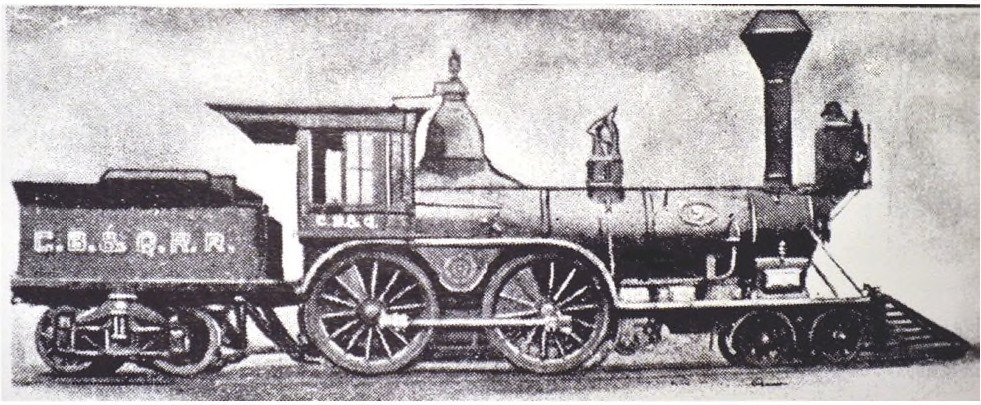
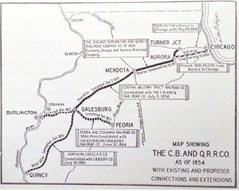
The Great Iron Horse Fact is, everything depended upon the railroad, upon the decision by the Northern Cross company not to construct a branch line through Middletown (Fandon), the mythic intersection of the stagecoach stop on the state road between Galesburg and Quincy and the midway point between Burlington and Beardstown.
Instead, railroad surveyors in the early 1850s looked five miles to the northwest, atop the southern ridge of the meandering Crooked Creek, where pioneer miners had begun chiseling out lumps of coal. Nature had already done some of the work by the millennia of the Creek’s meandering waters, obeying the laws of gravity and eating through the prairie.
Gordana Rezab in her fascinating collection of McDonough County place names, suggested that the railroad may have found the topography too steep in the Middleton area to construct a rail line from Quincy through Macomb to Galesburg. But then, there was that coal, very high quality coal. Where there is money to be made, there people will gather.
Yes, a few rugged pioneers in the early 1830s had turned logs into cabins along the crests of the creek. June Moon’s exhaustive history of Colchester Multum in Parvo (“Much in Little”) stated that oddly enough, most cabins were erected along streams near heavily forested areas. The open prairie, with its rich soil, was not considered viable during the harsh winters, too far from water and wood for fuel, as well as protection from the bitter weather.
In his collection of essays entitled McDonough County Heritage, noted area historian John Hallwas recorded that in the 1830s Tom Bacon built the first log cabin near a crooked creek two miles northeast of present day Colchester and may have constructed the first mill along its banks. Moon adds that this mill was considered one of the best in the country. Whenthe William Clayton family arrived in McDonough County in 1835, the father building the second cabin. He began digging coal out of the south side of the same Crooked Creek during the winter of 1835-36, hauling it to Macomb for 10 cents a bushel.
The first serious extraction, according to legend, was made by Mormons who transported coal to their Nauvoo settlement between 1840-1846. James Roberts is credited with the first large scale mining in 1853, expanding his operation due to the anticipated arrival of the rail line. However, the abundance of some of the highest quality coal in the state would be of little value without some means of transporting it to more populated and more industrial destinations.
Moon stated that until the railroad came, farm products and coal were hauled by wagons to points on the Illinois
and Mississippi Rivers. Supplies were received the same way.
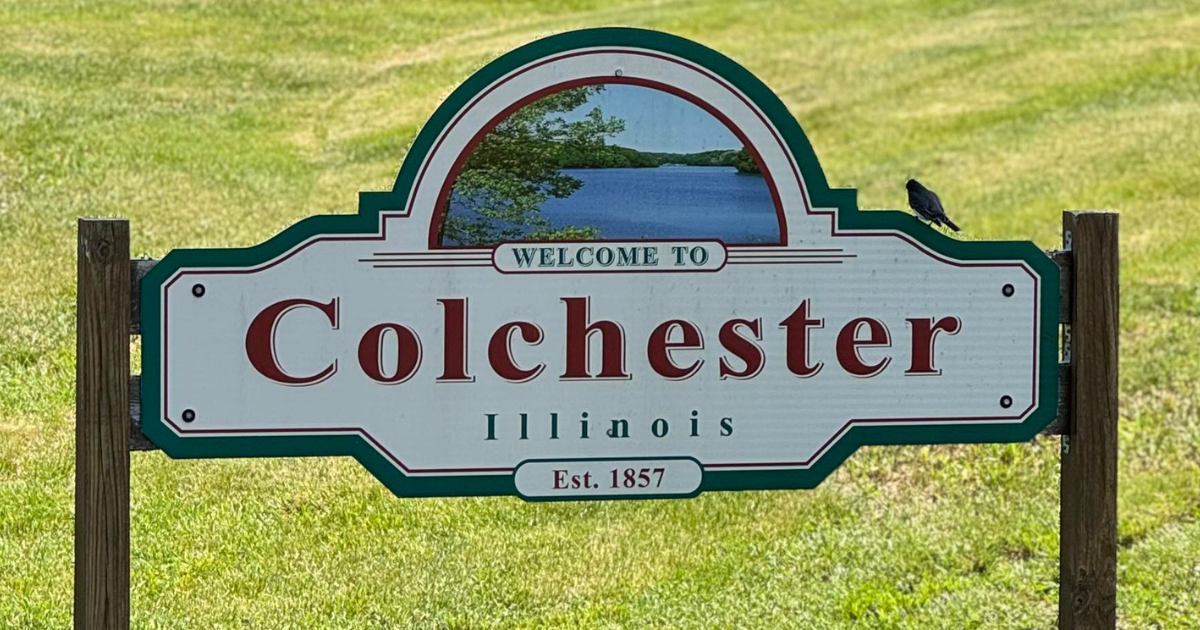
And with that arrival came a collection of unimaginably hard-working men and women to one particular spot along that rail line — 40º 25’ 32”N / 90° 47’ 32”W — later to be labeled on maps as Colchester.
According to Moon, not all of the settlers were enamored with the lure of the railroad (somewhat like the lure of large scale wind and solar farms or Amazon distribution centers). An election was held in McDonough County in 1851 to purchase $50,000 in stock for the first railroad line. It was scheduled for March, but proponents
thought it might fail for lack of promotion, so the vote was delayed until May 22, 1852. The results: 817 residents for, 644 against, not a particularly resounding endorsement. Another election was held August 20, 1853 with the proposal to buy $75,000 in shares rather than the original $50,000.
However, a year went by with no word of a railroad, prompting a number of scoffers. Yet people kept buying shares until the first locomotive appear in 1855, eventually connecting Quincy with Galesburg in 1856 and running through Macomb.

Giving the Town a Name As crews laid the Northern Cross rail line in the mid-1850s, Lewis H. Little, a landowner in northeast Tennessee Township thought a town ought to rise up along the tracks where coal was being dug from the surrounding earth.
The story goes that naming rights to the settlement went to Steven Chester, a railroad worker who surveyed the area, naming the town Chester after himself.
However, another town over in Randolph County already had that name. According to Moons history, for some unknown reason, Lewis Little tacked on the prefix “Col-.” Perhaps the choice was an awkward abbreviation of “coal.” Perhaps it was out of deference to Colchester, England, on the eastern shores of Great Britain, though, ironically, little if any coal has ever been mined from that area.
Back in 2013, our family toured Great Britain. Near the end of our travels at the city of York, I expressed disappointment in the tour not diverting to Colchester on our way back to London.
Our tour guide — Tom Hood, a native of Colchester, England — suggested that the name may have come from a nursery rhyme, the one about a famous, merry old king who called for his pipe, his bowl, and his fiddlers three — Ole King Cole. However, there is no record of any such King Cole ever existing.
Chalk this derivation up to whimsy more than history.
If you want the official word, The Daily Gazette/ Colchester Gazette newspaper in Colchester, England, posted that the city’s name evolved from the Latin Colonia Nictricensis, meaning “Colony of Victors.” The name was pronounced “Colneceaster” in Old English, meaning “fort of the river Colne” in which Colne is “river” and caester (caster) means “Roman fort.”
Incorportation Whatever the name, a settlement was platted in 1855.
In April of 1857, a public meeting was held in the emerging neighborhood to consider incorporating the town. Then in May of that year, a vote was put to the people with 58 voting for, 2 against with a final declaration with an ordinance on December 31, modeled on the City of Quincy charter.
But a strange twist of events nearly negated all this work. Moon, in her whimsical style, wrote about an unrelated court case involving the illegal sale of whiskey in Colchester.
However, the case was dismissed when the defendants lawyer asserted that the city of Colchester didn’t exist.
Apparently, town officials in 1857 made the mistake of assuming their vote to incorporate was sufficient when in fact they needed to apply to the state for an official charter. Moon says city officials tried to cover up their oversight, reapplied, and Colchester was then granted an official legal charter in 1867. Perhaps the famous Colchester centennial celebration in 1956 was built on a false premise.
Moon also shared another story that it’s not what you know, but who you know in determining the location of the City of Colchester. Though there is no historical record, a claim was made that the city was originally platted near Bean Burying Grounds, about two miles northeast of the present town, out near the first mill. However, coal baron James Roberts convinced the president of the Northern Cross Railroad that he could supply two train cars a day of top quality coal bound for Quincy; therefore, the train depot needed to be built near his operations. With this generous offer, the president agreed, and the town with its promised depot was settled.
Returning to the year 1855, Lewis Little laid out plots on his property but didn’t actively advertise them for sale. Nevertheless, the growing number of miners and workers in the area began buying them for $20 to $60 per lot. The History of McDonough County 1885 described those earlier settlers thusly: “As may be inferred, the class of citizens by which the town was settled was principally miners, hard working, intelligent men and women.”
Movement to Corporate Coal Once the rails were laid, coal mining operations expanded at a staggering rate. Unless otherwise noted, the information in this history was extracted from S.J. Clarke’s 1878 History of McDonough County Illinois, Its Cities, Towns, and Villages and the 1885 History of McDonough County Illinois publications.
Coal company partnerships went through several iterations until two companies emerged as the primary enterprises.
William Egerton established the Quincy Coal Company in 1856. Roughly 30 to 50 thousand bushel a month was mined, hauled to the rail line, with most of it shipped to Quincy. “The coal is all mined by shaft at a depth of about 70 feet, with two shafts in active operation, which furnishes employment to 50 or 60 men at an average of $2 a day for each miner.” Clark adds, “An industrious man it is said can make from $75 to $ 100 per month at the rate paid — 6 cents per bushels.”
As it grew, the Quincy Coal Company was largely owned by Boston, Mass., investors with a few Quincy businessmen involved.
Five additional shafts were sunk in the Colchester area averaging 85-90 feet in depth to the 30-inch seam of coal. “The seam is worked by men laying on their sides, swinging pick and sledge and wedge.” Coal was loaded into bed-size baskets and lifted to the surface.
From there, debris was cleaned (thus creating the piles of “tailings” scattered along Route 136 to the east and west of present day Colchester), and loaded into waiting train cars destined for Quincy. Anywhere from 12 to 24 railcars departed Colchester each day. According to Bureau of Labor statistics for that time, annual coal production was 71,718 tons.
The second big company was the Colchester Coal Company, which took a different approach to mining.
Rather than digging shafts, miners sliced sideways into the numerous ravines and gullies leading to Crooked Creek They dug about 20 feet into the banks to hit the
2-Vi foot thick coal seams.
From 1884-1892, miners extracted 98,421 tons of coal. The Company did have a shaft mine, at a depth of 80 feet, which produced 57,682 tons from 1881-1885.
A Fleeting Legacy The passage of 141 years since the publication of Clarke’s history is sadly ironic, given the problems associated with using fossil fuels as a viable source of energy and heat. After all, coal and oil are non-renewal, unless you want to sit around for 300 million years for decaying plants and dinosaurs to compress. For those of us who grew up with coal burning stoves in our kitchens and living rooms, the florid 19th Century prose from that volume, describing the wonders of Pluto’s domain, belies the reality of the present day: “Colchester has many advantages not possessed by other towns of the county.
The face of the earth not only yields its fruits to the work of the hands of her people, but the underworld is compelled to yield up her treasures, which go to enrich mankind and administer to the comforts of the race. Even should a drought occur, these people have a mine of wealth in their coal fields that cannot be effected by it. The demand for this product has never yet been less than supply; therefore while other places may feel from time to time the effect of a monetary crisis, Colchester does not suffer in comparison with them.”
With 2056, Colchester’s sesquicentennial, only 30 years away, and with not one whit of measurable coal being produced since the 1950s, one can only lament the promise of Colchester’s “abundance.” Nevertheless, historical events — coal and railroad and some political savvy — birthed one of McDonough County’s tiny communities — Colchester.