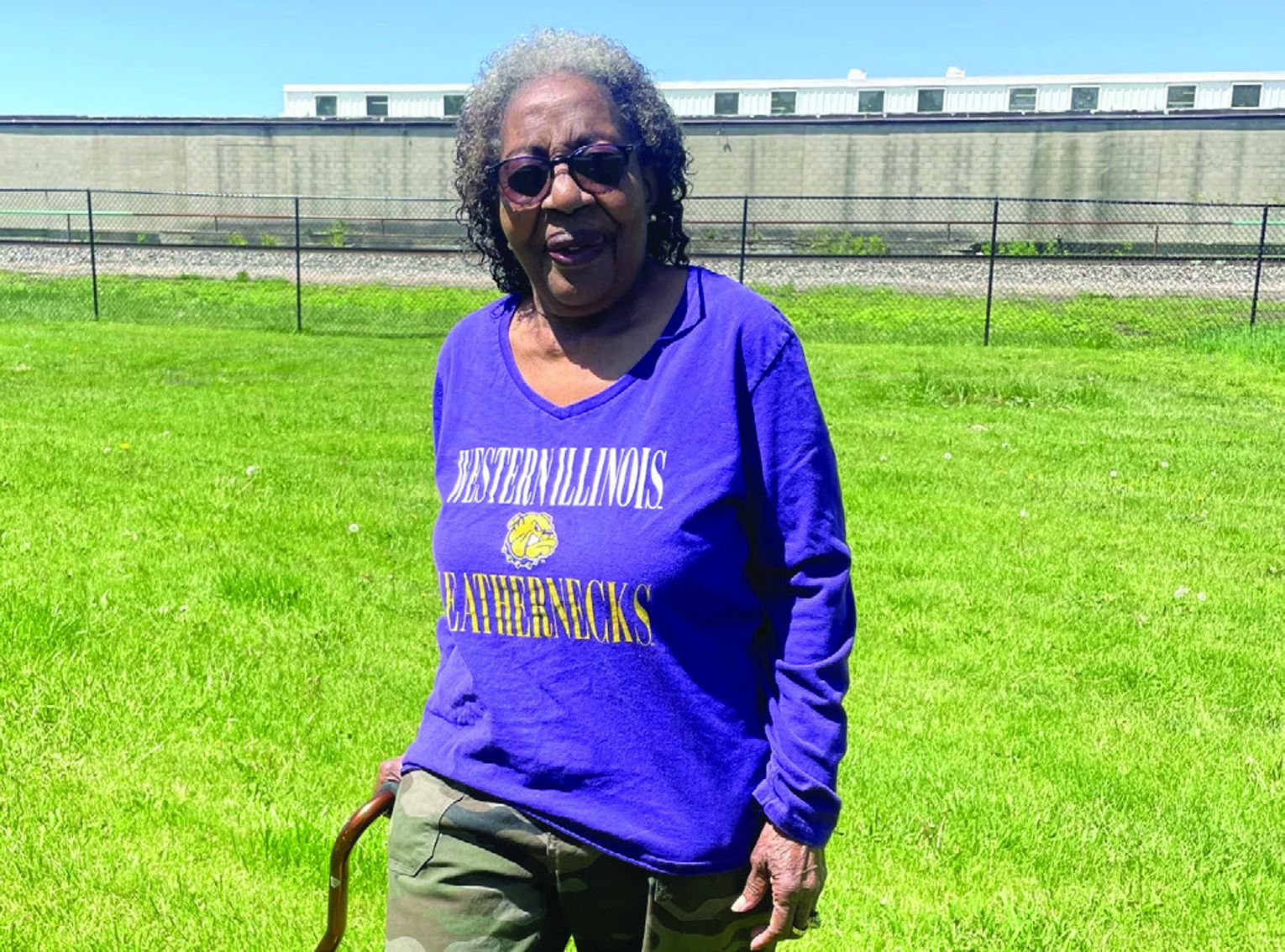
Celebrating Helen Thorpe – A Mover and a Shaker
February marks Black History Month, and as part of this month's celebration, the Community News Brief is focusing on Black women in the region who have made it their mission to serve their communities and make a difference, often in challenging times and sometimes being the 'first' at influencing change.
Helen Thorpe is one of the oldest original Black residents living in Macomb.
The Thorpes' Macomb legacy began in 1876 when patriarch Nathan Thorpe and his wife, Lutitia (also spelled Leititia in some records), moved to Macomb, joining the community's few other Black families calling Macomb home, such as Milford and Dica Daniels, who were the city's first Black residents, and the Coopers, Hustons and Sloans.
At 86, Thorpe might not get around like she used to, but the moves she made back in the day continue to resonate thanks to her perseverance and determination. Born and raised in Macomb, at the age of 19, she married William 'Bill' Thorpe, who became Macomb's first Black police officer, on June 29, 1958.
They celebrated their 61st wedding anniversary in June 2019, just a few months prior to Bill's passing. She had attended high school at the old Macomb High on Johnson Street; however, she had to leave school before graduating to help support her family. Eventually, after marrying and having and raising children – Gregg Huston, Pam Cole, Vanessa Huston and Bernice Thorpe – she returned to school to obtain her GED at Spoon River College when she was in her 30s. {Thorpe also raised two of her grandchildren, Shayne and Iesaha Thorpe}.
'I was blessed to go back later and get my GED. I went back and took classes at Spoon River, I just knew I needed to do that. I took the test when I thought I was ready, and when we were called into this man's office, another lady and I went into his office, and he said 'You passed' and I didn't think he was talking to me. I was just looking around,' Thorpe recalled with a laugh. 'He said 'I'm talking to you, you passed.' I didn't think I had because the first time I didn't. But this time I did!'
Creating Macomb's First NAACP Chapter It was that resolve that pushed Thorpe to 'push' the envelope of the times.
Thorpe, along with Leroy Daniels, worked to organize the first NAACP chapter in McDonough County.
'We organized the NAACP because Blacks in the community could not find gainful employment, they had a tough time getting loans from local banks and they were dealing with red lining. If you could afford a house, whites wanted to dictate where you buy and usually that was designated only in the east end of town,' she pointed out. 'Furthermore, the city government at that time did not put any tax money into improving the quality of life for the residents living in the northeast section of Macomb, known as the East End.'
When starting the Macomb chapter, Thorpe shared that in some ways it was hard getting buy-in, especially from older Black residents, but there were many more who said 'Yes.'
'People were wanting something, but no one wanted to be the first. I think I was vocal back then and no one wanted to go and do it, so I did it. With the NAACP, you have to have so many members to have a chapter,' she said. 'We went around and we just asked the Black residents of Macomb about joining and you took some of the old timers who thought we should leave it alone because we'd just 'stir up trouble.' But a lot of people said they couldn't get good jobs and more, so they signed up.' In 1978, during her time as NAACP president, Thorpe was awarded a federal CETA (Comprehensive Employment and Training Act) Grant, which employed 15 local Macomb and Bushnell residents. The purpose of the grant was to provide work and training programs for low-income and unemployed individuals living in urban and rural areas, so Thorpe and Daniels surveyed McDonough County residents gathering information about employment, lifestyles, family composition and primarily looking at poverty issues in Macomb.
Thorpe also co-founded the group, Concerned Citizens, with the late Essie Rutledge. The group, which was composed of Black and white Macomb residents, fought for social justice and addressed mistreatment by the police, inequalities in the court system and more.
A Sit-in at Sherman Hall
About 10 years before the move to establish Macomb's first NAACP chapter, Thorpe was already making what the late U.S.
Congressman and Civil Rights leader John Lewis referred to as 'good trouble.' Between 1966-1967, Thorpe and Daniels organized a sit-in at Western Illinois University's Sherman Hall, on the second floor outside of the personnel office, to protest the fact that Blacks could not get a job at the university.
Following the sit-in, the first Black person hired as a janitor was George Smith.
'It was a sit-in, but it wasn't like it was well-known. Leroy asked me about trying to get a job at Western and I told him I wasn't going to be able to get a job out there. There were several of us who did want to work out there to earn more money, so we sat outside of the personnel office, which was led by a man by the name of Ray Nissan at the time.
We sat by his door for a few hours every day for a few weeks. He was embarrassed and didn't want it out, so eventually he let us take a test for the job,' Thorpe said. 'But the tests he gave us at first were ridiculous. Somebody made these intentionally hard to keep us out. People can be pretty ornery and if they want to keep you out, they will try.'
Thorpe eventually was also hired as a janitor, working overnights, at Western.
Before joining the institution, she worked as a housekeeper in the early 1960s for several prominent Macomb families, and also worked at the St. Francis Hospital in the laundry room. She cleaned rooms at The Lamoine Hotel, and worked at the Porcelain Factory on Pierce Street, as well as Haegar Pottery.
'I was hired at WIU after the sit-in protest. I worked in janitorial for four years and was hired a year or two after George Smith. They didn't hire us all at once! Women did light work, such as dusting, but you had to be strong to stand some of the people because it was their little haven and there was an attitude about us being there,' she pointed out. 'You could tell we were not wanted or welcomed by a lot of the old timers there.
There were other white people who were hired when we were, and they were friendly because they were new. I did meet some nice people, and like anything else, the longer it goes, the better it gets. Especially when they realize you're not a threat like they thought you were.'
Thorpe eventually left Western when NTN Bower opened, and worked there just short of a year, before going to work for the Macomb School District's food service, and then it was on to serving lunches on Western's campus in the old Lab School. She soon found herself back in Western's janitorial department, where she stayed until her 2007 retirement.
The Wife of Macomb's First Black Officer Despite the abolition of slavery, Bill, even after being hired as the city's and county's first Black police officer in 1962, faced segregation, prejudice and violence. After several years on the force, he was promoted to sergeant, which was a rare occurrence for predominantly white police departments.
When he was first hired, he was assigned only menial tasks and couldn't take his service revolver home following his shift, unlike his white counterparts. Bill retired from the Macomb Police Department in 1984, after 23 years of service. After retiring, he attended and graduated from barber college in Peoria and then began working at WIU in the Physical Plant, where he became a supervisor. After 13 years at WIU, he retired and became a bus driver for Go West. A new park on Macomb's northeast side has been established and named in his honor, which she said is one of her proudest moments.
'I was proud when Bill got hired with the Macomb Police Department, but that did not last long. We started receiving threatening phone calls, name calling over the phone, threats to beat Bill and his family up,' she shared. 'Whoever was making the calls was a coward. They never approached me in person. Although I was afraid, I did not let it hold me back. I started working with Leroy Daniels and others to combat racism in Macomb. The rest is history. As time went on, things started to get better.'
Thorpe thinks it was that pushback on her husband's hiring with the police department that made her loud.
'That was my push to get out there to make a difference,' she added. 'He went through a lot, but he always remained calm.
A lot of the men didn't want to work with him and they kept him on midnight shifts forever so people could 'get used to him.' But people really responded to him. I had a city attorney tell me that people really loved Bill and he was magical in the way he could talk a crowd down.'
Macomb: Social Justice, Equity & Racism 'I have lived in Macomb all my life. Things have gotten better, but racism is still alive and well in Macomb. For a time, people were more sophisticated or covert in their racist actions, but now under the current administration, people feel more entitled and freer to make racist comments and exhibit behaviors they would not have done in previous years,' she noted. 'For example, individuals who want to discount the early history of slaves in the United States. Whites owned slaves in the United States for over 246 years and now there's the conversation that it did not exist or it wasn’t like it is portrayed in history books. The glass ceiling has not gone away for Blacks. We are still challenged and demeaned on every front. No matter how much education or status Blacks attain, they will always have to prove their worth.'
Thorpe added that things will get better 'in a way' and in a way they won't. As she put it, in all races, there are good and bad, and with the bad, some won't change for anything. They'll use racist language and hate speech and they'll continue thinking others are beneath them. But, Thorpe said, some people will continue to progress in their thinking.
'I used to work with a man on the evening shift at the university. We'd talk, we'd share food. We got along well. One night, we were talking and race came up. He said to my face he wouldn't want to live next door to a Black person. I just looked at him and told him basically he opened my eyes as to how he really felt,' she remembered. 'I think he forgot he was talking to a Black person.'
In addition to the national divide and more overt racism, Thorpe also feels the judicial system is still unfairly skewed, in which a white person who commits the same crime as Black person is typically treated in a much different fashion from what she sees and reads in the news.
'You can disfigure someone and kill them, and if you're white (speaking of a recent case that made headlines), you just let the white person go. If that was a Black person, they'd be locked up,' she added.
Editor's Note: We also discussed the recent sentencing of the former Sangamon County deputy who murdered Sonja Massey in her Springfield home. Massey's shooting death, and the limited sentence handed down to the deputy, was especially painful for Helen as Sonya's grandparents and family were good friends with Bill and Helen.
Final Thoughts
I think we are all put here for a purpose.
There are some things I'd rearrange, but I would do the same things because I believe in helping people,' Thorpe concluded. 'I'm not an angel, but I believe that’s what we’re here for. Everyone needs somebody and I feel like I'm one of the chosen ones. '