Editor’s Note: The Community News Brief has been covering the various aspects of community solar farms, going solar and more. This is the final story in the three-part series.
Jerry Brookhart was 'sustainably fashionable' before 'sustainable' was even part of the mainstream, and now 40-plus years later, the Macomb man continues to do his small part to help save the planet for future generations.
Brookhart's foray into solar and sustainability started in the 1970s when he was living in Colorado with his family. His children had erector sets that used the power of the sun to drive the toys, and his neighbor just happened to be the CEO of SolarX, which later got bought by Amoco Oil in the 1990s.
'When Amoco bought SolarX, I realized that oil companies were in more than just the oil business, they were in the energy business so they could control the cost of energy – oil, wind, solar, so my interest in solar and other forms of natural energy go way back,' he said.
In the 80s, while still living in Colorado, he installed a domestic hot water system on his garage roof to heat hot water for home use. And now all these years later, about three years ago, he installed a solar system at his Macomb home to generate electricity for home use, including powering the geothermal system to heat and cool the house. He is also leasing part of his land for the Ember Sun Solar Field. Besides being environmentally friendly, there are also numerous tax incentives in place for homeowners and landowners to 'go solar.'
'When I started looking into this a few years ago, the federal government had tax credits, plus there was an additional financial incentive from the state of Illinois that made installing solar panels financially attractive. And in McDonough County, you could get an additional 10 percent tax credit because this county has had mining operations,' he explained. 'We wanted to get in on this while the tax credits were still available. With the tax incentives, the payback on our system was about three years.'
Brookhart had been approached by a few solar companies who were looking to lease land in McDonough County. He ended up going with Nexamp, and the company is leasing approximately 20 acres on his property northwest of Macomb on what would be classified as class B farm ground. Nexamp has started construction on the community solar farm, which should be operational this spring, he said.
'One of the things I negotiated with Nexamp was to have pollinator plantings within the solar farm,” he added. 'I already have 16 acres of planted pollinator plots because I'm a firm believer in the importance of bees, butterflies and wildlife, so I really wanted that as part of our contract.'
In addition, he signed up with the USDA Conservation Reserve Program to convert the edges of tillable land next to the woods into pollinator plots. Because it actually costs money for the farm operator to plant seed in the transition area between farm fields and timber, his lessees agreed. Brookhart is also a member of the Macomb Noon Rotary Club, of which its parent organization, Rotary International, has a sustainability program including pollinator plots.
'I'm taking an acre next to my solar farm and turning it into a pollinator plot,” Brookhart shared. “We're going to have a Rotary sign there explaining pollination so school kids can come out and see the plots and learn about pollinators 'I guess you could say I've been environmentally conscious for more than 40 years. I was ahead of my time,' he said with a laugh. 'My University of Illinois degree is in agriculture, so I am attempting to prepare the family farm for future generations. That is why I have a lot of interest in preserving wildlife and being as sustainable as I can be.'
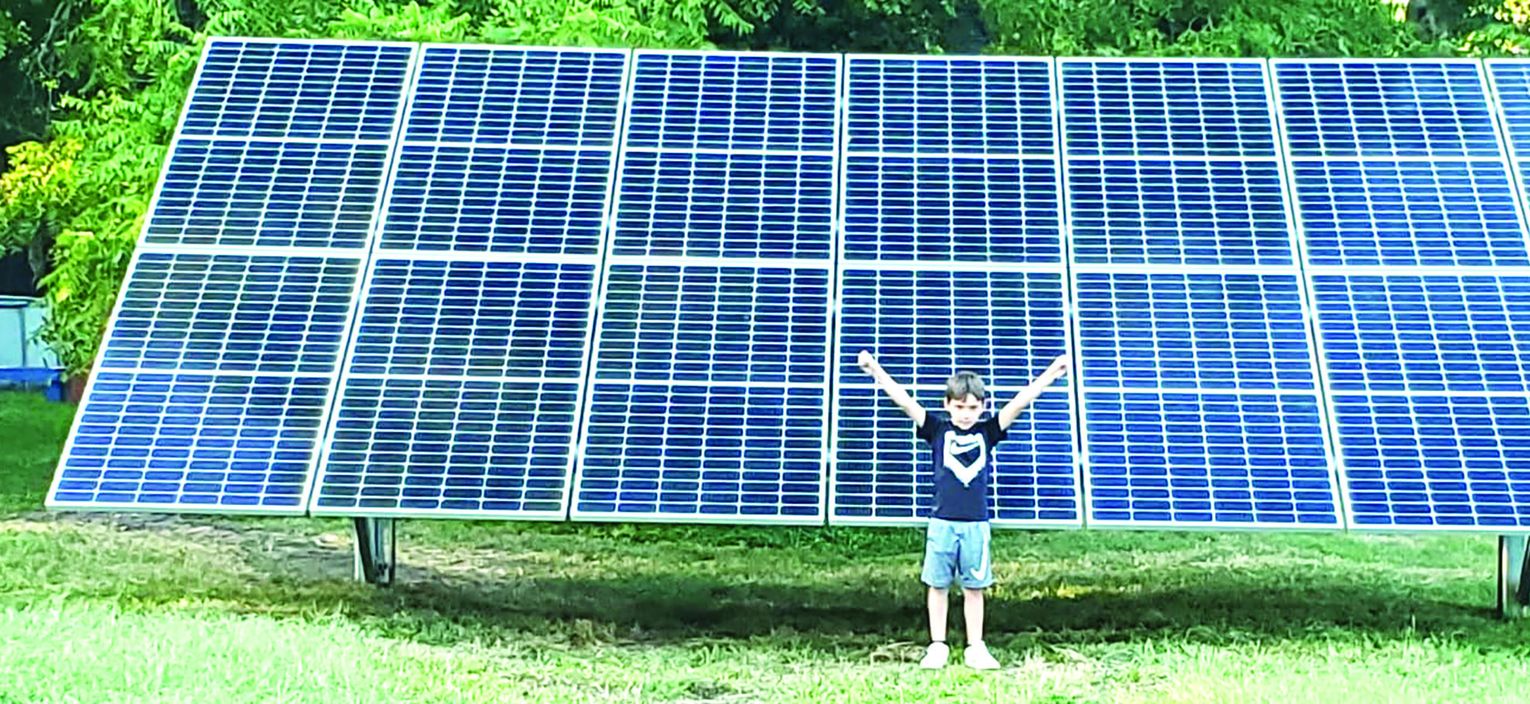
Going Solar in the Middle of Town In September 2022, Kimberly and Kirk Hare installed their first solar array in their expansive backyard just off of Piper Street. Shortly after 'going solar,' the longtime Macomb couple added a sunroom and a heated two-car garage, so just last year, in November they expanded their original solar array to offset the additional power to the additions. Their extra deep back yard, which is the result of a once-planned street that never came to fruition, allowed them to easily install solar panels on their back lot.
'Not only do we get the benefits of solar, we get to share this with a herd of deer who enjoy laying under the panels for shade in the summer,' Kimberly said.
A friend recommended StraightUp Solar when the Hares were doing their research, and that is the company they ultimately hired to install their array. According to Kimberly, they were easy to work with and spelled things out for 'solar rookies.' StraightUp also provides its customers with an app to track how much energy each individual panel produces.
'Our power meter actually turns backwards on sunny days,' she exclaimed. 'But the best part of this, to date, our original array environmental benefit is equal to offsetting what a car produces in emissions when driven 53, 216 miles or 46,886 pounds of CO2 emissions.'
To get started, StraightUp took a look at the Hares recent power bills and determined how big their array needed to be. They also looked at the possible locations to place the panels using satellite images of the property, which need to be offset from the property line and should not be obstructed by trees.
'After all this, they wrote a proposal and included the rebates and how much we'd save monthly and after 20 years,' she explained. 'It is an investment, but we don’t plan to leave this house. We enjoy the monthly savings and our overall total will continue to grow every year.'
There's no maintenance on the part of the Hares except keeping them clear.
'That isn't a problem once we established with our grandson that 'NO, he could not climb up them,' she laughed.
While Kimberly said they got a scant amount of negative impact when she posted a photo of their newest venture in 2022, overall, the feedback has been positive.
'Working with children everyday (the Hares own and operate Catch a Star in Macomb) and having grandchildren, then I am concerned about the planet we are leaving them,' she concluded.
Because of how pleased they were with the panels at their home, they also installed solar panels on the roof of Catch A Star Learning Center in October 2023.
Businesses and Organizations Going Solar A few years ago, in yet another move toward environmental sustainability, while helping area residents and visitors get their share of Vitamin D, the Macomb Park District installed two solar powered charging tables in Citizens Park. The two tables, which feature wireless device charging stations powered by the sun, were installed in Citizens Park to give individuals working downtown, as well as those out for a stroll, a place to sit and work, while enjoying the outdoor space.
According to Park District Executive Director Blake Severs, community members regularly use them to charge phones, enjoy seating and benefit from the added lighting in the evening hours. In addition, this district installed three solar panel arrays in Everly Park by the main office; at Lakeview Nature Center; and at Ball Fore.
'Across these locations, we have 54 large-array microinverters and 34 small-array microinverters. The systems were brought online in February 2025, and since installation, they have produced 59 megawatt-hours of energy for the Park District,' Severs explained. 'That production is equivalent to preventing approximately 42 tons of CO₂ emissions, or the environmental benefit of planting nearly 700 trees.
These solar investments are helping reduce operational costs while, more importantly, lowering our environmental impact and advancing sustainability within our community.'
In 2024, the YMCA of McDonough County received a grant from Illinois Solar for All to install solar panels on the roof of the Macomb building, with StraightUp Solar installing 564 panels. According to Executive Director Nick Knowles, the solar energy harnessed will cover approximately 62 percent of the facility's electricity, or in technical terms, 520,937 kWh.
The Illinois Solar for All Program provides equitable access to the solar economy through incentives to low-income and environmental justice communities. The StraightUp Legacy Fund provides maintenance and insurance during the term of the Power Purchase Agreement (PPA), which allows non-profit entities to go solar without capital investment. The system is installed on-site and electricity is then sold back to the on-site host (the YMCA) at a price that's less than the current energy rate, Knowles explained. When the PPA term is complete, the Y will take over the ownership of the system.
In the first year of the program, the YMCA of McDonough County saved $20,579 in electric costs.
Landowners & Opposition
In late 2022, local business and land owner Johnnie McKee got his first postcard inquiry from a solar company asking if he was interested in leasing his land, which is located just southwest of Macomb. After some research and thought, he decided to lease 37 acres of what he calls 'C-' (relative to the region) tillable land to Pivot Solar. The lease went into effect last month.
'This was an investment opportunity for me. We purchased the ground in 2021 to farm it, and we did make several improvements to continue to farm it, and then we were approached to lease out 40 percent of the 100 acres for solar,' he explained. 'Because the ground itself is not A+ farm ground, we decided to go with a solar company.'
While there has been opposition from neighbors who reside near the community solar farm, McKee said the company has been 'extremely accommodating.'
'They've gone the extra mile and have gone to a lot of extra expense to put up more fencing and make other concessions to help appease the neighbors,' McKee added.
Kathy Chenoweth is one of those neighbors who has been opposed to the project since it was announced. In her opinion, like that of her neighbors, is that the company hasn't done enough.
'I know it says a 10-foot fence around the property, but we're still going to be able to hear it,' she said. 'And I don't feel like the city listened. Their minds were made up before we even got in there. When we sell our property, we're not going to get much out of it because no one wants to live by a solar farm. We moved to the country for peace and quiet and now we won't have it.'
In a previous story in the series, Macomb Mayor Mike Inman explained that ordinances do exist to protect property owners, and the city has regulatory authority and zoning processes in place for solar companies that wish to build within city and county limits. Without these in place, the solar farm business would be a 'free for all,' without many stipulations, Inman pointed out. Solar companies must apply for a permit, and then follow all setbacks, fencing and other ordinances that are in place. They must also follow the city's unified development code, which oversees construction.
'While opponents want us to say 'no,' it's really a rules-based discussion. The company must follow the zoning and other ordinances in place, which includes adhering to our setback policies and more. If they do, the project most likely can move forward,' explained City Administrator Scott Coker. 'We've found that in all of the dealings we've had with the solar companies, the developers have been more than accommodating and often will go above and beyond the requirements.'