Celebrating Dr. Essie Manuel Rutledge: Noted Sociologist & Pioneer in African American Studies, Women's Rights, Equity & Social Justice
As we celebrate Black History Month, much is known about pioneering Black men who hailed from Macomb/McDonough County and contributed to not only the community, region and state, but often, to the nation at large as well.
Such men as escaped slave James Field who settled in Macomb and opened a barbershop and a church; jazz legend Al Sears; Civil Rights icon the Rev. Dr. C.T. Vivian, and the county's first Black police officer Bill Thorpe, each who made their mark.
However, little can be found about the Black women who blazed trails during the early days of McDonough County. Coming before – and after them - were also some Black women who made their mark and paved the way for those who came after them.
Inquiries to local archives and records haven't turned up information as more men were documented than women, which was typical of the times. During Black History Month, we'll pay tribute to three women we know of who made great strides in equality and social justice.
If you know of other Black females from days gone by that we can feature, please email [email protected].
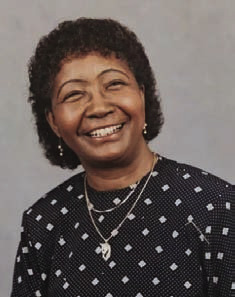
In June of 2025, Macomb, the region and the nation lost a notable trailblazer: Western Illinois University Sociology Professor Emerita Dr. Essie Manuel Rutledge, who had made Macomb, Illinois her home for over four decades. Rutledge paved the way for Black students, faculty and staff at WIU, in her community and beyond, and she shattered countless glass ceilings, upheld workers' rights and committed her life and work to social justice and equity.
Rutledge joined WIU's faculty in 1976 when she was named the first Black female chair of the African American Studies Department (and was the first Black woman to serve as chair at WIU). She later joined the sociology and anthropology department in 1985, where she taught until her retirement in 2006. Before arriving at Western, she was an assistant professor of sociology at the University of Michigan-Flint, and was a National Teacher Fellow/Assistant Professor of Social Sciences at Macomb County Community College, Warren, MI. Earlier in her career, Rutledge was an instructor of social sciences at Gibbs Junior College and at St. Petersburg (FL) Junior College. She began her career as a social studies teacher at Sixteenth Street Junior High School in St. Petersburg.
She began her educational journey as a student at Florida A&M University, obtaining a Bachelor of Arts Degree in Sociology in 1958, and later attended the University of Wisconsin, completing a Master of Arts Degree in Sociology in 1965.
Rutledge was the first Black woman to earn a Doctor of Philosophy Degree (Ph.D.) in Sociology from the University of Michigan in 1974.
She was also certified as a specialist in aging by North Texas State University Center for Studies in Aging in 1986.
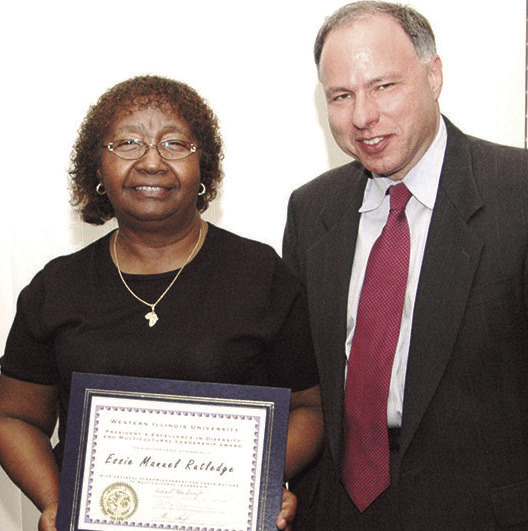
Just prior to her retirement, Rutledge received the University's 2006 Affirmative Action Director's Award, which recognized campuswide leadership reflecting the spirit of the University diversity efforts.
In 2019, Rutledge was honored by the Macomb Feminist Network with that year's Writing Women into History Award for her 'advocacy for equity through her mentoring of individuals on and off campus, and through her participation in multiple organizations, including the Macomb Equal Opportunity and Fair Housing Commission, the Lions Club, the NAACP and the Western Illinois Regional Council.'
In addition to chairing the African American Studies department, Rutledge also facilitated the creation of WIU's Women's Center and served on its advisory board. She was also a longtime member of UPI, WIU's faculty union, noting that women and people of color were often disadvantaged in salary and promotion negotiations; however, she was committed to the needs of all University personnel, according to the 2019 award nomination.
While she made her home in Macomb for many of her years, Rutledge was well-known throughout the United States for her work in sociology, Black women and the family, aging and social psychology. She was the recipient of the Albert Nelson Marquis Lifetime Achievement Award by Marquis Who's Who.
Throughout her career, Rutledge had been recognized for her many professional and civic contributions, and in the community, she was the first recipient of a new award established by the McDonough County Democrat Coalition and Democratic Party, the 'Essie Manuel Rutledge Humanitarian Spotlight Award for Social Justice in Action' (named in her honor). She had also served as president of the Lions Club.
Well into her 80s, Rutledge was an active member of social justice organizations, and would show up for protests, rallies and events to advocate for social justice, equity and ending racism.
In 2007, one year after her retirement, Rutledge completed an 'Across the Miles' television interview, produced by University Television (UTV) with former WIU Alumni Programs Director Gordy Taylor. In that interview, she talked at length about her life and storied career and some of the challenges she faced along the way.
'I grew up in the segregated South. One of the stories I usually tell is about the segregated water fountains. We would go to department stores and the water fountains would be side-by-side, one would read white and the other would read colored. We, being mischievous children, would drink out of the white fountain. We wanted to see if the water tasted differently,' she shared. 'All of the dressing rooms and department stores were segregated, service stations were segregated, schools were segregated. It was the law of the land.'
Rutledge told Taylor when growing up she was very aware that they were treated differently because they were Black. Her mother was a great proponent of education, and while the money wasn't there to send children to college, the family matriarch still instilled in her children that it was important that they were educated.
'Education when I grew up in the Black community was seen somewhat as the panacea to success. We did not feel that without education we would be able to achieve too much in this society,' she explained. 'And I felt that there was hope that I could be successful and because there were many role models in the Black community. There were doctors, lawyers, teachers and one of the things about segregated education is that we had teachers who were very committed to teaching us and preparing us for the segregated society that we had to live in.'
It was a teacher in fact that helped Rutledge get to college. Her Spanish teacher found out she wasn't able to go directly to college after high school, and he took it upon himself to call someone he knew with the Board of Control, which was the educational arm of the State of Florida, where Rutledge and her family lived. He stressed that Rutledge had to get into college and needed a scholarship. That call got her into Florida A&M on a work scholarship. However, before attending college, Rutledge worked as a chambermaid in a motel, which she said was an eye-opener.
'I decided from that experience I had to get a college education because I did not plan for the rest of my life to clean up behind the tourists who came to the beaches during the summer,' she said.
It was when she was in Ann Arbor, Michigan getting her Ph.D. that she met Chester Rutledge, who would later become her husband. The couple eventually made their way to Macomb when she was recruited as a professor for Western's African American Studies (AAS) program, where she stayed for a few years before transferring to the sociology department after AAS was eliminated. She did return for a stint as the interim director of the AAS program when it was resurrected in the early 1990s.
Along with speaking of her career trajectory and how she got to where she was thanks to the educational opportunities she had, Rutledge also pointed out in the interview that, especially in her early years, she had to 'work herself up by the bootstraps.'
'I was raised in poverty. I always had a meal in front of me, but I'll tell you what, I'll never eat another darn casserole as long as I live. I mean, my parents had extra jobs. They were going to foreclose on our house every week. It was a horrible, horrible financial existence that I grew up in. It was terrible,' she shared in that interview. 'However, having said that, I was the recipient of an absolutely stellar education K through 12. We had the labs, we had music, we had art, we had everything that anybody could want. And that was because I was raised in a Caucasian community and all those things were there for me that aren't for the young man or woman maybe who's in the inner city in Chicago or in East St. Louis. While I didn't have much growing up, I did have the opportunity that so many other minority children didn't have.
'What I have worked toward all my life is to be an advocate for social justice and equality,' she concluded. 'I would always want to be remembered for being a proponent of social justice and for being a person of integrity.'