Back in the fall of 2024, I wrote a four-part series on the history of Marietta.
While at first I was skeptical on how much information I would find and to what depths I would have to look to find it, those doubts were soon extinguished.
I drove to Marietta, more than once, and met up with Mary Virag, a vibrant, energetic gal who not only had books and pictures to loan me, she had a fourwheeler gassed up and ready to go. She wasn't going to tell me about Marietta and its hidden gems, she was going to show me. Every village or small town needs a Mary Virag. She grew up near Marietta, knows the bones of the land, has studied the history, attended the sales and auctions and to put it quite plainly, she loves it there. She is Marietta's gatekeeper when it comes to preserving the rich history of this tiny town that was once traveled by Indians and boasted a thriving stone quarry, from where many of the foundations of farm barns still stand.
One might imagine Mary to be an older, gray-haired senior who had lived in Marietta for many decades during which she collected the history of the area. But Mary is not a senior … Mary Virag is an energetic, vibrant middle-aged mom and wife who just happens to have a passion for her community. She knows volumes of information about Marietta, which is why I say it's a shame that every little village doesn't have a historian as passionate as Mary Virag.
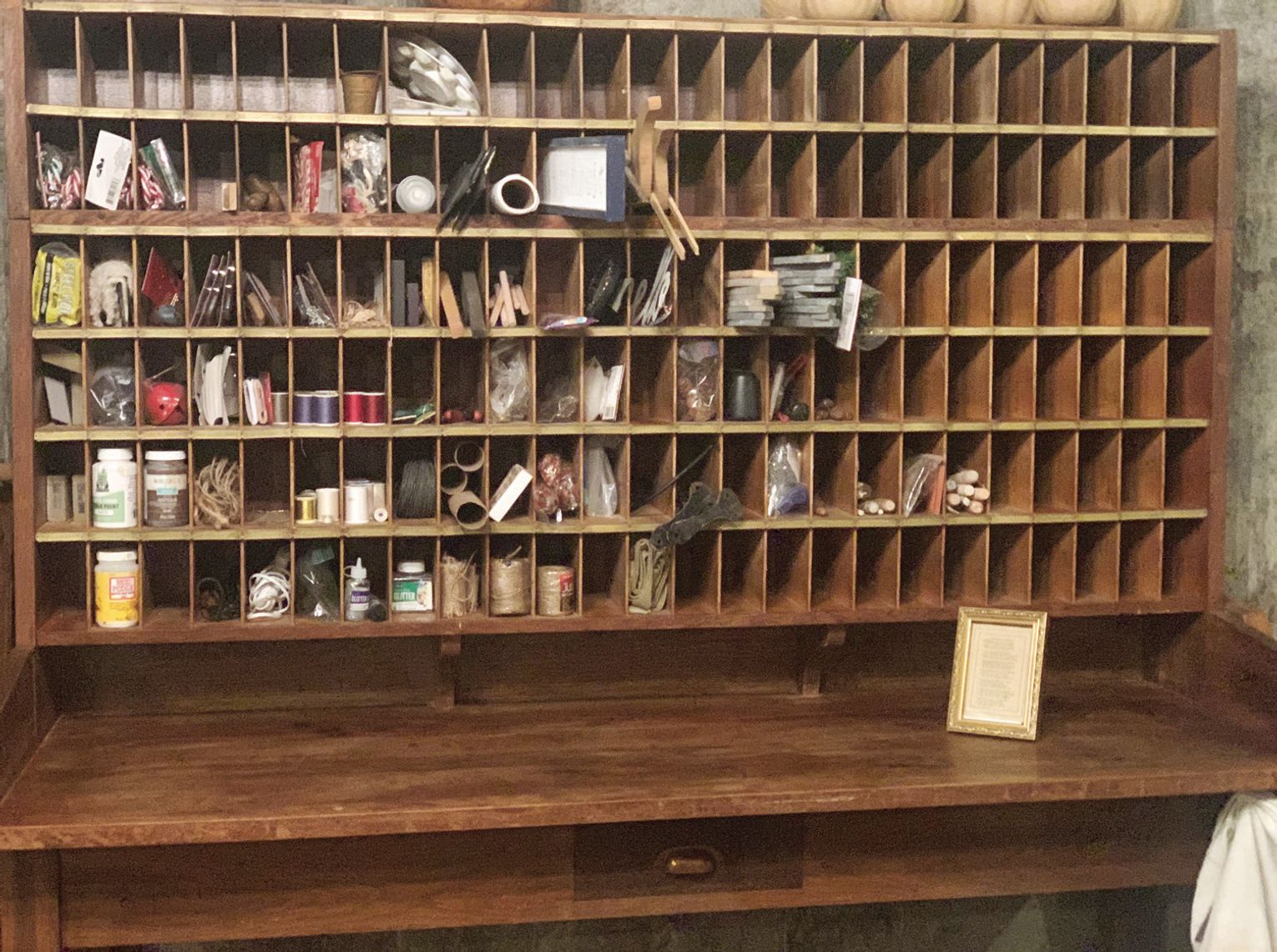
Which brings me to Mary's most fascinating desk.
In between four-wheeler excursions through the woods of Marietta and amongst the ghost towns of such places as Seville, Leaman, Fuller's Mill and Vanopolis, Mary told me she wanted me to see something in the basement of the beautiful, rustic country home Mary shares with her husband, Tony Ackers. Something that was obviously very special to her. Here is the story of the long and curious journey of Mary Virag's Postmaster's Desk.
In Mary Virag's own words...
'The Postmaster's Desk' 'It started with my love of the history of my little village, Marietta, Illinois.
When I found out that a piece of the village's history was being sold at Auction, it was on my birthday (January 23). I was all in to get a few items to keep in the area. It was a long day and yes, I mean a long day. The auction consisted of random items from various buildings around Marietta, and the money raised would go to the benefit of the village of Marietta.
The desk was the very last thing to sell, and I was determined to get it. I did get the desk, once again finding myself a steward to a valuable piece of Marietta's history.
The desk is made of walnut and oak and weighs about 200-250 pounds.
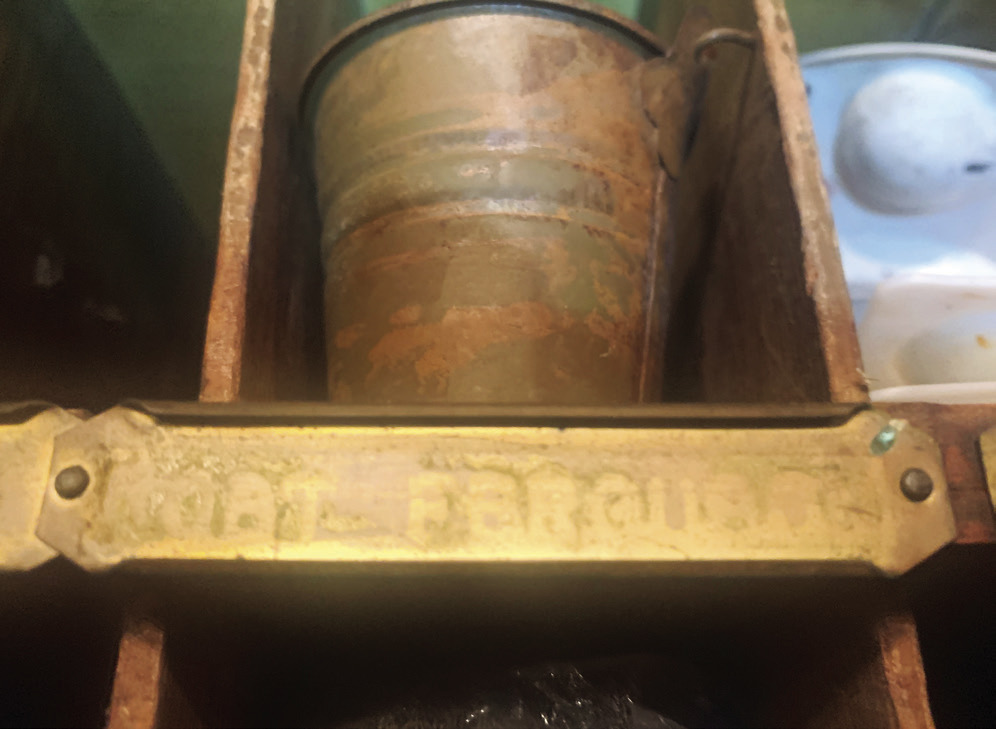
Fortunately, it can be broken down into two pieces {Mary's husband says he will never move it up or down a flight of stairs again}. Each cubby hole for sorting mail had a brass marker and on the lower right side of the desk was a hook that the postmaster could hang the mail bag on.'
Here is where the interesting journey of Mary Virag's desk begins. The desk came from New Britain, CT, circa 1831 or 1837. The bottom of the desk is stamped 516-B Carriers Bounting case and table, property of the Post Office Department from Corbin Cabinet and Lock Company, New Britain, Connecticut, 1831-1837.
The desk was destined for a tiny post office in central Illinois called Vanopolis, which was referred to as a 'paper town,” a town that was drawn out on paper, but in reality did not actually exist.
No paper town was cast in a more beautiful and picturesque setting than Vanopolis. Just below Seville, the Spoon River makes a bend and in this site, selected by William H. Van Epps, the town was platted in 1840.
There were great hopes for Vanopolis because it was highly anticipated that it would be on the railroad that was planned to connect Peoria, Canton and Quincy.
The postmaster's desk was taken from Connecticut to the Vanopolis post office, but neither Mary nor I can document who that first postmaster may have been. It was likely brought to the Marietta area by horse and wagon.
Unfortunately, the railroad did not get built for another 30 years. Not only that, the route went to Warsaw, not Quincy.
As a result, Vanopolis was vacated and only Fuller's Mill remained. The Marietta Post Office that had been relocated to Vanopolis (1840) was moved back to the Village of Marietta, and along with that move went the beautiful walnut and oak postmaster desk.
Mary Virag in her words:
“The desk was moved back to Marietta into the old post office. Some of the names still visible near the brass tabs include familiar Fulton County families.
Names like Havens, Fergusons, Strode, Spangler, Ridle and Graves. One can only imagine the postmaster sorting the mail into the cubby holes in the mid-1800's.'
For the first settlers in Harris Township, the most accessible post office was St.
Louis. Any mail reaching St. Louis would await the arrival of someone who came by flat boat to purchase supplies. He would then return with all the letters for the community.
Probably the first postmaster in the Marietta area was Ossian M. Ross of Lewistown. In 1832, his 15-yearold son was appointed to carry the mail between Springfield and Monmouth.
The 135-mile trip was made once a week in all kinds of weather, quite possibly on foot. The post offices along the route were at Lewistown, Canton, Farmington, and between Knoxville and Monmouth, there was not a single house.
As Harris Township is primarily rural, it was a great step forward when rural free delivery was established, Route No. 1 out of Marietta in August 1904, with James A. Walker as the first regular carrier, and Route 2 in June 1905 with Sameul E. Walters as carrier. In 1938, the two routes were combined, as with the automobile and hard roads, one carrier could cover both routes in less time than it had taken for one man to cover a route by horse and buggy.
The Connecticut postmasters desk was not done moving. At some point in time, the 'old' Marietta post office was replaced by a new one.The desk was given to Mary Virag's aunt, Betty, who decided to store it in the old church building she had purchased along the hard road in Marietta. Many years later it was decided to auction off various village artifacts to raise money to benefit the community.
That is how Mary Virag, by being the high bidder, came to be the proud owner of the 1831 postmaster's desk. It sits prominently in her basement and she uses it to store her sewing equipment. But mainly, Mary is just thrilled to have such a rich piece of Marietta's history so close that she can touch it. And no, it is not for sale.
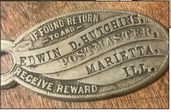
In recent years a man gave Mary a silver tag. He said he knew of her love for history and her connection to the postmasters desk. The tag states 'If found, return to Edwin D. Hutchins, Postmaster, Marietta, IL. Receive Reward' I researched the name and found he was born May 6, 1868 in Waterview Cumberland, KY.. He moved to Harris Township, Fulton County, Illinois. He died November 27, 1944 in Marietta, IL at the age of 76 and is buried in Point Pleasant Cemetery, Marietta, IL.
Mary does not know what the tag was used for but this writer and Mary both believe it may have been a keychain for the post office keys (if any reader knows please let the Community News Brief know at communitybrief@ gmail.com).
Credit: History of Fulton County of Illinois in Spoon River Country 1818-1968 Published by the Fulton County Board of Supervisors with the cooperation of the Fulton County Historical Society