In 1838, before the railroads were even completed a rough log one-room school house existed in Bushnell- Priarie City township located three miles west of Bushnell. As the town grew, so did the number and sophistication of the school buildings and curriculum, to the extent that Bushnell also had one of the county’s first “normal” teaching colleges for over 20 years.
In 1954, as part of the Centennial Celebration, a new high school was dedicated showing the evolution from log cabin to the twostory brick construction, to a one-story “modern” campus with state-of-theart classrooms and sports complex.
The first school houses in the Bushnell area were rough log cabins, usually with one window. Students sat on crude benches made from logs, and the teacher sat on a three-legged stool at a rough desk, which sat on a raised platform.
The first school house in Bushnell was a frame building between Hail and Hurst streets. As Bushnell grew, more schools were constructed, until there was one in each ward: Sperry Street, Water Street, between Rile and Sperry, on the NW corner of Jackson and Davis, and on the southeast corner of West Hail and Washington. As far as rural areas, the number of children was growing and around 18541872 most schools were built in the country.
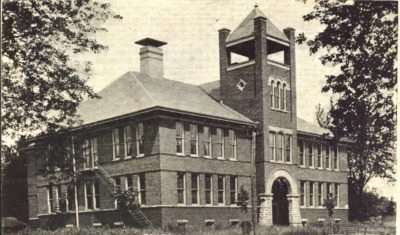
In the year 1875 a large two-story brick building was built at the corner of Jackson and Twyman streets. This helped with the implementation of a graded system when advancement was standardized. This building had eight classrooms, four basement rooms, and was built out of red brick for about $20,000. A two-year high school class was added and the first graduating class was in 1878 and consisted of one boy and five girls.
Within 11 years, a third year was added to the school. Unfortunately in 1896, that same year the high school was expanded, the building was destroyed by fire.
Bushnell needed a school so within nine months, West Side School was built on the same site. The cost of this impressive buff brick ornamental structure was around $15,000. In 1901, the high school course was extended to four years. In 1905, Bushnell was growing at such a pace as to warrant the building of another school. This time, students would be divided by where their parents lived. East Side School was constructed on the corner of Cole and Hurst at a cost of around $25,000. It would house grades one to seven, with the dividing line being West and East Main streets.
In 1922, a two-story brick addition was built onto the East Side School. The addition included a gym, an auditorium with a stage, and a home economics laboratory. This school eventually became the High School and then the Junior High School. Both buildings were torn down in 1981.
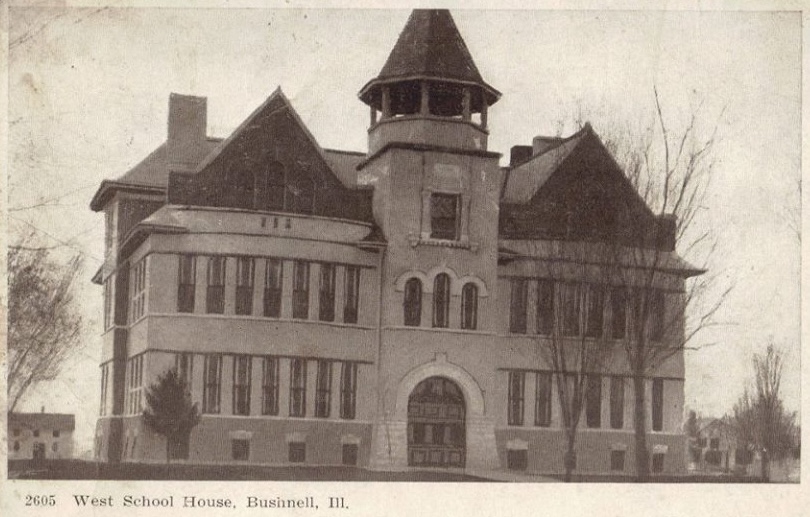
Another fire in 1936 destroyed a Bushnell School building (the earlier West Side School burned in 1889). As before, Bushnell began rebuilding at once and the “new” West Side School was ready for students by 1937. In March 1948 residents of Prairie City and Bushnell went to the polls and voted to form a new school district-Community Unit No. 170.
Bushnell and Prairie City consolidated in 1951. This gave all district students access to sports, extracurricular activities, band and music lessons, and choices of classes such as chemistry, home economics and trigonometry. In 1953-54, the current B-PC High School was built and cost the taxpayers around $750,000. B-PC Elementary School was built in 1961 and the B-PC Junior High School opened in 1980.
Great care was taken to save the bell and arch from prior schools and move them to the new Bushnell campus (they came from the old junior high building).
Western Normal College-First Period 1881-1886
Western Normal College began in the spring of 1881 when I.E. Wilson and C.F. Holcomb visited several large towns in Illinois for the purpose of finding a suitable location to start a “normal” college. The name “normal” school or college was taken from the French word used in 1834 to identify the first French School established to be a model school. It became the title of schools, usually two-year programs, for training chiefly elementary teachers.
Bushnell had no existing building to use as a college. The south public school building, then vacant, was secured and opened on July 20, 1881, with about 15 students and four teachers. Enrollment soon increased by the close of the first term, reaching 20 students.
The first days of the new college were held in a handful of locations. General exercises were held in the old brick Christian Church, at West Hurst and North Dean. Offices and classrooms were located on the second floor of a bank and the post office building (which was then located on the north side of the first block of East Hurst).
As far as living arrangements, students were housed in rooms in the Cole building (on the corner of East Hail and East Main streets).
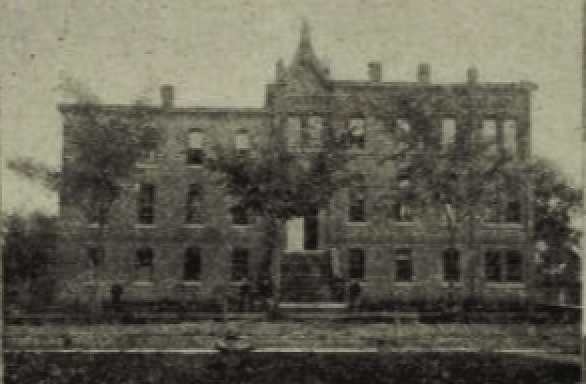
In the late part of 1882, the land for the main building was purchased and Western Normal College was begun (north of the business district on East Main Street). A rough weather year only allowed two stories to be built-the next spring the third-story was completed in the autumn. The top floor of the Chandler block held the business, art and music departments. The school had 10 courses of study including classic, scientific, teacher certification, business, preparatory, music, fine arts, penmanship, phonographic and telegraphic. Western Normal College saw numerous presidents come and go. In 1886, when college manager and professor Lyons Left, no one could be found to replace the school, consequently it closed until 1888.
Western Normal College-Second Period 1889-1898
Prior to 1888, the Western Normal College had a large rate of turnover in its presidents and faculty. So much that between 1886 and 1888 the school had to close. In early 1888, W.M. Evans, then superintendent of schools in Virden, and W.W. Earnest, then principal of schools in Nilwood, Illinois, became aware of the vacant school in Bushnell.
The two men secured the right paperwork and set out to make the college a bigger and better school than had ever been dreamt of. They soon added three buildings and large land holdings for expansion. They built two dormitories, one with eight suites and an additional 16 rooms with a dining hall underneath. The outlook for Bushnell’s revitalized college looked good, as students flocked to attend.
An advertisement in the July 4, 1899 McDonough Democrat announced courses for teacher certification, commercial courses, art, music, penmanship and telegraphy. Degrees offered at the Western Normal College included Bachelor of Education, Bachelor of Science, Bachelor of Arts, and certification in music, art, commerce and law.
Western Normal was one of the first colleges in the country to operate through the summer and continue through a full school year of 50 weeks, making it possible for students to do four years of college in three years. Finding a school that offered summer school was a rarity in those days.
A wide variety of classes were available, including rhetoric, grammar, arithmetic, algebra, geometry, trig, U.S. and general history, botany, physics, penmanship, Latin, German, Greek including Homer and Virgil, logic, political economy, moral philosophy, debating, vocal and piano, business courses, art and special courses in telegraphy. The fee for graduation was $3.
Students schedules were filled with school. Mondays were the day off, since students attended on Saturday. The first morning bell was rung at 5:30 a.m. and breakfast was served at 6 o’clock. Chapel was each day at 8:45 p.m. Dinner was served at noon and supper at 6 p.m. The buildings were closed at 10 p.m. Total cost for tuition, room and board was $30 for 10 weeks. Ladies cost $1 more, or $31. Included in that figure were the expenses of lights, washing, stationary, book rent and fuel in the cold season. If a student chose to live at home, the tuition was $1/week for any class. Private houses were also available, for a cost of $5-$8.50 per term.
The Western Normal College boasted an above average dining hall. For $1.60/week the following foods were available: fresh bread, real butter, potatoes, coffee, tea, milk, crackers, syrup, oatmeal, pork steak with gravy, cheese, sausage, beef, cabbage, pie, beet pickles, cucumber pickles, fried eggs, sheet cake, cold beans, white cake, dried peaches, hash and prunes.
Conduct at Bushnell’s Western Normal School
Very few rules of conduct were needed at Bushnell college, as the emphasis was put on courtesy and the necessity of giving all students a fair chance of achieving their goals. The high standard expected of pupils included honor, dignity and gentle behavior. Students were encouraged to attend church and Sunday School.
Dormitories at Western Normal School
A room at Bushnell’s college could range from 40¢ - 70¢ a week, with a higher premium put on corner rooms, single rooms, etc. Rooms were furnished with carpet, stove, coal box, commode, table, chairs, bowl and pitchers, slop-pail, mirror, bedstead, mattress, straw bed, blankets, sheets, pillows, cases and comforters.
A student could provide their own lamp oil at a cost of 10¢ a week. Soft coal was delivered in the coal boxes in the rooms at the cost of the coal and labor, or a student could bring their own coal. Coal tickets for a ¼ bushel (around 20 lbs.) could be bought at the college bookstore. Students moving in that did not want to wrangle with heavy trucks could pay 15¢ to have their belongings delivered to their room.
What Happened?
The enrollment at Bushnell’s Western Normal College eventually reached 600 students. The school seemed to be assured of having continued growth and prosperity. However, Bushnell’s college was private pay. A new movement was growing to have the states fund schools. This made it increasingly difficult for schools like Bushnell’s that relied entirely on student fees.
In 1898, one of the school’s two managers left, after the school was no longer able to justify having two leaders financially. In 1902, a serious epidemic decreased the enrollment so that it became necessary for the school to stop, one young lady actually died.
When Bushnell’s Western Normal College closed in 1902, the state controlled Western Normal College opened at Macomb. The college in Bushnell offered to sell its compound to the Bushnell School District but it was declined.
In 1907 the main building of the Western Normal College was demolished to make room for a private home. The dormitory facilities were used as apartments and later made into individual homes.