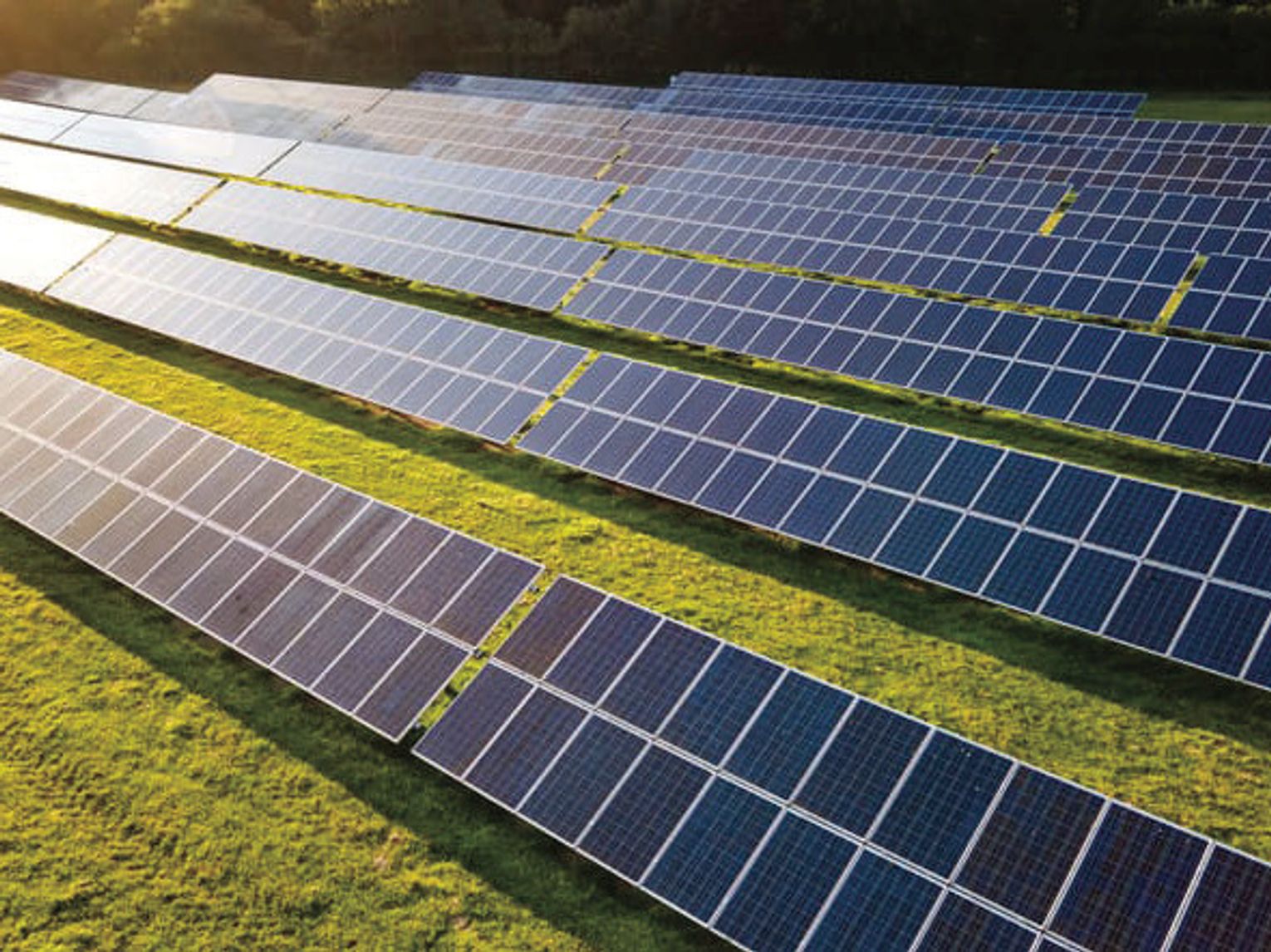
There's a new 'crop' in the county – and state – that appears to be popping up like wildflowers with each passing month. Solar panels are appearing on farm land and property along highways, county roads and interstates as farmers, landowners, municipalities and residents realize the benefits of solar, both financially and environmentally. The Community News Brief talked with a solar provider, local government officials and homeowners and landowners to learn more about community solar farms, and the pros and the cons of going solar within a community. This is the first in a three-part series on community solar.
Building a Solar Farm
For landowners with farmland that isn't considered 'Grade A,' or who are looking to supplement their farm income due to the ongoing uncertainties with crop prices, establishing a solar farm on their property can guarantee a monthly income for up to the next 30 years, according to Keith Hevenor, communication manager for Nexamp, a solar company establishing 'community solar farms' in McDonough County.
Nexamp currently has four community solar farms in the county – either operational or in the process of being built - Ember Sun, 1150th Sun, Bushnell Sun and 1150th East. Working with landowners, the company enters into a long-term lease in which they build the solar farms on a portion of the land, and then the solar energy is 'sold' to area residents to help decrease their electric bills. But before a solar farm can even be considered, the companies must undergo numerous steps and processes within a municipality, including engaging with relevant planning, zoning and permitting committees, Hevenor said.
'While we work with private landowners for most of these projects, we must work with the county or city governments to follow all ordinances, zoning and other procedures. We also ensure we comply with all environmental and conservation requirements that the county and state have in place,' he added.
Nexamp developers work to find landowners with a suitable location who are willing to lease their land for 20-30 years. Once all permits are in place, the company, which is based in Boston, MA and Chicago, take on the cost of everything from civil work to preparing the land to the equipment. They also hire local contractors to complete the construction, and once completed, they hire local landscapers and/or a property manager to maintain the site.
'The economics are going to change in the near future as the current incentives offered by the federal government are going away, but those who have installed, or are prepping for the installation of, solar panels, will take advantage of tax credits, for years to come,' Hevenor noted. 'Future projects will benefit from decreasing equipment costs and will continue to be economically viable even without federal tax credits.'
The federal government's recent 'One Big Beautiful Bill' act phases out renewable energy tax credits and froze federal funding for energy projects.
Ameren & Solar
According to Andrew Parker, director of Clean Energy Transition Strategy for Ameren, their company plays an important role in facilitating the safe interconnections between Ameren and companies like Nexamp. Because of the intermittency of distributed energy (e.g., the amount of energy produced varies based on weather), and the location of many of these projects on rural circuits with relatively little load, Ameren often needs to install extra equipment to ensure that energy is available to meet the needs all customers served on a local circuit. While Ameren Illinois does not install panels; construction on the Ameren Illinois side of the meter may be necessary to facilitate the interconnection of solar.
'This may entail making substation enhancements or installing equipment to provide automated circuit protection not available with the current standard equipment. Ameren Illinois is actively working on grid advancements and interconnection efficiencies that facilitate the adoption and development of alternative energy sources, including rooftop solar installations,' Parker explained.
Ameren currently offers various programs and initiatives related to solar energy, including rebates and metering options. Parker said they're also committed to providing educational programs and expanded offerings that provide opportunities for customers to learn more about, and take advantage of, solar and other options that line up with Illinois' clean energy goals. More information, including cost savings and benefits, can be found at Ameren.com/ Service/Renewables/Solar.
'Participating in solar projects may lead to reduced electricity bills, and customers are able to receive credits on their Ameren bill for the solar electricity they produce. This can also help reduce carbon emissions,' he noted.
To continue its sustainability efforts, in addition to working with solar companies, Ameren has developed a multi-year plan that focuses on delivering clean energy benefits to its customers; is working toward Illinois clean energy goals, and is investing in modernizing its grid, among other initiatives. For more information on Ameren's sustainability efforts, visit Ameren.com/ Sustainability.
'Ameren Illinois encourages customers to take charge of their energy costs, and participating in solar—either by installing their own system or subscribing to a community solar project—is an excellent way to do so,' Parker added.
Permits, Codes and Ordinances
While a new bill signed into law by Illinois Gov. J.B. Pritzker will change the city's and county's ordinances surrounding alternative energy sources, currently there are numerous processes in place before a solar company can begin a project within the city and county. Senate Bill 25 or the Clean and Reliable Grid Affordability Act (CRGAA), which was signed by the governor Jan. 8 and will go into effect June 1, is an energy reform package aimed at bolstering the state's power grids.
The new 'virtual power plant' (VPP) programs under the law allows homes and businesses with solar panels or wind turbines to pool energy together, acting 'virtually' like a power plant despite not physically existing as one. The idea is that the energy stored in residential and business batteries can be contributed to the electrical grid when the state’s primary electric delivery companies, like ComEd and Ameren Illinois, face high supply prices during peak hours of use, especially during the summer.
Homes and businesses who contribute energy to the grid via VPPs will be paid for their energy. The law also mandates that electric utilities offer optional 'timeof- use' pricing, allowing customers to save money by using less energy during periods of high demand.
At present, the city and county have regulatory authority and zoning processes in place for solar companies that wish to build within city and county limits. Without these in place, the solar farm business would be a 'free for all,' without many stipulations, according to Mayor Mike Inman. Solar companies must apply for a permit, and then follow all setbacks, fencing and other ordinances that are in place. They must also follow the city's unified development code, which oversees construction. Senate Bill 25 will require some rewrites of the ordinances in place for the City of Macomb and McDonough County, but will still include safeguards and procedures.
'The county and school district do benefit in terms of property tax dollars from these solar farms, and while some detractors want us to say 'no,' it's really a rulesbased discussion. The company must follow the zoning and other ordinances in place, which includes adhering to our setback policies and more,' explained City Administrator Scott Coker. 'We've found that in all of the dealings we've had with the solar companies, the developers have been more than accommodating and often will go above and beyond the requirements.'
The City of Macomb is building its own solar field at the corner of Ward and Grant streets, which will be used to power the city's existing wastewater plant. This, both Coker and Inman explained, will keep costs more manageable for both residents and the city.
From the county side, McDonough County's Commercial Solar Energy System (CSEFS) Ordinance, as well as an ordinance for the Siting of Commercial Wind Energy Facilities (CWEF) have been manageable and participating agencies have been cooperative, according to McDonough County Board Chair Eric Blakely. While the county is currently revising both ordinances; Illinois' new energy bill will necessitate just a few changes, mainly to the fee structure (lower maximum restrictions within the new law)., he added. Additionally, the Illinois State Association of Counties is in the process of preparing sample ordinances for counties to assist in preparing acceptable ordinances.
'We will review these aids prior to implementing any revisions to our ordinances by June 1, 2026,' Blakely said. 'We are confident that facility owners will continue to find our ordinances acceptable and we look forward to developing positive relationships.'
Homeowner & Landowner Benefits
For homeowners or renters who can't, or don't wish to, install solar panels on their roof or their property, there are still ways to tap into the community solar farms within their region to reap the benefits, he pointed out. Within the city limits, most residents have Ameren as their provider, and Nexamp works with the electric company to apply bill credits based on each individual homeowner's/renter's electric bill.
'The energy produced by a community solar farm goes directly to the Ameren power grid. Ameren establishes the value of the solar energy, and it's credited back to us as bill credits, which we allocate to our subscribers. We bill our customers for the value of the credits minus a fixed discount, so they end up saving about 15 percent on their electric bill over the course of the year,' Hevenor said.
When a homeowner signs up for Nexamp, they must provide their Ameren account number, and Nexamp will take a look at the last 12 months of usage to get an average. Using $100 a month as an example, they would allocate a portion of the farm that generates $100 worth of credit to the consumer. Ideally, the homeowner would see a $100 credit on the Ameren bill, therefore, reducing the bill.
'Nexamp will send a bill for whatever amount of credit we issued, ideally enough to 'wipe out; the Ameren bill. In a perfect world, a $100 Ameren bill would be zero, and we'd bill for the $100 credit minus 15 percent, which would mean essentially instead of paying Ameren $100, you'd pay Nexamp $85 that month,' Hevenor explained.
The solar farm will generate more energy in the summer versus winter, so their customers will see fluctuations in their bills; however, over the course of the year, they should get more credits on the Ameren side to draw upon in the colder months when less solar energy is generated.
'It varies by state, but in Illinois, the programmatic savings is 15 percent and it is a fixed discount. Once the credits are applied to your Ameren bill, you're spending 15 percent less than before,' he said. 'Currently, the customer does have to deal with two bills, which is a sticking point for some folks, but over the course of the year, you are saving some money and it's a way to participate in renewable energy if you don't want to, or can't, put panels on your roof or lease panels to place on your property. And if you try it and it's not for you, you can cancel at any time. Community solar providers are working toward a consolidated billing approach with the utility in near future.'
In almost all cases, Nexamp leases the land versus buying the land. Hevenor pointed out they hear a lot of opposition that community solar is taking farmland out of commission; however, in reality, most of their landowner partners are leasing a very small portion of the land they own.
'In active farming today, that lease income is providing them w/ a certainty to keep the farm going. It's the reality in this day and age, if they lease us 15 of their 200 acres, that's a guaranteed source of income for 20-30 years,' Hevenor concluded. It's better than selling off part of their family farm – it's still their land we're just leasing it. And at the end of the lease term, if they decide not to renew, that equipment is removed and recycled and the owner can farm the land again.'
Locally, Midwest Grass & Forage in Macomb, as a consultant for Harvest Solar, also gives area agriculture producers a way to save money amidst continued rising operating costs.
Midwest Grass & Forage, which is owned by the Lant family, became a local consultant for Harvest Solar, which deals solely in agriculture and rural solar systems, in 2022. The Lants work with producers and rural residents and serve as the local point of contact for Harvest Solar.
'While we don't do the installation, we take care of the preliminary legwork and we provide that local source as investigation and researching solar options can be overwhelming,' she shared in an earlier story with the Community News Brief. 'The payback/return on investment varies, based on providers and the size of a farm or property, but the average is a payoff within two to seven years of installing solar.'