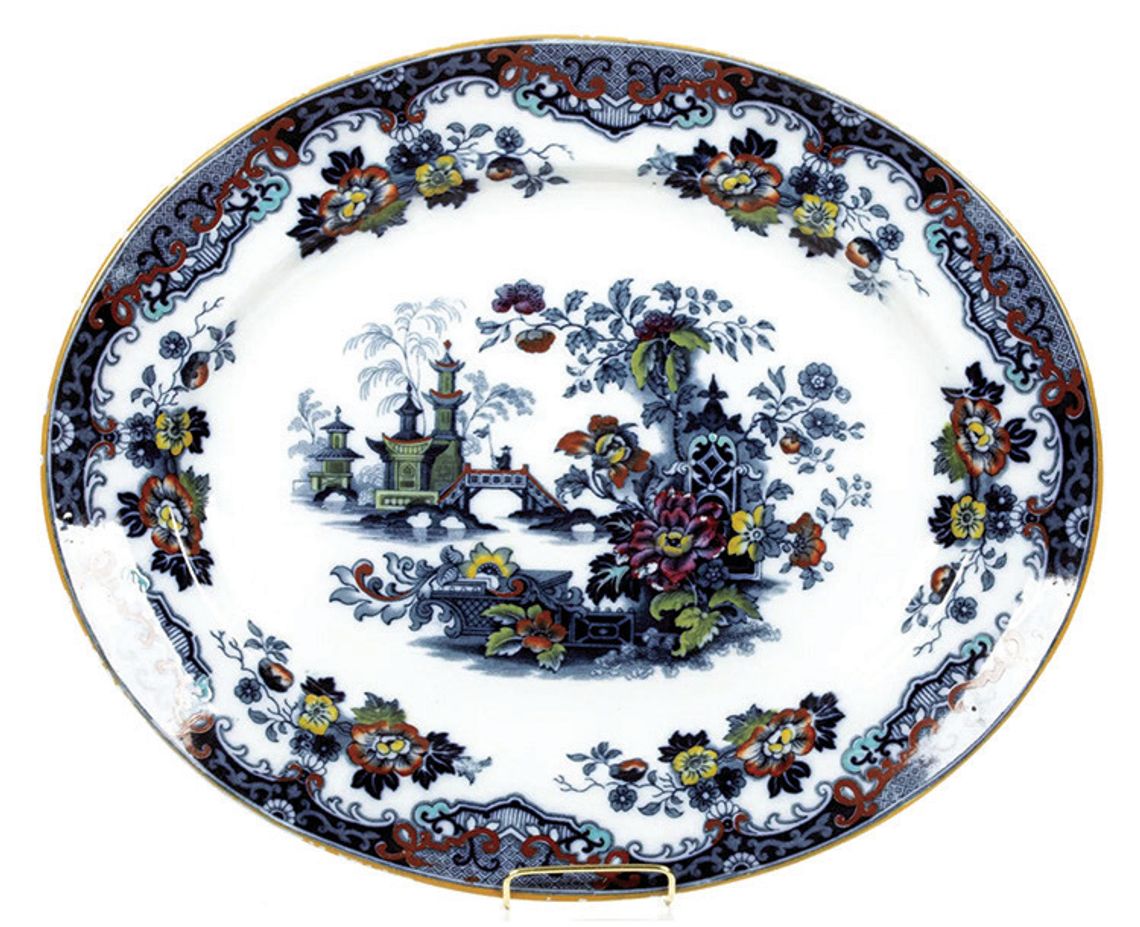
If you’re familiar with 19th-century ceramics, you probably know about ironstone. It was first made by English potter Miles Mason, who sold Chinese export porcelain and decided to make his own replacements for broken dishes. To make these replacements, he created a ceramic using slag from processing iron, which his son patented as ironstone in 1813. Heavy, durable and hard to chip, it was clearly different from porcelain, but quickly became a favorite for tableware. Many other potteries began making ironstone, especially in the Staffordshire district of England.
Albion Pottery, also known as Bourne & Leigh, active from about 1892 to 1941, was one of them.
The platter shown here, which sold for $95 at DuMouchelles, is an example of their ironstone. The pattern’s name, “Chinese,” evokes Mason’s original intention of making dishes to use with Chinese porcelain. Many popular ironstone patterns imitated East Asian designs. This Albion Pottery platter includes a landscape with buildings and a bridge with a figure, reminiscent of Nanking china or the design that inspired the famous Blue Willow pattern. A close look at the platter’s border shows geometric patterns like the ones found on Chinese porcelain.
Q: I have a child’s chair shaped like a handcarved bear cub that looks like a Black Forest piece but I’m not sure. Can you tell me, and what it is worth? How old, too?
A: Black Forest furniture was first made in the late 1800s.