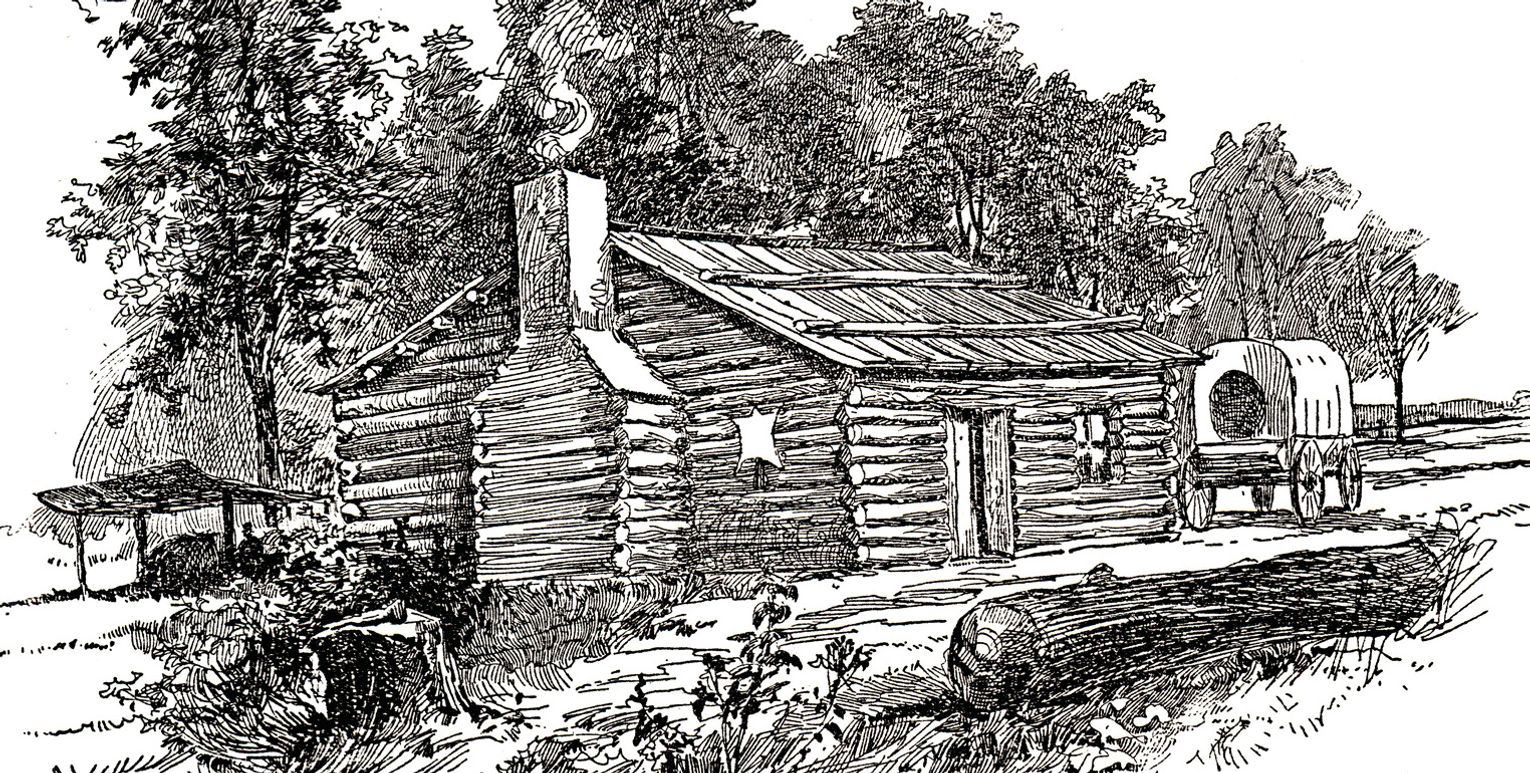
During the bicentennial year of McDonough County, I will be writing a monthly column for the Community Brief that looks into the experience of residents here through the generations. WIU Senior Archivist Kathy Nichols, the founder and leader of Macomb’s “Local History Day” for students, will illustrate those with drawings and photographs from the hundreds of thousands available in the WIU Malpass Library regional archives collection. These dozen articles will appear in chronological order, conveying many of the remarkable cultural changes that have occurred over the years. This initial one reflects life on the raw frontier.
The beginning of McDonough County came along in the later 1820s, when Illinois was still a thinly settled, mostly unorganized, wild state, 221 miles wide and 381 miles long, that featured a mix of prairies and woodlands, as well as helpful rivers. It had been occupied by some Indian tribes for thousands of years (since about 8,000 B.C.)—as well as by some French settlers near the Illinois and Mississippi rivers since the later 1600s and a small number of British settlers since the 1700s.
Statehood in 1818 had encouraged American settlement, but another factor had come after the War of 1812 ended in 1815: the federal government established The Military Tract, a 3,500,000-acre section of western Illinois, to provide land grants for war veterans who applied for the 160-acre sections.
That brought more former soldiers to western Illinois, but some of them quickly sold their land (valued at $1.25 an acre) to investors in the East—who then promoted those properties, which encouraged other settlers to come. McDonough County—named for Commodore Thomas McDonough, a noted War of 1812 leader—would develop in the center of that area, and the county seat of Macomb—named for General Alexander Macomb, also a celebrated leader in that war—later promoted itself as “The Hub of the Military Tract.” Those leaders have a monument in Chandler Park, and portraits of them are also located in the City Council Chamber of the Macomb City Hall.
Several counties in southern Illinois were created before statehood, but the number increased after 1818. One dramatic year was 1825, when no less than ten counties were established in western Illinois. Among other things, that shows the impact of the Illinois and Mississippi rivers on travel, shipping, and settlement. And McDonough County was added on January 25, 1826—the 45th county in a state that would eventually have 102.
Of course, life on the frontier was a struggle, for settlers had to cope with log cabins, tiny villages, dirt roads, harsh weather, rampant diseases, and wolves. The map presented with this article is a modification of one created in 1839, which shows the locations of various early settlements—including Carter’s Settlement (1826), Job’s Settlement (1827), and Wolf Grove (1832), which vanished before the Civil War. Two other early settlements, Pennington Point (1828) and Camp Creek (1829), retained their identities until the early twentieth century. The three villages of Hills Grove (1830), Doddsville (1836), and Middletown (1837) had a few businesses and were active until the early twentieth century, but they also disappeared. Macomb in that era was also a hamlet of small log structures scattered around and near the square. A good description of it in 1833, when there were still just “eight log buildings,” was provided for the 1897 Macomb Journal by early Bardolph settler Anderson Cannon: “The (log) courthouse stood on the (northeast) corner. . . . After they began to get too proud to use the little log hut for a courthouse and got a better one, Edward Dyer bought the old one and used it for a wagon shop. After Dyer went out of it, John D. Walker bought it and made a barn and chicken house out of it.”
He also points out that “the finest building in town” was a tavern on the square, built of “hewn logs,” for “the rest of the buildings were just rough poles.” Of course, that tavern was a gathering place for men—because people generally believed that women belonged at home and should not hang out in town.
And speaking of homes, they were all made of logs, too: “Jim Campbell built the first house with glass windows. The others just had a couple of logs cut out, and a cloth hung over that opening, so when a fellow wanted to shoot a deer or a prairie wolf, he just raised the cloth and banged away.”
Of course, people also had horses, hogs, cattle, and chickens in their yard areas as well, so it was not uncommon to see loose animals in town.
Another early resident was Abram Powers, whose family settled in the southeast area of the county during 1833. Like so many in the countryside, they occupied a log cabin and strove to develop a small farm, which was eventually not far from early settlements like Doddsville, Table Grove, and Vermont.
His family suffered from various tragic matters, as he mentions in his memoir book, Sunshine and Shadows: Or the Life and Early Adventures of A. Powers, One of the Pioneer Settlers of McDonough County (1895). One disaster was the death of his father from a wagon accident in 1836. Of course, that kind of loss could endanger the survival of the whole family. Abram’s older half-brother, who was living in Rushville, then came to help the family, but he soon suffered a leg injury from an axe and became “a cripple instead of a help.” Shortly afterward, the Powers family lost an infant to disease as well—and that kind of death was also common on the frontier.
But Powers also recalls positive aspects of the county’s frontier life. One was that each resident in their settlement “seemed ready and willing to share a burden with his neighbor; each ready to contribute to the common welfare.” In his view, that was because “They were working for a common object, to build homes for themselves and their posterity,” so “They well understood the ancient adage, ‘In union there is strength,’ and hence they were liberal in both giving and forgiving.” (At least, most of the frontier residents were.)
As mentioned in the book Macomb: A Pictorial History (1990), when our earliest settlers came, Illinois was “the essence of the frontier, the edge of the Far West,” and for many it was “the land of promise.” And that hopefulness, that sense of having a better future, was a deep bond that united the first comers to McDonough County, despite their differences in cultural background.
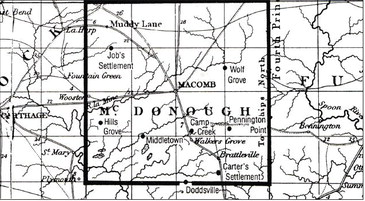
An early map of McDonough County, extracted from David H. Burr’s Map of Illinois and Missouri (1839), showing settlements and villages in a wild landscape marked by the “R. LaMine” (Lamoine River) and its many tributaries.
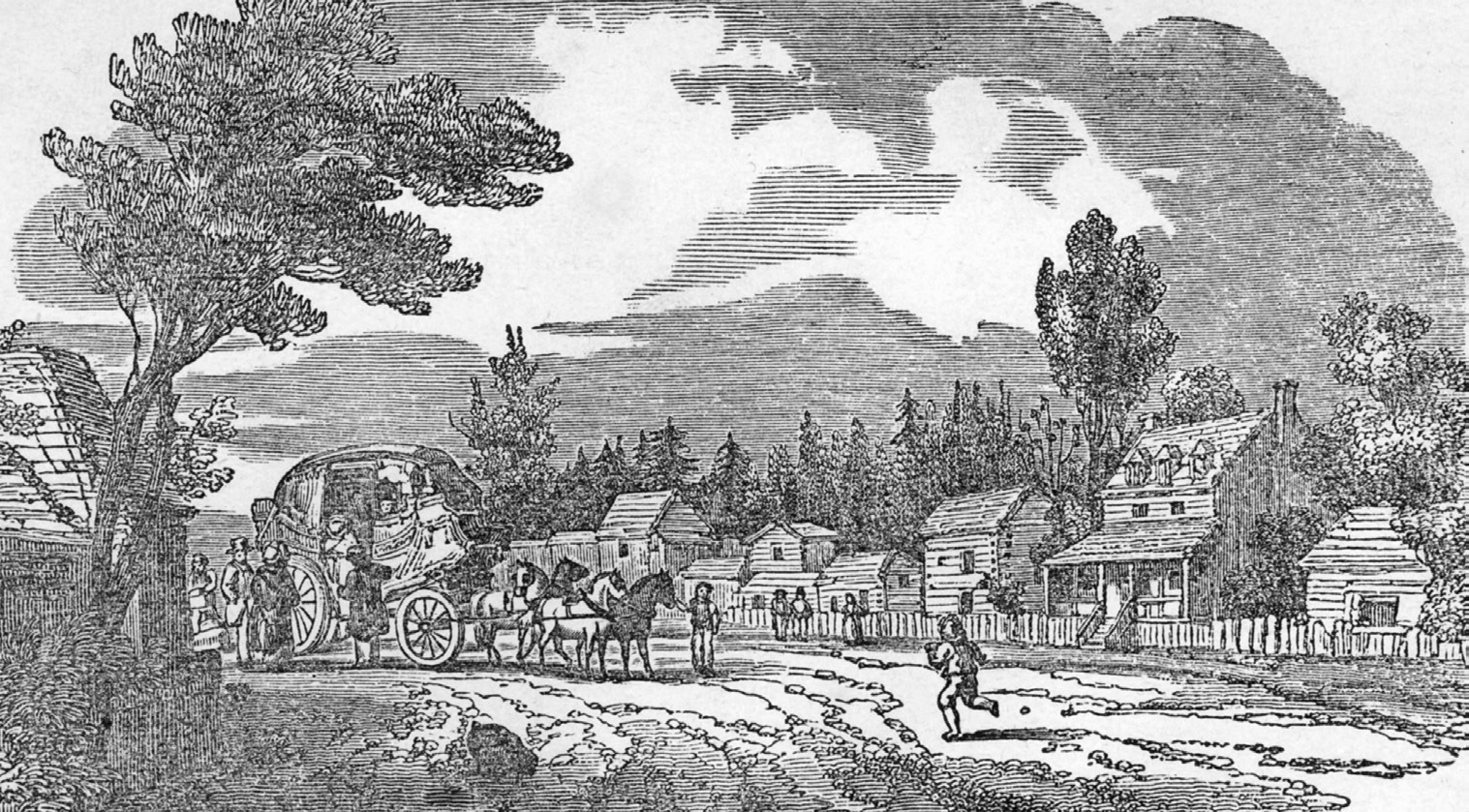
An early log cabin village in western Illinois, showing the arrival of a stagecoach. From John Regan’s book, The Emigrant’s Guide to the Western States of America (1852, which centers on his experience in western Illinois during the 1840s.
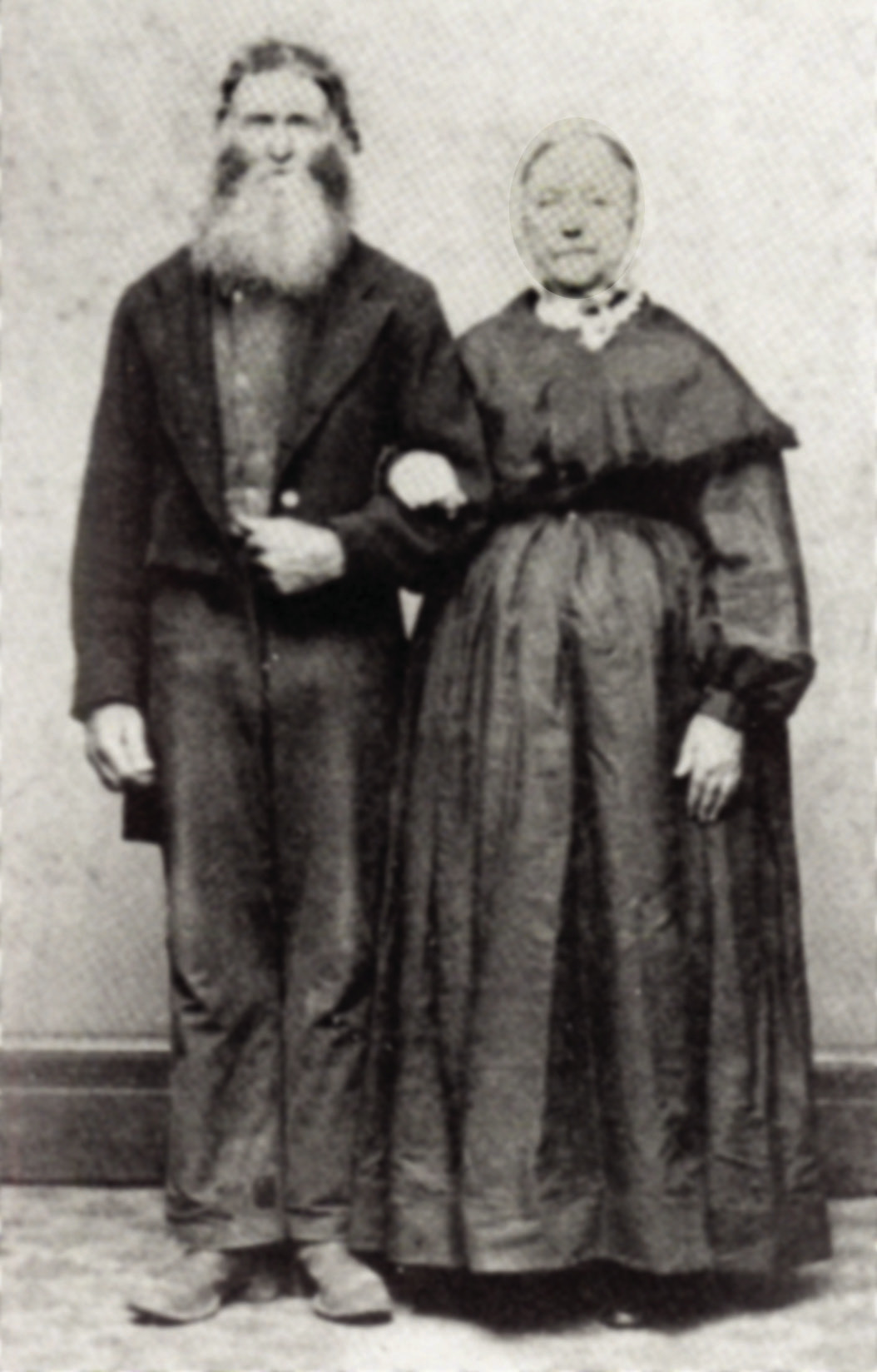
A late nineteenth-century photograph of frontier settlers John Wilson and Martha Vance, who were married in McDonough County during 1828, before Macomb was officially founded, at Carter’s Settlement. They were the first couple wed in our county—and they lived for many years in a log cabin. (A quilt created by Martha is now preserved in the vast collections at the WIU Archives.)
Another author from the frontier period was S. J. Clarke, whose parents, David and Eliza Clarke, arrived in McDonough County during November, 1830. They had been encouraged to come by David’s brother James, who had settled in Macomb during the spring of that year. One of the first county commissioners, James rode to the land office in Springfield during the winter of 1830-1831 and entered the quarter section of land on which Macomb was laid out the following spring.
S. J. was not born until 1842, but his family connections gave him a wonderful sense of commitment to, and appreciation for, McDonough County pioneers. He wrote the first extensive history of our county, printed in 1878, and he based it on many interviews with old pioneers, including his father, mother, and Uncle James.
He surely knew more older residents than anyone else of his generation, and his book was a quest for connection with them.
One of S. J. Clarke’s notable sources was an 1876 letter from his highly regarded uncle, which described frontier life during the noted “Winter of the Deep Snow” (1830-1831), when a four-foot accumulation of snow lasted for weeks and threatened the lives of settlers: “The first thing done each morning would be to build the fire and put on a big pot of water into which the corn would be thrown and boiled awhile, then taken out and grated and made into good, wholesome bread. This, with what game we could get, was what we had to live on during the long winter.
Several families came to the county that fall and, of course, had no corn. All things were then held more in common. Those that had none were welcome to help themselves from their more fortunate neighbors—all that was required of them being that they should gather it themselves. Resin Naylor, better known as ‘Boss’ Naylor, was one of that class, and it was a little amusing to see him go out to the fields, walking for a time on top of the snow, on which a crust was formed, but now and then going through it, getting his corn, and coming in (the cabin) blowing like a porpoise and sweating dreadfully. But, we all managed to live, and had good cause to be thankful that it was no worse.
The young men and women of this day have little knowledge of what a pioneer life back then consisted of. Way out upon an almost boundless prairie, far from (one’s original) home and kindred, with an opportunity of hearing from them only every few months, it was dreary indeed.”
After S. J. Clarke’s long effort and the popularity of his 692-page book, no wonder he eventually moved to Chicago and established the S. J. Clarke Publishing Company, which specialized in producing state, county, and community histories and became very successful.
Influenced by his History of McDonough County, I included brief memoirs by various early residents in my history of Macomb—which I had gathered mostly from old newspapers. And that fostered my own sense of connection to those earlier residents, too.
One such personal account, which I also found in Clarke’s excellent history, was John Wilson’s “Making a Home in McDonough County.” (A photograph of John Wilson and his wife, Martha Vance, in their later years, is reprinted with this article.) Among other things, Wilson describes the variety of hard work that he (and his wife) were confronted with on the frontier: “The first year I broke my land with a Bershire plow, a wooden affair. I borrowed a wagon. . . . After this I made a wagon myself entirely of wood, the wheels of which were hewed out of a large tree. There being no iron about it, I had to keep it well soaped to keep it from being set on fire by the friction. I now had three calves... With them I done my plowing, and hitched them to my wagon, and done all my hauling of wood and rails... I used to raise large fields of cotton, and we made all the cotton goods we used. I also raised flax, which we spun and wove and made into goods. We didn’t buy many ‘store goods’ then.”
Wilson also mentions “the abundant game” that men like him so often hunted— and “the wild animals” they had to be aware of, too, such as “the wolf, wildcat, fox, lynx, badger, and even the black bear.”
Of course, his account of frontier life makes us realize the enormous cultural changes that have occurred during many generations since the frontier. And it should remind us, too, that our broad awareness of what earlier residents were faced with and how well they coped encourages us to respect the human struggle and appreciate what we have today—which is also a product of so much human effort. That’s one of the great advantages of fostering our historical awareness—and realizing the complexities and challenges that people faced in earlier eras. As I said in the “Foreward” to my history of Macomb, forty-six years ago, “Each local resident is part of a vast succession of lives that extends back to a single log cabin in the wilderness and will extend forward to an unimaginable future—that we have a hand in shaping. There is, then, a need for us to appreciate the distance Macomb has come and to understand the complexity of the story that we are participating in. As with every generation since the frontier, ours will pass, but the community will survive us, bearing the results of our presence. And we will always belong to it.”
Of course, that is also true of our relationship to the entire county, which can become for all of us a mean-