Part 3
The possible downfall of the Moses King Brick and Tile Works as a business may have started in 1949, as an innocent quest to modernize the company. With Joe King’s sons running the business (Verne, Keith and Jack), the decision was made to try to convert the natural gas to fire the kilns, as coal was becoming too expensive.
Although it pleased all of the ladies in Colchester on laundry day (black soot no longer came out of the chimneys), the move turned out to be even more expensive. The sons found out that to heat the huge burners and maintain that heat with natural gas, took a lot of money. According to some who worked there, it was a huge mistake.
Tim Schroll, who actually lived on the grounds later and had opportunities to visit with oldtimers who actually worked there, said that another factor creeping in in the 1950’s and 1960’s was labor. Nobody was wanting to do backbreaking work for pennies a day. And the owners couldn’t afford to raise the prices of their bricks because they were starting to compete against more mechanized operations.
Another decision was made to try to salvage the business in the late 1950’s and early 1960’s. Joe King’s family decided to switch their main product to field tile, tile that came from an orange/red clay used in many cases for drainage.
But in the late 1960’s, plastic had become cheaper than clay tile, it was lighter in weight, and easier to lay. So the tile idea was shortlived. No one could afford to hand-dig tile anymore.
According to Schroll, in 1968 the decision was made to close what was then known as “Colchester Brick and Tile Company”. It must have been an excruciatingly hard decision to make by Joe King’s sons. When the factory was shuttered, it was still totally functional. In Schroll’s words, “They turned the key off, shut the switch down and closed the doors. All of the machinery was still in place-everything worked. The motors still worked, the pug mill still worked, the pan grinder-it all still worked. There just wasn’t anybody there.”
As happens so often, when a place isn’t closely monitored, the vandals discovered the copper wire that was the heartbeat of the factory. Thieves stole about $500 worth of copper, which in today’s money would be much more. They were caught, but the damage had been done, the wire was never replaced or reinstalled.
The Brickyard, as most of us know it by, lay idle from 1968 until 1977, when Keith King, who still owned the Brickyard, decided to turn the place into “The Brick Village”.
According to Schroll, the stories tell that they had a black powder shop and possibly a leather shop. Keith King tried and tried to get the kilns in suitable condition for the public to view, but was fighting an uphill battle.
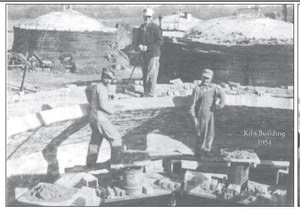
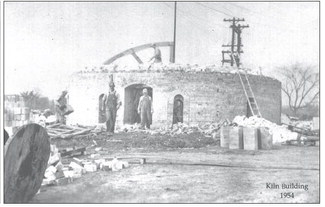
When one reads about how the kilns were constructed, it seems a miracle that they are still standing today.
The kilns resemble igloos but are built with mortarless bricks. The roof is four bricks thick laid on forms, and when the forms are removed, the pressure of the brick downward is all that holds them in place.
Steel bands around the outside keep the walls from bulging out. When it rains, the water finds a crack, even when King would apply tar. The bricks were constantly expanding and contracting. Not able to generate enough money or interest from the public to continue “The Brick Village”, Keith King finally gave that idea up and sold the property to his daughter and another person or persons. And then-sad to say-the Brickyard laid idle for 12 years.
In 1990 a local artist named Dev, who knew Keith King through a mutual friend, bought the Brickyard. She wanted to buy the land so she could have a “place where art could happen”.
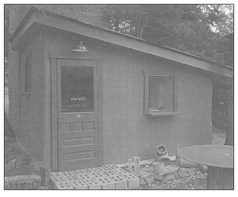
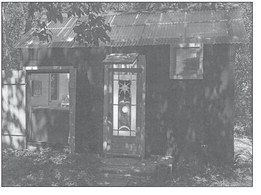
Dev, Schroll and many volunteers worked over the years to restore the site, which truthfully had become somewhat of a dumping ground.
Schroll enlisted the help of classes from WIU-many of those students from Chicago said they had never seen anything quite like the Brickyard before.
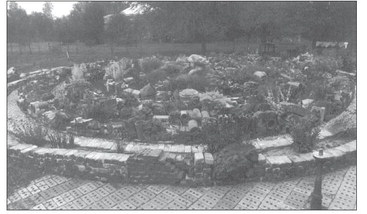
Volunteers helped clear the junk and planted many trees. Fish ponds were dug and over time the Brickyard became a place where art just seemed to happen. Old junk and debris became sculptures, some are still there today.
In 2001 the Moses King Brick & Tile Works was added to the National Register of Historic Places as a National Historic District. At that time it was the only site in McDonough County listed as a National Historic District. In 2006, the Brick and Tile Works was granted 501(c)(3), not for profit status. That status was dissolved around 2018. The new owners, Todd and Melonie Icenogle, are currently working with the State of Illinois to reinstate the nonprofit status.
Over the years, under Dev’s watch, the Moses King Brick and Tile Works was a meeting haven for artists, musicians, writers and history buffs. The stories that could be told are no doubt endless.
When “Dev” passed away, May 26, 2018, the Brickyard became the property of her son, Sean. Sean later sold the property to Joe Gibbs and Jane Howe. On November 4, 2025, the torch was passed once again, with the sale of the property to Todd and Melonie Icenogle.
See part 4 of the Moses King Brick and Tile Works series to learn about the ambitious plans the Icenogles have for the property.
Sources: WIU Oral Histories Program- Presentation on Brickyard Campus in Colchester, IL, May 19, 1995, Presenter-Tim Schroll; KHQA Newsweek-”Historic Colchester Brickyard Has a Story to Tell-September 13, 2014; Tri-States Public Radio-” The Brickyard: From Junk to Treasure”-October 26, 2007; Tri States Public Radio-”Restoration Continues at the Brickyard in Colchester”-August 26, 2014