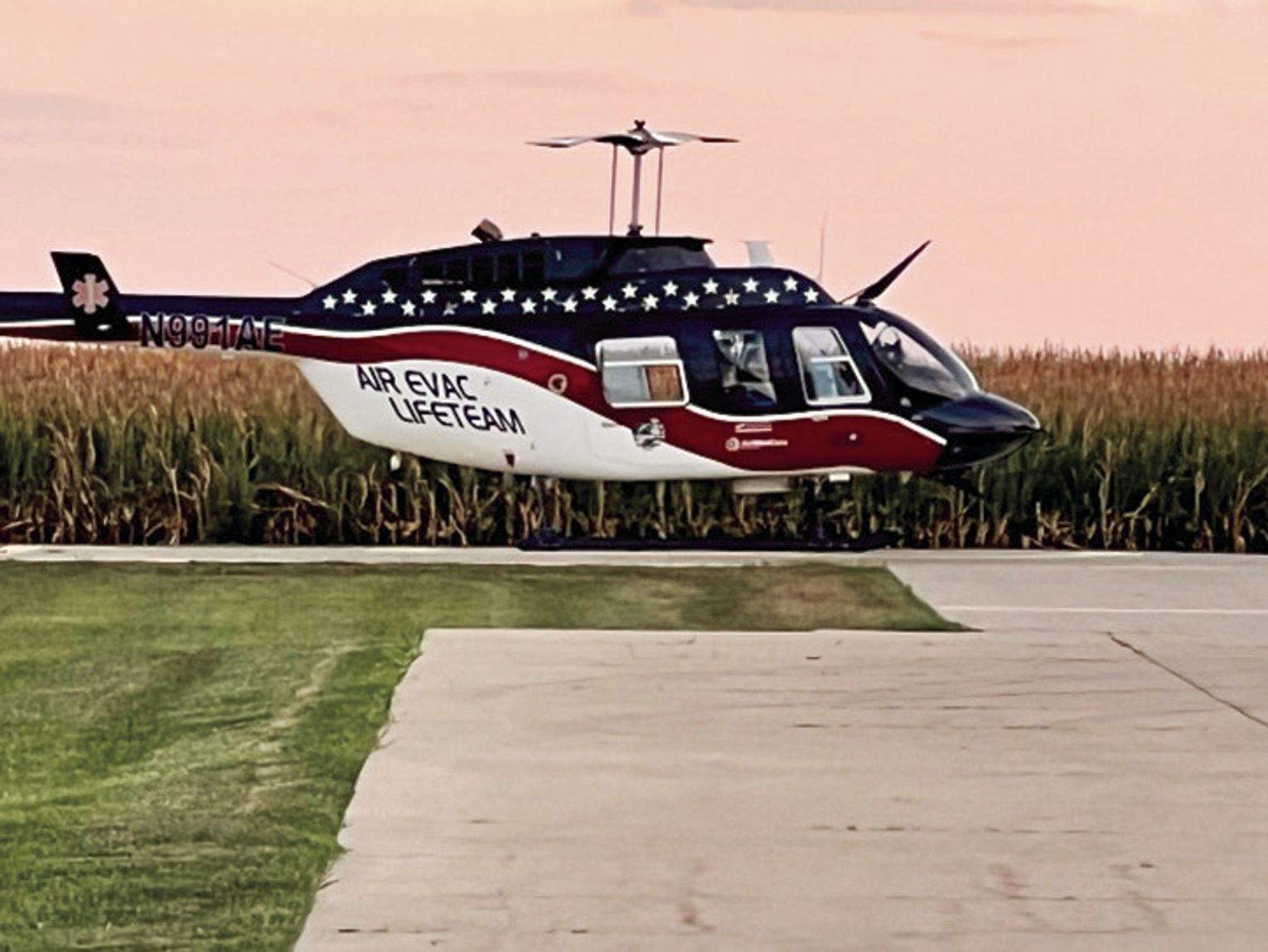
When it comes to air transportation in Macomb, you may think of Macomb Municipal Airport. But there’s another hangar in town. An Air Evac Lifeteam medical transport helicopter waits at the ready in a metal building on the south edge of McDonough District Hospital’s campus. An orange windsock signals its presence.
Having the medical helicopter based on hospital grounds provides a quicker response for critically ill or injured people in McDonough County who need care at major trauma centers. The main reasons for air transport are stroke, heart attack and trauma.
Evolution of an emergency response - The process for using medical helicopter transport begins when the emergency medical services (EMS) dispatch center in the McDonough County Sheriff’s Office receives a 9-1-1 call. The dispatcher sends an ambulance. Depending on the situation, the Air Evac Lifeteam crew with a pilot, nurse and paramedic may be signaled to prepare for a flight.
“It takes roughly 10 to 15 minutes to do weather checks and ensure they can fly. They will send an ambulance first because it gets there quicker,” said Kory Nichols, who is the hospital and county EMS coordinator.
A Lifeguard Service ambulance based in Macomb responds to emergencies in the city. In rural areas, one of nine local volunteer EMS rescue squads and a Lifeguard ambulance are dispatched. In most cases, after arriving on the scene and assessing the patient, EMS caregivers determine whether a helicopter is needed.
Within city limits, patients who require helicopter transport are brought by Lifeguard ambulance to the helicopter’s landing pad near the hangar. For rural emergencies, the helicopter flies the short distance to the emergency site or a nearby designated landing area.
To land at the site of a medical emergency, EMS personnel must create a safe landing zone, which includes checking for power lines and trees, creating a boundary for bystanders and, if it is dark, setting up lights.
Because accident sites usually aren’t ideal spots for a helicopter landing, local EMS and Air Evac Lifeteam pilots have determined safe landing areas where ambulances and helicopters can meet to transfer patients.
“We have 11 designated landing zones in our county to speed up the process of getting people to another facility as needed for a higher level of care,” Nichols said. “Most landing areas are at schools because parking lots and ball fields have open areas with few obstacles like power lines and trees.”
After being secured in the helicopter, patients usually are taken to one of three regional trauma centers.
“Most of the time, trauma patients go to Peoria,” Nichols said. “Stroke patients go to Peoria or Springfield. A lot of our cardiac patients have wanted to go to Blessing (hospital in Quincy) because they have a great cardiac facility.”
Ready when needed - The Air Evac Lifeteam helicopter base was established at MDH in 2017.
Nichols said there often are times when Macomb’s helicopter is responding to a call and a second aircraft is needed. In these instances, an Air Evac Lifeteam helicopter based in Galesburg, Jacksonville, or Fort Madison, Iowa, may be called.
“There's always one available with only a slight delay because it’s coming from a different location,” he said. “The longest I've ever had to wait was 26 minutes, and that was from the time I got the page for the call until the helicopter landed.”
Nichols said Air Evac Lifeteam is always the first choice in securing helicopter transport, but another will be dispatched if Macomb’s primary service is unavailable. For example, an OSF Life Flight helicopter is based at OSF Holy Cross Hospital in Monmouth.
Air Evac Lifeteam didn’t provide statistics about its usage.
“We’re unable to share specific flight volume and pattern of pick-up locations,” said Kelly Watson, public relations specialist for Global Medical Response, the parent corporation of Air Evac Lifeteam. She provided written answers to Community News Brief’s questions.
High cost of air care - There is a fee for helicopter and Lifeguard ambulance transportation. Both are billed to patients’ health insurance carriers but coverage varies. There is no charge for medical care provided by volunteer EMS crews.
Air medical transport is expensive, and the cost is unpredictable. Charges vary by the complexity of the patient’s condition, distance flown, type of helicopter and other factors. The cost usually exceeds $10,000. Insurance coverage for medical transport by air depends on the policy.
“Air medical transport is billed to insurance, both government (Medicare & Medicaid), private, and third-party payers,” Watson said. “Even with strong coverage, patients may still be responsible for substantial coinsurance and deductibles.”
AirMedCare Network (AMCN), a division of Global Medical Response that provides medical air transportation including Air Evac Lifeteam, offers a membership plan that ensures members have no out-of-pocket costs after payment by insurance providers. Membership covers everyone living in the household and extends to other AMCN providers in 38 states, so it may be used while traveling if transport by the network is available.
According to Watson, more than 5,000 McDonough County households have memberships. Membership is not required to receive service. If a patient is transported by a helicopter that is not part of Air Evac Lifeteam or AMCN, their membership benefits don’t apply.
Hospital-to-hospital transfer for admitted patients - In some cases, patients who have been admitted to MDH require medical transportation to another hospital by ambulance or helicopter. To prepare for transport, according to Nichols, the physician overseeing the patient’s care in Macomb coordinates transfer of the patient’s medical information to the physician who will care for the patient at the new hospital.
After the transition of care is initiated, the MDH physician determines which method of transportation will be used. In non-critical situations, using a medical helicopter may not be the best choice because of the cost and use of a limited resource. McDonough County residents are fortunate to have options.
“I love having a helicopter here because the actual transport times are extremely fast,” Nichols said. “It has its place (in medical care) and it’s wonderful.”