Information provided by Moses King Brick & Tile Works published by the National Historic District
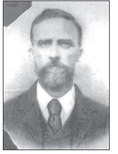
Moses King immigrated to the U.S. from England in 1871 with his wife Anne and daughter Lizzie, embodying the immigrant pursuit of the American Dream. After a brief stay in Pennsylvania, where their daughter Anna Mary was born in 1872, King moved to Colchester, Illinois, in 1875 seeking opportunity in coal mining.
King purchased land known as Vinegar Knob in 1876 for $150 and began mining coal. His growing family included sons William Henry (born 1875), Robert Moore (1877), and twins Benjamin Franklin and Joseph Harrison (1879).
Faced with surplus coal and knowing the region’s rich clay deposits, King combined his knowledge of brickmaking from England with local resources. In 1881, he partnered with Joseph Harrison and William Fish to start the Moses King Brick & Tile Works.
Initially, bricks were made by hand mixing clay and water, sun drying, and firing with coal and wood. The partnership dissolved when Fish, a minister, refused to work on Sundays, ending his involvement. By 1885, King had bought out Harrison’s share and became sole owner.
Growth and Innovation - King built the first of seven beehive kilns in 1885; that kiln still stands today.
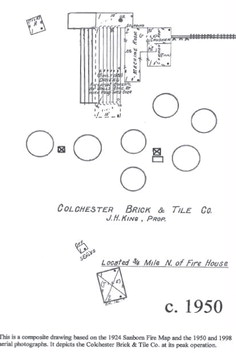
By 1898, the brickyard had expanded to four kilns and two exhaust stacks. The business passed to King’s son Joe after Moses’s death in 1909.
Joe King modernized the operation, replacing horses with tractors and bulldozers, building a new factory in 1920 with drying tunnels and a tramway into the clay pit. By 1922, the site spanned 30 acres and produced a wide range of products, including face brick, drain tile, fire brick, and paving brick.
The brickyard’s clay was renowned for quality. A 1929 newspaper article boasted: “Colchester clay is noted the world over for its quality. The company does not make cheap brick, but meets competition with low-priced, high-grade brick.”
Legacy and Impact - At its peak, the brickyard processed 50 tons of clay daily, producing 60 bricks per minute—over 86,000 bricks every 24 hours. The King Brickyard supplied brick and tile across nearly every U.S. state.
Local landmarks featuring Colchester bricks include the Lamoine Hotel, Hainline Theater, Washington Lincoln Towers, and Grant School in Macomb, as well as Camp Ellis chimneys and Colchester Grade School.
The brickyard closed in 1968, but four of the original seven beehive kilns remain as historic reminders of the industry that shaped the region.
Tours and Donations - Support preservation and are tax-deductible. The Moses King Historic District was dissolved around 2018. The current owners of the property are working with the State of Illinois to reinstate the non-profit status. If you are interested in making a donation, please visit The Brickyard Facebook page at https://www.facebook.com/KingBrickyard.