Some people take long walks in the woods to get in touch with nature, but if you're Alan Curtis, a woodworker, you scout for branches with unique twists, oak burls, dead and semi-dead hardwoods. Like a sculptor examining a block of marble, Curtis can visualize hidden shapes and designs in what others would consider firewood.
At the November 14 meeting of the McDonough County Retired Teachers, Curtis outlined his multifaceted career and displayed some of his wood creations — bowls, cutting boards, even a mountain dulcimer.
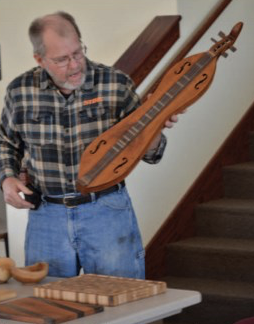
Though born on a dairy farm, Curtis chose a path in instrumental music at Western Illinois University. In one of his theory classes, a professor displayed an unusual folk instrument — a mountain dulcimer — thus sparking an interest in how piecing together wooden elements could produce such a unique instrument. Even though he spent a few years waving a baton, conducting school bands, the woodworking bug had bitten. His first woodworking venture was creating a mountain dulcimer, without having all the appropriate tools and a sense of what to do and what not to do.
Curtis spoke of getting his start through family members who restored antique furniture. Eventually, he bought the business in 1979 and operated it until the mid 1980s. He'd strip, restore, and repair old furniture and developed the skill of replicating missing or damaged parts. However, by the 1980s, sourcing worthy antiques became more difficult. It was time for another career change.
He worked in factories, for an environmental agency, and as a farm hand. He finally settled in as manager of Keokuk's Farm and Home Supply, a position he held for 22 years. But he still had his workshop, his tools, and a love for what he could shape out of wood. Eventually, he and his father and a cousin bought a large circular saw mill and began to cut up various tree species into rough boards for sale to other woodworkers. But even that didn't prove profitable..
By chance, Curtis discovered an entrepreneurial article that advised crafters to 'paint the picture,' meaning create unique works through use of lathes and band saws, finish them, and sell at farmers markets and craft shows. He's not interested in making repetitive copies of things, a dozen identical stools, shelves, or kitchen utensils. Instead, he wants to create unique wood items, letting the wood tell him what it wants to become.
Curtis accepts the fact that his wooden creations are never truly finished. Sometimes the interior of a prospective log is wetter than the outside. That means some seasonal shrinkage and expansion in the finished design because of changes in humidity, even cracking. In fact, some dead timber may actually contain a fungus that will later appear, creating blackened grain that enhances the original plan.
Various woods appeal to Curtis, but he especially enjoys working with osage orange (also known as hedge or, in Missouri, bow d'arc from which ancient bows were made). Other favorite woods are hickory, cherry, mulberry, and wild crabapple.
Ironically, Curtis brought a few items for display to retired teachers, but after his presentation, several gathered at the table to purchase his cutting boards, wooden vases, and bowls. As a result, he now needs to replenish some of his stock for upcoming shows and markets.
In many ways, Alan Curtis is a renaissance man — a musician, a naturalist, a businessman, a minister for two churches, and a master craftsman working with wood. You can find him and his creations at the Macomb Winter Farmers Market at the Macomb American Legion, starting November 22, December 13, January 17, February 7, March 7, and March 28 (all Saturdays), from 8:30 a.m. to noon. His shop is located at 1665 N County Rd 1700 E, Carthage, IL 62321.
In other activities at the meeting, Dale Mansir conducted a memorial service for teachers who had passed away. This year, only one teacher had passed — Richard Frowein. Plans are being made to ring bells for Salvation Army at Hy-Vee on Monday, December 1, and Christmas caroling Tuesday afternoon, December 2. Several teachers were recognized for their volunteer service to McDonough County schools. The next meeting of the Retired Teachers will be held March 13, 2026, at the Western Illinois Museum with Sue Scott, Curator of the museum, speaking on 'Lessons from the Prairie: Early Women Educators in West Central Illinois.'